

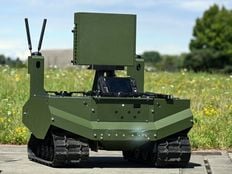
Humanoid robots may grab the headlines, but they represent just one small piece of a much larger opportunity in the physical AI ecosystem. Autonomous robots, drones, collaborative robots (cobots), and electric vertical takeoff and landing (eVTOL) vehicles are rapidly transitioning from conceptual hype to scaled industrial and defense deployments. This wave of physical AI is acting as the primary engine behind a broader industrial resilience and reshoring push across the U.S., Europe, and Japan.
Key Takeaways
- The Pentagon’s autonomy budget request has skyrocketed from $250 million to $55 billion, with $14 billion earmarked specifically for unmanned systems.
- U.S. industrial Purchasing Managers’ Index (PMI) data is climbing again, fueling an incredible year for core industrial robotics component and robot-arm manufacturers.
- Legacy Japanese industrial champions like Fanuc, Mitsubishi Electric, and Yaskawa are hitting multi-year or all-time highs due to physical AI partnerships and reshoring tailwinds.
National Security Drives Physical AI and Defense Integration
The intersection of national security and automation is driving significant growth for the AI industry. Zeno Mercer, head of robotics & AI research, at VettaFi said on a recent call with investors that the Pentagon’s autonomy budget request has surged from $250 million to $55 billion and includes $14 billion for autonomous systems
Moreover, it includes significant partnerships with commercial pioneers. For example, aviation innovator Joby (JOBY), which aims to launch its commercial flying-car operations in the U.S. by 2028, is partnering with defense giant L3Harris to open entirely new military eVTOL markets. This defense-backed funding provides a highly stable revenue floor for automated systems manufacturers, insulating them from purely cyclical consumer electronics slowdowns.This wave of physical AI underpins a broader industrial resilience and reshoring push in the U.S., Europe, and Japan. The reshoring story is tightly linked to automation. Industrial Purchasing Managers’ Index (PMI) in the U.S. is “finally climbing again,” and core industrial robotics players — especially components and robot‑arm makers — have had “an incredible year” as highly automated, miniaturized manufacturing comes back onshore, Mercer said. Consequently, humans are increasingly focused on maintaining, repairing, and managing these systems rather than doing the most precise production work themselves.
On the competitive front, Chinese automation and EV names like XPeng (XPEV) have been punished by a weak domestic auto market and brutal price wars, even as they push into humanoid robots, in‑house chips, robo‑taxis and flying cars.
XPeng’s CEO has taken over its robotics unit, which is targeting 1,000 iron humanoid robots in production by year‑end. Meanwhile, the company is developing its own Turing chip to sell to Volkswagen and building out its AeroHT flying‑car division, a robo taxi division similar to what Tesla is doing, Mercer said.
Physical AI Market Leaders and Regional Resilience
Simultaneously, Japan’s industrial sector is experiencing a powerful structural turnaround. Fanuc (6954) has reached all-time highs while partnering with Nvidia (NVDA) on physical AI applications, Mitsubishi Electric (6503) is co-developing advanced drones and ground robots, and Yaskawa (6506) has guided for its operating profit to nearly double this year.
Investors finally recognize Japan as “one of the most formidable robotics markets” and a key beneficiary of both physical AI and global reshoring, Mercer said.
Fanuc, Mitsubishi Electric, Joby, Xpeng, and Yaskawa are holdings in the ROBO Global Robotics and Automation Index ETF (ROBO ). ROBO offers diversified exposure to the global hardware and physical logistics side of this theme.
Conversely, for portfolios requiring exposure to the underlying software and computational intelligence powering these autonomous units, the ROBO Global Artificial Intelligence ETF (THNQ ) focuses on key enabling technologies and applications.
Looking for regular updates? Subscribe here for weekly insights on robotics, AI, and healthcare technology, delivered straight to your inbox.
For more news, information, and analysis, visit the Artificial Intelligence Content Hub.
vettafi.com is owned by VettaFi LLC (“VettaFi”). VettaFi is the index provider for THNQ and ROBO, for which it receives an index licensing fee. However, THNQ and ROBO are not issued, sponsored, endorsed, or sold by VettaFi. VettaFi and its affiliates have no obligation or liability in connection with the issuance, administration, marketing, or trading of THNQ and ROBO.

