


We take the push of a button for granted. A tap on a smartphone’s tempered, touch-sensitive glass can summon a product, start a conversation with AI, or set a global logistics network in motion. For most of human history, that would have looked like magic. Follow the cascade and the magic resolves into a map of the technologies working behind the scenes. It also shows where AI supply chain stocks in the ROBO and THNQ indexes fit.
Key Takeaways
- Modern digital commerce relies on touch sensors, mobile processors, networks, cybersecurity, cloud data platforms, observability software, and AI compute.
- Once an order is confirmed, software coordinates inventory, robotic picking, sorting, packing, and staging. This is where AI bridges into the physical world of robotics and automation.
- Last-mile fulfillment can involve human drivers, delivery robots, autonomous vehicles, or drones, linking a digital transaction to a physical product.
Buttons have been compressing distance for more than a century. Kodak captured the idea in its 1888 slogan, “You press the button, we do the rest.”
Today, “the rest” is no longer a hidden darkroom process. It is a globe-spanning chain of chips, light, software, warehouses, sensors, and robots. Because that chain moves so quickly, we rarely stop to see it.
So let’s slow one ordinary tap down and follow what happens between the screen and the doorstep.
See more: ROBO and THNQ Index Rebalance Shifts Weight Toward AI Backbones and Physical Automation
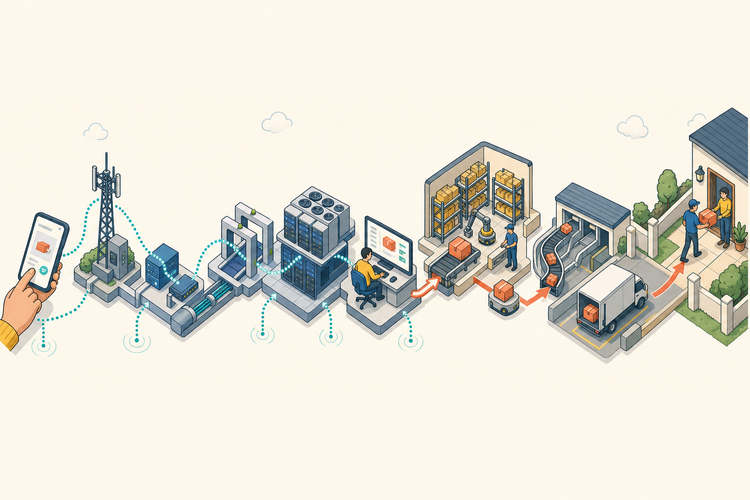
The First Transformation: A Fingertip Becomes Data
The story begins at the glass. Your fingertip changes the screen’s electric field, and the phone’s touch controller turns that disturbance into coordinates. The application processor then turns your intent into data that the rest of the system can understand. MediaTek (2454) supplies smartphone processors that combine computing, on-device AI, and wireless connectivity to make that input network-ready. Qualcomm (QCOM) supplies Snapdragon handset platforms and modems that process the request and send it over 5G or Wi-Fi; related Qualcomm technology can later help a connected vehicle process data on the delivery route.
Leaving the Phone: Through Security Gates
The request is ready to leave the phone, but before it can reach compute, it has to be trusted. Cloudflare (NET) can meet the request at the network edge, filter malicious traffic, and route legitimate traffic toward the application. CrowdStrike (CRWD) protects the endpoints, servers, and cloud workloads processing the transaction by detecting malicious behavior at runtime. Palo Alto Networks (PANW) applies security controls across the network, cloud, and application. Each company secures a different point in the transaction, from the network edge to the cloud workload. For more, see How AI Rewrites the Cybersecurity Stack.
Inside the Data Center: The Request Becomes Computation
That intent signal now leaves the phone. It crosses the air as radio waves, passes through routing and security layers, and often enters fiber-optic networks as pulses of light. When it reaches a cloud data center, Arista Networks (ANET) supplies the high-speed Ethernet switches and routing software that move the request between servers and AI clusters. As the signal enters fiber, Lumentum (LITE) supplies lasers and optical transceivers that convert electrical data into light and carry it across fiber links. At the next handoff, Credo Technology (CRDO) supplies cables, transceivers, retimers, and digital signal processors that keep high-speed traffic intact between servers and racks. Inside the rack, Astera Labs (ALAB) supplies PCIe and CXL connectivity devices that link processors, accelerators, and memory.
With the path open, accelerated silicon handles the AI behind the response. GPUs can run inference, recommendations, and optimization models that help generate an answer or route an order. Nvidia (NVDA) supplies a widely used GPU and AI-software platform for those workloads. AMD (AMD) supplies Instinct data center GPUs and its ROCm software stack for AI training and inference. Around those accelerators, Marvell Technology (MRVL) supplies custom AI silicon, network switches, and electro-optics that connect accelerators and move data between racks and data centers. From there, the system can return an answer, make a recommendation, or send a fulfillment instruction downstream.
Around that compute layer, Snowflake (SNOW) stores, integrates, and serves governed enterprise data for analytics and AI. At a higher level, Datadog (DDOG) acts like a watchdog, tracing requests end to end across applications and infrastructure and correlating metrics, logs, and traces to surface latency and failures.
How Does the Order Take Physical Form Inside an Automated Warehouse?
Once the data center confirms the order, the signal becomes instructions for a physical warehouse. Nothing has moved yet. Now robotic systems have to find, retrieve, and route the product. Symbotic (SYM) combines AI software, vision-guided equipment, and autonomous robots to retrieve cases and build outbound pallets. Zebra Technologies (ZBRA) supplies barcode scanners, RFID readers, and mobile computers that identify the item and update inventory as it moves. AutoStore (AUTO:OSL) uses grid-top robots to retrieve storage bins and deliver them to fulfillment workstations. Daifuku (6383) provides conveyors, sorters, and automated storage systems that move goods between warehouse stations. Software has now become physical motion: The item is picked, sorted, packed, and staged.
The Physical World Moves: The Last-Mile Handoff
With the item retrieved and ready to send, the next handoff is the last mile. If that journey uses autonomous systems, it depends on sensors and edge processors. Ouster (OUST) makes lidar sensors that can give a delivery vehicle or mobile robot a 3D view of obstacles, distance, and motion.
Lidar detects the scene; onboard processors still have to interpret it. Ambarella (AMBA) supplies edge-AI vision chips that interpret camera feeds locally so the system can recognize vehicles, people, and road conditions. Beneath that intelligence, Infineon (IFX:ETR) supplies microcontrollers and power semiconductors that manage energy and control functions throughout the vehicle. That stack gives the vehicle the perception and control needed to move the order through the last mile.
Zooming Out: What the Full Chain Means for Investors
By the time the package reaches the doorstep, one small tap has crossed chips, networks, cloud software, security systems, warehouses, and vehicle sensors. For investors, THNQ leans toward the digital intelligence layer, while ROBO leans toward physical automation. Nvidia, Qualcomm, and Ambarella help bridge the two because their computing platforms can operate in both digital services and physical systems.
As of July 2026, all 21 companies profiled here are constituents of at least one index. The two indices spread exposure across multiple stages of the AI and robotics value chains.
From Fingertip to Doorstep
The tap began as a tiny change in an electric field and ended with a physical item at the door. Along the way, digital infrastructure handed intent to automation. The map follows a connected chain of technologies that receive, transform, protect, and move the same request.
For more on how the indices map the AI infrastructure shift, see Industry of Industries Keeps Humming Amid Market Volatility.
The U.S. ROBO ETF tracks the ROBO Global Robotics & Automation Index. L&G’s Robotics and Automation UCITS ETF, including its GBP-listed ROBG share class, tracks the related ROBO Global Robotics and Automation UCITS Index. The ROBO Global Artificial Intelligence Index underlies the U.S. THNQ ETF and L&G’s Artificial Intelligence UCITS ETF; its USD LSE ticker is AIAI.
For more news, information, and analysis, visit the Artificial Intelligence Content Hub.
VettaFi LLC (“VettaFi”) is the index provider for ROBO and THNQ, for which it receives an index licensing fee. However, ROBO and THNQ are not issued, sponsored, endorsed, or sold by VettaFi, and VettaFi has no obligation or liability in connection with the issuance, administration, marketing, or trading of these funds.

