

China startup DeepSeek shook the AI ecosystem last month with its development of competitive AI at a fraction of the cost of most current models. It holds the potential to become the ChatGPT revolution equivalent in that country, and China companies are all in.
“The impact of DeepSeek’s emergence has been profound,” explained KraneShares in a recent white paper. “It has challenged the notion that developing cutting-edge AI models requires vast resources, prompting a reevaluation of AI development strategies globally.
The China startup developed several AI models that compete with current AI iterations from OpenAI and similar companies. They did so with minimal costs and drastically reduced costs to consumers. What’s more, the company released a good portion of its R1 model as open-source, making it widely available to developers, researchers, and the like to tweak the code as needed for their individual use cases.
China Tech Companies All in on AI
Similar to their U.S. counterparts, China tech companies invest heavily in the development and use of AI. For companies like Alibaba, a major e-commerce tech company, AI like DeepSeek’s models could help to streamline logistics and improve product recommendations for consumers, according to KraneShares.
“DeepSeek’s breakthrough has catalyzed an AI arms race among China’s internet giants,” KraneShares wrote. “We believe DeepSeek could be the ChatGPT moment for China internet companies and potentially lead to a revaluation of these companies that is more in line with their US peers.”
Indeed, news broke yesterday that Apple is partnering with Alibaba to use Alibaba’s AI on iPhones in China. Alibaba’s stock rose 8% in trading overnight in Hong Kong on the news. The company’s large language model (LLM) Qwen 2.5-Max released last month and outperforms GPT-40 and other prominent AI models. Alibaba also released Qwen 2.5-Max via APIs on the company’s generative AI development platform, KraneShares reported. This allows developers globally to access and use the model across a range of capabilities.
Alibaba’s commitment to and development of AI reflects a broader trend across China’s tech industry. Tencent offers its own open-source LLM model, Hunyuan-Large, while Kuaishou developed KwaiYii. Baidu will launch an updated version of Ernie LLM in the first half of this year, and ByteDance just released Doubau-1.5 Pro last month. The addition of DeepSeek to the mix only broadens the playing field’s capabilities looking ahead.
“As these companies continue to push the boundaries of AI technology, we can expect to see transformative changes in how digital services are delivered and consumed, both within China and globally,” KraneShares explained. “The race is on, and China’s internet giants are poised to play a leading role in shaping the future of AI.”
KWEB Positioned to Capture the DeepSeek Disruption
Should the DeepSeek moment happening in China reflect the rapid gains made by U.S. companies when ChatGPT launched in 2022, investors find themselves with a rare opportunity to capture potential gains.
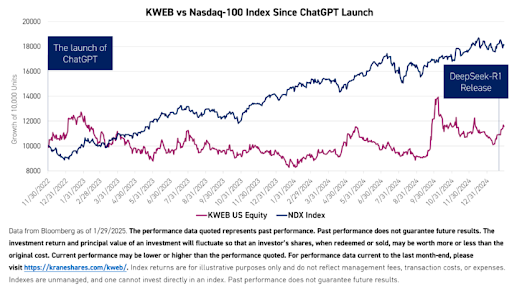
The KraneShares CSI China Internet ETF (KWEB ) measures the performance of publicly traded companies outside of mainland China that operate within China’s internet and internet-related sectors. It seeks to track the CSI Overseas China Internet Index. The Index provides exposure to the China internet equivalents of Google, Facebook, Amazon, and eBay. It trades in securities on the Nasdaq Stock Market, the Hong Kong Stock Exchange, and the New York Stock Exchange.
Top holdings within the fund include Alibaba at a 10.62% weight, Tencent at 9.95%, and Baidu at 3.91%, as of February 11, 2025. In the last two years, the fund has worked to convert all possible share classes to Hong Kong shares. It’s a calculated move away from ADRs to protect investors from added risk. Sixty-four percent of assets held by KWEB currently list in Hong Kong, while 34.2% list on U.S. exchanges over the same period.
The ETF carries an expense ratio of 0.70%.
For more news, information, and analysis, visit the China Insights Channel.

