

ETFdb Logo
  • ETF Database
  • Content Hubs
    • Themes
      • Active ETF
      • Alternatives
      • Artificial Intelligence
      • China Insights
      • Core Strategies
      • Crypto
      • Disruptive Technology
      • Energy Infrastructure
      • ETF Building Blocks
      • ETF Investing
      • ETF Strategist
      • Financial Literacy
      • Fixed Income
      • Free Cash Flow
      • Future ETFs
      • Innovative ETFs
      • Institutional Income Strategies
      • Leveraged & Inverse
      • Market Insights
      • Market Outlooks
      • Modern Alpha
      • Nuclear Energy
      • Portfolio Strategies
      • Sector Investing
      • Tax Efficient Income
      • Thematic Investing
    • Asset Class
      • Equity
        • U.S. Equity
        • Int'l Developed
        • Emerging Market Equities
      • Alternatives
        • Gold/Silver/Critical Materials
        • Cryptocurrency
        • Currency
        • Volatility
      • Fixed Income
        • Investment Grade Corporates
        • US Treasuries & TIPS
        • High Yield Corporates
        • Int'l Fixed Income
    • ETF Ecosystem
    • ETFs in Canada
    • Market Outlook
    • Crypto ETF Hub
  • Tools
    • ETF Screener
    • ETF Country Exposure Tool
    • ETF Database Categories
    • Indexes
    • Scenario Analysis
    • Watchlists
    • Head-To-Head ETF Comparison Tool
    • Mutual Fund To ETF Converter
    • ETF Stock Exposure Tool
    • ETF Issuer Fund Flows
  • Research
    • ETF Education
    • Equity Investing
    • Dividend ETFs
    • Leveraged ETFs
    • Inverse ETFs
    • Index Education
    • Index Insights
    • Top ETF Sectors
    • Top ETF Issuers
    • Top ETF Industries
  • Webcasts
  • Sectors
    • Sector Investing Content Hub
    • XLK
    • XLI
    • XLU
    • XLY
    • XLP
    • XLRE
    • Sector Power Rankings
    • XLE
    • XLC
    • XLF
    • XLV
    • XLB
  • Multimedia
    • ETF 360 Video Series
    • ETF of the Week Podcast
    • Gaining Perspective Podcast
    • ETF Prime Podcast
    • Video
  • Company
    • About VettaFi
  • PRO
    • Pro Content
    • Pro Tools
    • Advanced
    • FAQ
    • Free sign up
    • Login
  1. China Insights Content Hub
  2. KSPY a Shoe-In for Retirement Portfolios
China Insights Content Hub
Share

KSPY a Shoe-In for Retirement Portfolios

Karrie GordonDec 06, 2024
2024-12-06

Growing equity valuation disparity and concentration risk within the major indexes creates potential challenges for retirement portfolios. Those seeking to hedge for possible equity downside while remaining invested in equities should consider the KraneShares Hedgeye Hedged Equity Index ETF (KSPY B).

“Investors constantly tell us that if their equity portfolio experiences a significant drawdown, it could completely change their ability to retire, as well as their financial standing,” explained John McNamara III, CIO of Hedgeye Asset management, in a recent interview with KraneShares. “For investors approaching retirement, the strategy offers a way to balance continued market participation with a potential downside hedge.”

KSPY seeks to track the Hedgeye Hedged Equity Index, providing exposure to the S&P 500. The strategy works to reduce volatility and hedge downside risk through its use of three different options strategies. Hedgeye manages the index and uses its proprietary risk management model that measures the trading range of the S&P 500 on a daily basis.

Since the fund’s launch in July, KSPY has mitigated several market drawdowns. On July 24, the S&P 500 dropped 2.27%, while KSPY’s Index only declined 1.28%, McNamara noted. On October 15, the S&P 500 fell 0.78%, while KSPY’s Index only slid 0.06%. What’s more, it still captures much of the market rally. In the period between July 16 and October 28, the S&P gained 3.77% on a total return basis. In comparison, KSPY rose 2.15%, participating in much of the upside while offering a smoother ride for investors.
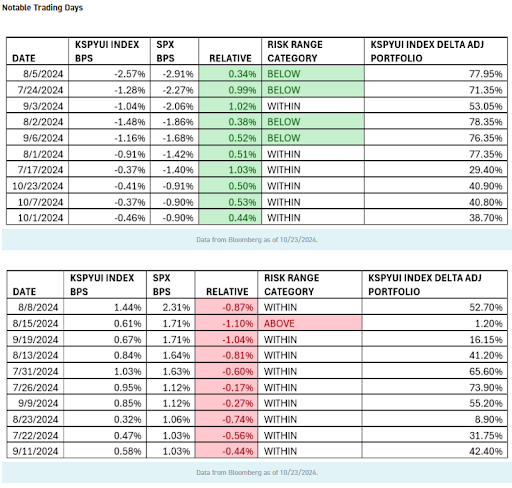
KSPY Index performance vs SPX
Image source: KraneShares

The fund uses calls and puts on the S&P 500 Index and FLEX options that track the S&P 500 or similar indexes. Hedgeye’s proprietary Risk Range signals decide the options position within the fund. These signals measure volume, price, and volatility. From these, the strategy selects its options positions from one of three different strategies. These positions change as often as daily, depending on market movement. This includes what calls and puts to use as well as the strike prices to use. The options roll once every three weeks, remaining dynamic and offering flexibility.

“The systematic approach and hedging capabilities can help investors navigate market uncertainty while maintaining long-term investment objectives,” McNamara said.

The strategy seeks to hedge downside risk while giving up some upside potential to do so. Premiums earned from selling options are used to fund the fund’s options purchases. The premiums may also help compensate for some of the lost upside potential of the fund while providing income.

It carries an expense ratio of 0.69% with a fee waiver that expires August 1, 2025.

For more news, information, and analysis, visit the China Insights Channel.


Content continues below advertisement

Loading Articles...

Advertisement

Is Your Portfolio Positioned With Enough Global Exposure?

ETF Education Channel

How to Allocate Commodities in Portfolios

Tom LydonApr 26, 2022
2022-04-26

A long-running debate in asset allocation circles is how much of a portfolio an investor should...

Core Strategies Channel

Why ETFs Experience Limit Up/Down Protections

Karrie GordonMay 13, 2022
2022-05-13

In a digital age where information moves in milliseconds and millions of participants can transact...

}
X
