

The Federal Reserve will need to see strong evidence that inflation is retreating before it will be willing to relax its policy of interest rate increases even if the economy slows rapidly, but inflation remains high according to Federal Reserve Chair Jerome Powell, reported the Wall Street Journal.
May’s soaring inflation coupled with inflation expectations was the catalyst for the 0.75% interest rate increase at the June Federal Reserve meeting, explained Fed Chair Jerome Powell in his testimony before lawmakers this week. When pressed if the central bank would back off should growth stall for the economy while joblessness rose, Powell reiterated that the Fed would be “reluctant to cut” rates unless there was clear signs that inflation was falling.
It’s something that the central bank has learned from historically; in the 1970s, the Fed also enacted aggressive rate hikes to take on the substantial inflation of the time, but it backed off too early, which resulted in even sharper hikes later.
Another concern for the Fed is the pattern of future inflation expectations resulting in a self-fulfilling loop of actualized inflation; Powell said there were “small concerning signs” that long-term inflation expectations could be on the rise.
“As a general matter, people do expect inflation to come back down to levels that are consistent with our price-stability mandate,” Powell said. “But we haven’t had a test like this. We haven’t had an extended period of high inflation for some time. So it’s not a comfortable place to be.”
Investing for Stagflation With IVOL
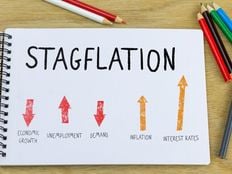
Should inflation continue to remain elevated while the economy slows, it could create a lingering environment of stagflation. Most traditional 60/40 portfolios are susceptible to inflation and rising interest rates.
“Inflation robs us all of purchasing power. Having inflation-linked assets in a portfolio is a key asset allocation,” said Nancy Davis, founder of Quadratic Capital Management and portfolio manager of the Quadratic Interest Rate Volatility and Inflation Hedge ETF (IVOL ), in a communication to VettaFi earlier this month. “If all investors are exposed to the loss of purchasing power, then all investors should consider ways to mitigate or hedge that risk. There is no reason to not have some protection for inflation in the portfolio.”
The Quadratic Interest Rate Volatility and Inflation Hedge ETF (IVOL ) from KFAFunds, a KraneShares company, is designed to have a twofold hedge against an increase in fixed income volatility and/or an increase in inflation. In the days surrounding the June Fed meeting, IVOL had inflows of $117 million.
The fund also seeks to maximize yield curve increases, either brought about by long-term interest rates increasing or short-term interest rates falling; both are tied to big equity market declines.
IVOL is the first of its kind in active and passive options and offers access to the OTC fixed income options market, the mechanism it uses for long interest rate volatility. The fund invests in a mix of U.S. Treasury Inflation-Protected Securities (TIPS) of any maturity, which are U.S. government bonds whose principal amounts increase with inflation.
IVOL also invests in long options directly tied to the shape of the U.S. interest rate swap curve, which steepens when the spread between longer-term debt instrument swap rates and shorter-term debt instruments grows larger, flattens when the spread grows smaller, and inverts when the spread is negative.
IVOL is actively managed by Quadratic Capital Management, an alternative asset management firm with experience in the options and volatility markets. It expects to invest less than 20% of the fund in option premiums and seeks to purchase options with a time-to-expiration between six months and two years.
IVOL carries an expense ratio of 1.05% and has nearly $1.7 billion in assets under management.
For more news, information, and strategy, visit the China Insights Channel.

