

ETFdb Logo
  • ETF Database
  • Content Hubs
    • Themes
      • Active ETF
      • Alternatives
      • Artificial Intelligence
      • China Insights
      • Core Strategies
      • Crypto
      • Disruptive Technology
      • Energy Infrastructure
      • ETF Building Blocks
      • ETF Investing
      • ETF Strategist
      • Financial Literacy
      • Fixed Income
      • Free Cash Flow
      • Future ETFs
      • Innovative ETFs
      • Institutional Income Strategies
      • Leveraged & Inverse
      • Market Insights
      • Market Outlooks
      • Modern Alpha
      • Nuclear Energy
      • Portfolio Strategies
      • Sector Investing
      • Tax Efficient Income
      • Thematic Investing
    • Asset Class
      • Equity
        • U.S. Equity
        • Int'l Developed
        • Emerging Market Equities
      • Alternatives
        • Gold/Silver/Critical Materials
        • Cryptocurrency
        • Currency
        • Volatility
      • Fixed Income
        • Investment Grade Corporates
        • US Treasuries & TIPS
        • High Yield Corporates
        • Int'l Fixed Income
    • ETF Ecosystem
    • ETFs in Canada
    • Market Outlook
    • Crypto ETF Hub
  • Tools
    • ETF Screener
    • ETF Country Exposure Tool
    • ETF Database Categories
    • Indexes
    • Scenario Analysis
    • Watchlists
    • Head-To-Head ETF Comparison Tool
    • Mutual Fund To ETF Converter
    • ETF Stock Exposure Tool
    • ETF Issuer Fund Flows
  • Research
    • ETF Education
    • Equity Investing
    • Dividend ETFs
    • Leveraged ETFs
    • Inverse ETFs
    • Index Education
    • Index Insights
    • Top ETF Sectors
    • Top ETF Issuers
    • Top ETF Industries
  • Webcasts
  • Sectors
    • Sector Investing Content Hub
    • XLK
    • XLI
    • XLU
    • XLY
    • XLP
    • XLRE
    • Sector Power Rankings
    • XLE
    • XLC
    • XLF
    • XLV
    • XLB
  • Multimedia
    • ETF 360 Video Series
    • ETF of the Week Podcast
    • Gaining Perspective Podcast
    • ETF Prime Podcast
    • Video
  • Company
    • About VettaFi
    • Get VettaFi’ed
  • PRO
    • Pro Content
    • Pro Tools
    • Advanced
    • FAQ
    • Free sign up
    • Login
  1. China Insights Content Hub
  2. KBUF & KPRO Receive New Cap & Buffer Periods
China Insights Content Hub
Share

KBUF & KPRO Receive New Cap & Buffer Periods

Karrie GordonJan 29, 2025
2025-01-29

KraneShares announced in a press release today the new caps as well as an extension of the buffer periods and new names for its defined outcome ETFs. The firm attributed the choice to extend the period covered and subsequent cap and name changes to ongoing momentum for China internet stocks.

The KraneShares 100% KWEB Defined Outcome January 2027 ETF (KPRO B-) extended its coverage from 2026 to 2027. The outcome period for the fund is now January 27, 2025 to January 22, 2027. The fund’s cap over the outcome period now sits at 10.01%.

Meanwhile, the KraneShares 90% KWEB Defined Outcome January 2027 ETF (KBUF B) shares the same new outcome period. The fund now offers a cap of 40.01% over the outcome period.

Understanding Buffer Strategies

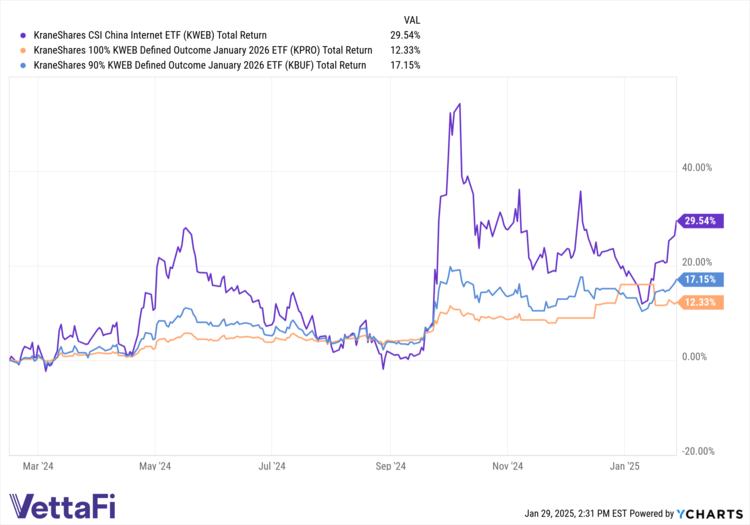
Defined outcome strategies seek downside protection in the form of a buffer, over the outcome period. They also capture the upside, but only to a predetermined cap over the outcome period. Both funds invest in the KraneShares CSI China Internet ETF (KWEB B). KPRO offers a 100% buffer against drawdowns over the outcome period. KBUF buffers 90% of the downside of KWEB over the outcome period.

“KWEB has exceeded performance expectations since KPRO and KBUF were launched in February 2024,” explained Jonathan Shelon, COO of KraneShares, in the press release. “We believe that resetting the downside protection and increasing the upside potential by extending the outcome period is a benefit to existing and new investors.”

Content continues below advertisement

KWEB, KPRO, and KBUF

Both funds invest in KWEB as well as Flex Options (FLexible EXchange Options) on KWEB. China internet companies traditionally maintain higher levels of volatility than their U.S. counterparts. That means KPRO and KBUF may offer higher caps on the upside than other strategies based on U.S. tech stocks.

KPRO carries an expense ratio of 0.98%, while KBUF maintains an expense ratio of 0.97%.

For more news, information, and analysis, visit the China Insights Channel.

Loading Articles...

Advertisement

Is Your Portfolio Positioned With Enough Global Exposure?

ETF Education Channel

How to Allocate Commodities in Portfolios

Tom LydonApr 26, 2022
2022-04-26

A long-running debate in asset allocation circles is how much of a portfolio an investor should...

Core Strategies Channel

Why ETFs Experience Limit Up/Down Protections

Karrie GordonMay 13, 2022
2022-05-13

In a digital age where information moves in milliseconds and millions of participants can transact...

}
X
