


2025 will likely bring with it a number of changes for markets, including carbon markets. Here’s a guide to the top 5 fundamental drivers KraneShares predicts for carbon markets this year, discussed in their Carbon Market Now blog.
California’s Carbon Market Reforms Finalized
Although California’s carbon market regulatory body (CARB) announced further tightening to 2030, the lack of additional clarity in 2024 led to investor disappointment. The market was fraught with volatility and drawdowns on ongoing delays and uncertainty. 2025 should prove different, with CARB expected to release details regarding reforms this year.
The reforms seek to cut greenhouse gas emissions to 85% of 1990 levels by 2045. “To align with these goals, the state plans to tighten emissions reductions for 2030 from 40% to 48%,” KraneShares wrote. The state proposed two different paths to the new 48% reductions last year. It should announce sometime this year which version they’ll implement starting in 2026.
See also: The Case for Carbon Investing Under a Trump Administration
European Carbon Allowances Gain More Demand on Updates
2025 brings with it a number of changes to the EU allowance market. The emissions coverage increases this year for the maritime sector that falls within the EU Emissions Trading System (ETS). Last year they needed to cover 40% of emissions, and this year that increases to 70%. Furthermore, free allowances for the aviation sector were eliminated. Both sectors will likely drive notable increased EUA demand this year.
“These two factors are a key driver behind ICE’s launch of ‘mini-EUA’ futures, which has so far been unsuccessful but may pick up in 2025 with the reforms,” explained KraneShares. These mini-futures offer exposure to 100 tons of EU allowances versus the current 1000 ton exposures.
Ongoing Impacts of CBAM on Carbon Markets Worldwide
The implementation of the EU’s carbon border tax (CBAM) will continue to cause ripple effects throughout global markets. “By aligning the carbon costs of imports with EU pricing, CBAM encourages other countries to create or enhance their own carbon markets to avoid paying EU/UK carbon tariffs,” Kraneshares said.
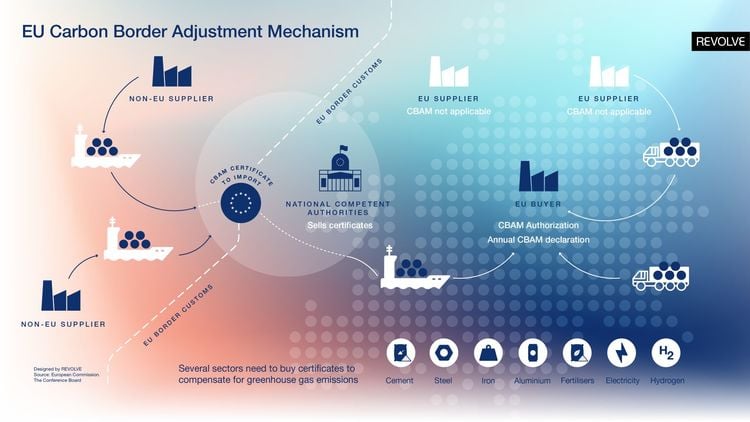
CBAM works to level the playing field for market participants. It ensures they don’t operate at a disadvantage to countries without emissions regulations by imposing a carbon tariff on imports. Countries with existing cap-and-trade markets receive varying discounts, depending on how their coverage compares to the EUs. It creates incentive to develop carbon markets for those countries without.
Linking of Fledgling Markets and New Developments
Washington state’s cap-and-trade market just passed its first major hurdle in November’s election. Despite challenges to its legitimacy, voters acted to support and enshrine the fledgling market. Current discussions on the table for the market include the potential to link to the Western Climate Initiative. WCI is the non-profit entity that handles emissions trading between the joint California and Quebec market.
“The integration could lead to a more unified and robust trading environment, potentially driving up prices across all three jurisdictions,” noted KraneShares. Washington’s market is already undergoing changes to align with WCI, including adjusting auction limits, compliance period scheduling, and more.
Oregon is also considering relaunching its cap-and-trade program. It aims to “enhance the regulatory reach across the U.S. West Coast and contribute to a more integrated North American carbon market.”
The New York Market
Though it’s likely that New York State’s market won’t launch until 2026, there’s a slim chance it gets everything off the ground this year. The state is in the midst of designing and building out its own Cap-and-Invest Program (NYCI) to cut emissions. KraneShares estimates it could become the third largest in the U.S., with a market cap of $5.6 billion.
KraneShares offers a suite of ETFs focused on harnessing the investment potential in a decarbonizing world. The firm has three funds with exposure to some of the largest regulated carbon markets. These include the targeted KraneShares European Carbon Allowance Strategy ETF (KEUA ) and the KraneShares California Carbon Allowance Strategy ETF (KCCA ).
The firm also offers the KraneShares Global Carbon Strategy ETF (KRBN ) that invests in global and domestic markets. These include the California market, RGGI, the EU and UK markets, and the Washington state market.
For more news, information, and analysis, visit the Climate Insights Channel.

