

ETFdb Logo
  • ETF Database
  • Content Hubs
    • Themes
      • Active ETF
      • Alternatives
      • Artificial Intelligence
      • China Insights
      • Core Strategies
      • Crypto
      • Disruptive Technology
      • Energy Infrastructure
      • ETF Building Blocks
      • ETF Investing
      • ETF Strategist
      • Financial Literacy
      • Fixed Income
      • Free Cash Flow
      • Future ETFs
      • Innovative ETFs
      • Institutional Income Strategies
      • Leveraged & Inverse
      • Market Insights
      • Market Outlooks
      • Modern Alpha
      • Nuclear Energy
      • Portfolio Strategies
      • Sector Investing
      • Tax Efficient Income
      • Thematic Investing
    • Asset Class
      • Equity
        • U.S. Equity
        • Int'l Developed
        • Emerging Market Equities
      • Alternatives
        • Gold/Silver/Critical Materials
        • Cryptocurrency
        • Currency
        • Volatility
      • Fixed Income
        • Investment Grade Corporates
        • US Treasuries & TIPS
        • High Yield Corporates
        • Int'l Fixed Income
    • ETF Ecosystem
    • ETFs in Canada
    • Market Outlook
    • Crypto ETF Hub
  • Tools
    • ETF Screener
    • ETF Country Exposure Tool
    • ETF Database Categories
    • Indexes
    • Scenario Analysis
    • Watchlists
    • Head-To-Head ETF Comparison Tool
    • Mutual Fund To ETF Converter
    • ETF Stock Exposure Tool
    • ETF Issuer Fund Flows
  • Research
    • ETF Education
    • Equity Investing
    • Dividend ETFs
    • Leveraged ETFs
    • Inverse ETFs
    • Index Education
    • Index Insights
    • Top ETF Sectors
    • Top ETF Issuers
    • Top ETF Industries
  • Webcasts
  • Sectors
    • Sector Investing Content Hub
    • XLK
    • XLI
    • XLU
    • XLY
    • XLP
    • XLRE
    • Sector Power Rankings
    • XLE
    • XLC
    • XLF
    • XLV
    • XLB
  • Multimedia
    • ETF 360 Video Series
    • ETF of the Week Podcast
    • Gaining Perspective Podcast
    • ETF Prime Podcast
    • Video
  • Company
    • About VettaFi
    • Get VettaFi’ed
  • PRO
    • Pro Content
    • Pro Tools
    • Advanced
    • FAQ
    • Free sign up
    • Login
  1. Climate Insights Content Hub
  2. California Carbon Market Consensus & KCCA’s Breakout
Climate Insights Content Hub
Share

California Carbon Market Consensus & KCCA’s Breakout

Karrie GordonMay 08, 2024
2024-05-08

Investors seeking opportunity would do well to look to the recent price movement of the KraneShares California Carbon Allowance Strategy ETF (KCCA B+). The fund broke upward this week from a price consensus trend months in the making and could head higher looking ahead.
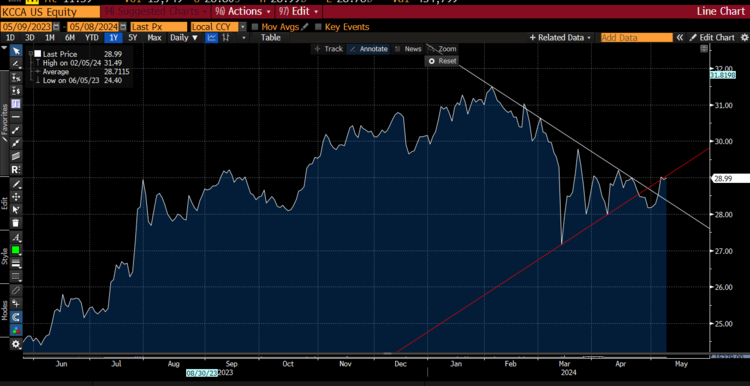
Technical analysis chart of KCCA as of May 8 2024

“When you get a pattern like this, what you’re getting is the market coming to a consensus,” explained Luke Oliver, managing director, head of climate investments at KraneShares.

A price consensus happens as price peaks (buyers) and troughs (sellers) trend toward a narrower price range. While it doesn’t mean that the short and long buyers agree on a specific price point, there is a better-defined range that can be tracked within the trend.

This creates opportunities for breakouts, both positive and negative, when prices move above or below the trend bounds. In the case of California carbon allowances and the KraneShares California Carbon Allowance Strategy ETF (KCCA B+), that breakout happened to the positive this week.

Strong Fundamentals Lay the Foundation for Price Appreciation

“All the fundamentals have been clear that carbon prices go higher,” said Oliver.

Long-term price forecasts place the cost of California carbon allowances around $93/mt by 2030. The joint California and Quebec carbon market seeks the most aggressive emissions reductions within the U.S. to-date.

California’s market mechanisms also create a favorable floor for rising prices. CCA prices appreciate annually with a floor price that rises 5% each year plus current inflation. Current emissions goals aim for 48% reductions by 2030 compared to 1990 levels. However, the California Air and Resources Board is seeking to tighten these targets further.

Investors looking to capture the price potential in CCAs would do well to consider the KraneShares California Carbon Allowance Strategy ETF (KCCA B+). The fund offers targeted exposure to the joint California and Quebec carbon allowance markets.

KCCA stands to benefit from California’s aggressive push to reduce emissions alongside the increasing demand for allowances within the market. Carbon allowance investing is worth consideration for the diversification benefits that they offer portfolios as well as the strong long-term outlook.

The ETF is a fund that offers exposure to the California cap-and-trade carbon allowance program. The market is one of the fastest-growing carbon allowance programs worldwide. Its benchmark is the S&P Carbon Credit CCA Index. The CCA includes up to 15% of the cap-and-trade credits from Quebec’s market.

The index tracks the most traded CCA futures contracts. The fund uses a wholly owned subsidiary in the Cayman Islands to prevent investors from needing a K-1 for tax purposes.

KCCA carries an expense ratio of 0.81%.


Content continues below advertisement

For more news, information, and analysis, visit the Climate Insights Channel.

Loading Articles...

Advertisement

Is Your Portfolio Positioned With Enough Global Exposure?

ETF Education Channel

How to Allocate Commodities in Portfolios

Tom LydonApr 26, 2022
2022-04-26

A long-running debate in asset allocation circles is how much of a portfolio an investor should...

Core Strategies Channel

Why ETFs Experience Limit Up/Down Protections

Karrie GordonMay 13, 2022
2022-05-13

In a digital age where information moves in milliseconds and millions of participants can transact...

}
X
