


Carbon offsets have long garnered criticism for their lack of regulation and any number of bad actors trying to cash in on decarbonization efforts. Increasing regulations from several significant entities, including most recently the CTFC, creates the potential for stronger carbon offset market fundamentals.
The carbon offset industry differs drastically from the regulated carbon allowance market. Carbon offsets, or credits, are a voluntary market that creates offsets through a variety of projects. These include the preservation of forests, carbon capture and sequestration, the creation of renewable energies, and more.
Bad actors in the category intentionally sell empty offsets that have no impact. In addition, there are those acting in good faith but whose offsets don’t actually reduce emissions. With no blanket regulation or standards due to the market’s nascence, investment risk remained significant.
The creation of frameworks to define high-quality carbon credits last year was a significant step in the right direction. The Integrity Council for the Voluntary Carbon Market created designations for quality credits utilizing Core Carbon Principles. Credits that meet CCP guidelines guarantee quality and integrity for companies purchasing them.
The frameworks alongside increasing proposed regulatory oversight from several outside players such as the CFTC most recently help move the needle in the right direction for investors.
“The CFTC rulemaking attempts to specify the underlying quality criteria that must be addressed by exchange operators (in this case, designated contract markets) when authorizing the eligibility of voluntary carbon offset products,” Alex Rau, Ph.D., CFA and partner at Environmental Commodity Partners, said in an interview with Resources.
Rau goes on to explain that the CFTC’s proposed rulemaking does little to change the underlying market. Much of the needed regulations and standardizations must come from the bottom up according to Rau. That said, it’s another potential layer of oversight and scrutiny from the top-down perspective. The CFTC’s involvement in the carbon offset market only serves to benefit investors in both the short- and long-term.
Investing in Carbon Offset Market Potential
Carbon offset markets remain nascent and therefore volatile with elevated risk profiles. Given the increasing momentum and urgency of decarbonization efforts, there’s also untapped opportunity. Carbon credits remain a popular choice with companies looking to offset existing emissions as they work to transition to greener models.
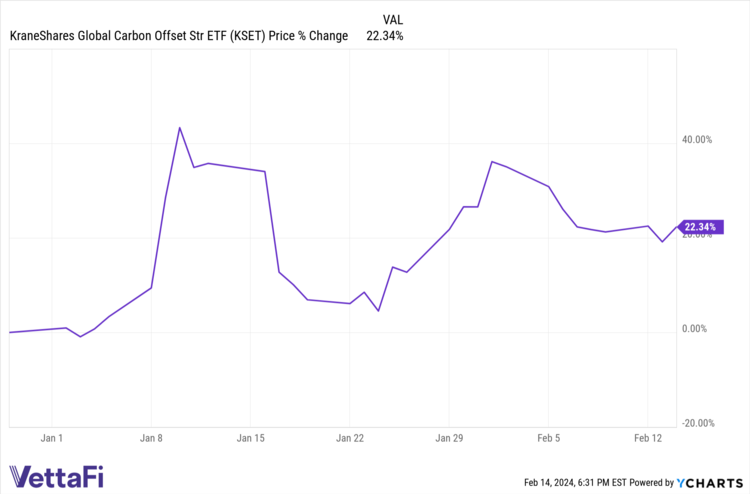
The KraneShares Global Carbon Offset Strategy ETF (KSET ) is the first U.S.-listed ETF that offers investors carbon offset investing opportunities and exposure to the voluntary carbon markets. It tracks the S&P GSCI Voluntary Carbon Liquidity Weighted Index. The index offers a first-of-its-kind benchmark for the global voluntary carbon futures market performance that trades through the CME group.
The fund aims to offer global coverage of voluntary carbon markets. KSET tracks carbon offset futures contracts comprised of nature-based global emissions offsets (N-GEOs). It also includes global emissions offsets (GEOs) that trade via the CME group.
The voluntary carbon markets are a dynamic space. As such, the index is structured in a way that will allow flexibility in re-weighting the securities it tracks. It will also move securities in and out of the index regularly. The index only tracks carbon offset credit futures that have a maturity within the next two years. Furthermore, the index weights the offset futures it tracks by the total value of their traded volume over the last six months.
KSET carries an expense ratio of 0.79%.
For more news, information, and analysis, visit the Climate Insights Channel.

