


California carbon allowance prices dropped rapidly last week on a technical sell-off. While prices recover, investors find themselves with a prime opportunity to gain entry at reduced prices.
Prices for December 2024 California Carbon Allowances (CCAs) fell nearly 8% on March 18. KraneShares attributed the sell-off to option expirations and artificially long positions.
“The March option expiry (and hedging by put sellers) led to forced selling, which was then exacerbated by a ‘long squeeze,’” KraneShares wrote in the Climate Market Now blog.
An abundance of put options at the $25 and $30 strike price range meant banks selling the puts ended up in synthetic long CCA positions. To compensate, the banks increase their long positions. When the put options neared expiry well outside of their strike price, banks sold out of some of their long positions.
The long and short of the temporary CCA price capitulation? A technical sell-off by institutions. Some speculate investors leaving the market to re-enter nearer California Air & Resources Board regulatory announcements later this year.
CCAs already appreciate annually with a floor price that rises 5% each year plus current inflation. CARB is looking to further tighten emissions trajectories from the current 48% reductions of 1990 levels by 2030. Prices are forecast to more than double by 2030, according to Bloomberg NEF estimates. They put CCA prices in the $93 range by 2030.
Capture Long-Term CCA Appreciation Potential at a Discount
The fundamentals remain strong for CCAs, creating an opportunity for investors to gain exposure at reduced prices. Prices largely recovered in the wake of the sell-off but remain subdued for now.
“Whatever the cause, we believe this is a key entry point to position ahead of the program’s upcoming market-tightening reform,” KraneShares wrote.
Investors wanting to harness the long-term potential of CCAs would do well to consider th KraneShares California Carbon Allowance ETF (KCCA ). The fund offers targeted exposure to the joint California and Quebec carbon allowance markets. It stands to benefit from California’s aggressive push to reduce emissions alongside the increasing demand for allowances within the market. Carbon allowance investing is worth consideration for the diversification benefits that they offer portfolios as well as the strong long-term outlook.
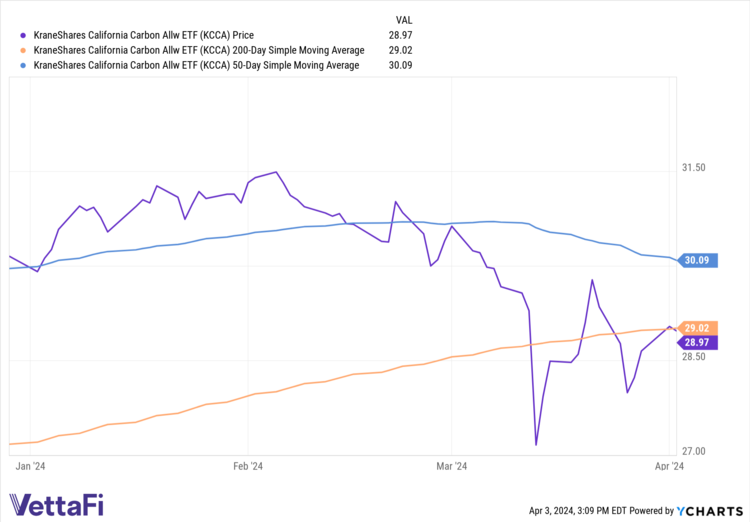
KCCA is a fund that offers exposure to the California cap-and-trade carbon allowance program, one of the fastest-growing carbon allowance programs worldwide. Its benchmark is the IHS Markit Carbon CCA Index. The CCA includes up to 15% of the cap-and-trade credits from Quebec’s market. The fund currently trades below both its 50-day and 200-day SMA.
The index measures a portfolio of futures contracts on carbon credits issued by the CCA. The fund uses a wholly owned subsidiary in the Cayman Islands to prevent investors from needing a K-1 for tax purposes.
KCCA carries an expense ratio of 0.78%.
For more news, information, and analysis, visit the Climate Insights Channel.

