


Climate change and the climate crisis remain hot topics in a charged election year. However, the energy transition supersedes political agendas, with global capital already in flow. Aligning portfolios for the transition creates notable opportunity for investors, particularly within carbon markets.
Luke Oliver, managing director, head of climate investments, head of strategy at KraneShares, discussed opportunities in carbon markets in a recent webinar hosted on the VettaFi platform.
“Government policy and government spending globally is all aligned with decarbonizing the global economy,” he explained. Ensuring your portfolios are at minimum protected from energy transition impacts will prove advantageous long term. Tilting toward the energy transition and gaining exposure to the unique opportunities it creates could prove highly beneficial for long-term investors.
Investing in the Mechanisms of Change
Regulated carbon markets sit at the heart of the energy transition. By putting increasing costs on emissions, they encourage energy transition while also funding further renewable energy technological development and scaling. This funding in turn drives down the cost of renewables, bringing them in line with fossil fuel costs and encouraging further adoption.
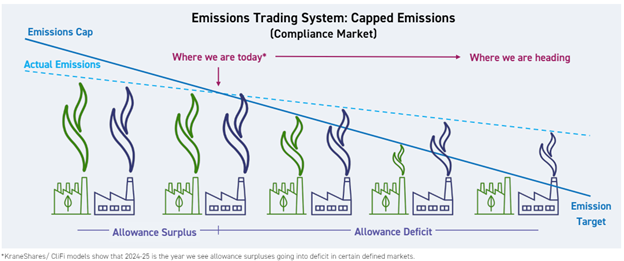
These cap-and-trade programs work by auctioning a set amount of carbon allowances each year. Market participants must turn over allowances at the end of each year equal to their emissions, broken down into one-tonne increments of carbon dioxide. Over time, the number of available allowances reduces to align with long-term emissions goals. It creates upward price pressure for allowances, increasing the cost of pollution.
It’s a mechanism that allows companies to manage their individual decarbonization journey.
“What that does is create the incentive to change that does not rely on a company ‘being nice,’” Oliver noted. “It relies on a company being motivated by profits.”
Carbon Markets Reach Inflection Point
Carbon markets currently sit at a key juncture, shifting from historical surplus into deficit territory looking ahead. In the EU and California, the amount of allowances issued this year falls short of current emissions levels. This means companies must begin to use the additional allowances they’ve stockpiled, further reducing supply.
“This is where the rubber meets the road; this is where the price lifts off,” added Oliver. It creates a strong bull case from a fundamental level looking to 2030 and beyond.
The mechanisms of carbon markets allow for price control through the ability to hold or release extra supply when necessary. This allows for carbon markets to control the price trajectory, preventing tightening from happening too rapidly or too slow.
“What you end up with is this expectation of a low vol outcome, which is very healthy returns … but also you get volatility on the way there,” Oliver divulged.
He went on to detail the individual market mechanisms and trajectories for the European Union market, the California market, as well as the Regional Greenhouse Gas Initiative (RGGI) and the UK market. EU allowances currently trade around 72 euros, with consensus price forecasts between 140-150 euros by 2030. California allowances currently trade around $37, with forecasts of at least $90 by 2030.
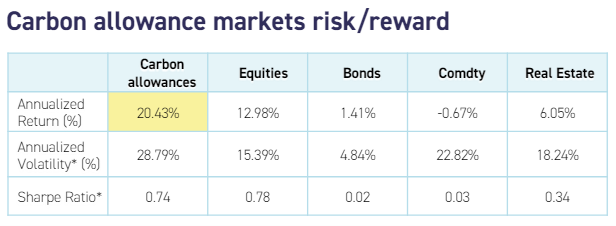
On a historical basis, the top four carbon markets globally generated an annualized return of 20.43% between August 2014 and March 2024. For reference, equities generated 12.98% annualized returns over the same period.
Investing Opportunities With KraneShares
KraneShares offers the KraneShares California Carbon Allowance Strategy ETF (KCCA ) with targeted exposure to the joint California and Quebec carbon allowance markets. The KraneShares European Carbon Allowance Strategy ETF (KEUA ) offers targeted exposure to the EU carbon allowances market.
Meanwhile, for those investors seeking diversified exposure across the major carbon markets, the KraneShares Global Carbon ETF (KRBN ) offers exposure to the major, established carbon markets. It includes contracts from the European Union Allowances (EUA) and California Carbon Allowances (CCA). It also includes the RGGI) markets and the United Kingdom Allowances (UKA).
You can register here for the Carbon Allowances webinar replay and 1 CE credit.
For more news, information, and analysis, visit the Climate Insights Channel.

