


The global voluntary carbon markets are growing exponentially as more corporations seek to meet net-zero pledges, providing opportunity for investors looking to capture exposure to the rapid growth that is expected to continue.
Voluntary offsets markets, known as secondary markets (mandatory compliance markets are primary markets), quadrupled in transactions between 2020–2021, growing from $520 million to over $2 billion. It’s a growth trajectory that looks to continue as more of the private sector turns to offsets to meet their net-zero emissions goals.
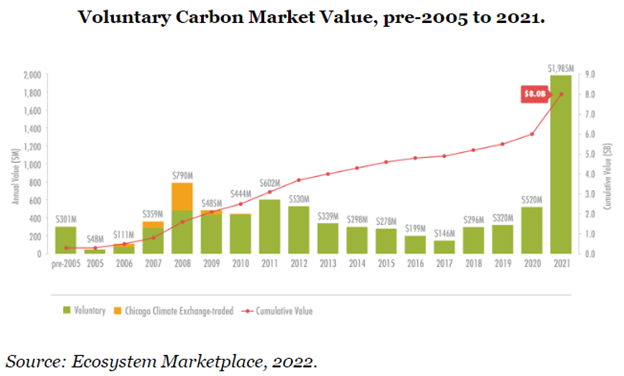
The gains were largely attributed to increasing costs of credits, particularly within projects that are nature-based such as reforestation, forest preservation, and marine and coastal ecosystem projects. Since 2005, the voluntary carbon markets have contributed to $8 billion in climate financing, but remain a drop in the bucket compared to fossil fuel subsidies that amount to roughly $6 trillion annually.
That said, the role of carbon offsets are likely to grow substantially in coming years as emissions regulations and investor pressure drive companies to rely on carbon offsets to account for emissions overages.
The voluntary markets face similar challenges to many other nascent industries: there currently is no centralized framework, a range of transparency on individual offsets, and little regulatory oversight, although there is headway being made to create a global benchmark for high-integrity credits. The Voluntary Carbon Markets Integrity Initiative, a multi-stakeholder platform, has put forth a Claims Code of Practice that is in the process of being adopted and refined by companies.
Investing in the Voluntary Carbon Markets With KSET
Further regulation and transparency will bring increased stability and likely drive even greater investment in the coming months and years. The KraneShares Global Carbon Offset Strategy ETF (KSET ) is the first U.S.-listed ETF that offers investors carbon offset investing opportunities and exposure to the voluntary carbon markets. It tracks the S&P GSCI Voluntary Carbon Liquidity Weighted Index, which also offers a first-of-its-kind benchmark for the global voluntary carbon futures market performance that trades through the CME group.
The fund is structured to offer global coverage of voluntary carbon markets by tracking carbon offset futures contracts comprised of nature-based global emissions offsets (N-GEOs) as well as global emissions offsets (GEOs) that trade via the CME group.
As the voluntary carbon markets are a dynamic space, the index is structured in a way that will allow flexibility in re-weighting the securities it tracks. It will also move securities in and out of the index regularly, and it only tracks carbon offset credit futures that have a maturity within the next two years. The index weights the offset futures it tracks by the total value of their traded volume over the last six months.
KSET carries an expense ratio of 0.79%.
For more news, information, and strategy, visit the Climate Insights Channel.

