

What You’ll Learn:
In this article, you’ll learn how Bitcoin mining functions as both a security mechanism for the Bitcoin network and a strategic driver of U.S. economic and energy innovation. It explains how mining supports grid stability, advances ESG goals, revitalizes local economies, and is gaining federal policy support. You’ll also understand why advisors should view mining not as a liability but as a real-world infrastructure asset relevant to portfolio strategy, sustainability analysis, and client education.
Bitcoin mining is often oversimplified in mainstream narratives, leaving even professionals with partial or outdated information. For financial decision makers, understanding the mechanics behind Bitcoin’s infrastructure is essential—not because they’re behind, but because they’re on the front lines of client education and portfolio innovation, especially in the U.S., where mining has become an emerging pillar of both the economics and energy infrastructure.
In simple terms, Bitcoin is secured by a global network of participants who compete to validate transactions through “proof-of-work”—a protocol that requires real energy expenditure.
Miners use specialized equipment to solve cryptographic puzzles. The first to succeed adds a block of transactions to the blockchain and earns a reward in bitcoin. This system isn’t arbitrary—it enforces monetary discipline and transaction integrity. The cost to cheat the system is prohibitively high, and the barrier grows as the network expands.
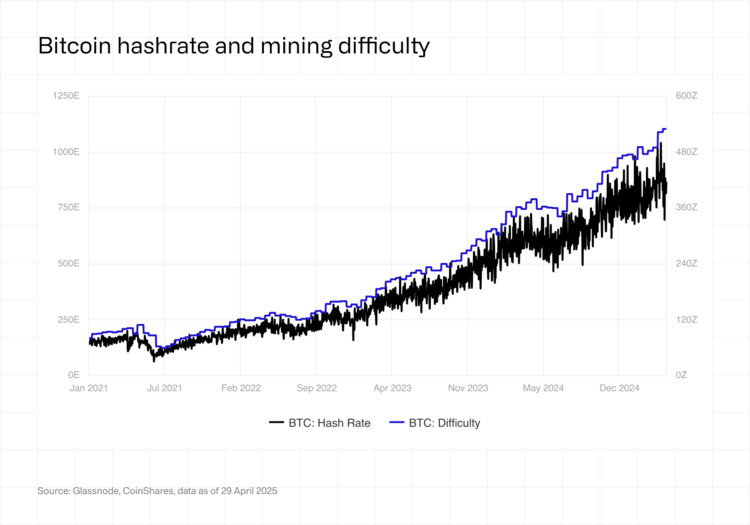
Bitcoin’s security is quantifiable and enormous
Bitcoin’s decentralized security model isn’t just theoretical—it’s backed by real-world economics. A 2024 academic study estimated that a 51% attack on Bitcoin would require up to $20 billion in hardware and millions per hour in energy costs, making such an attack functionally impossible. As of early 2025, estimates place the hourly energy cost of an attack at over $2 million.
This energy consumption isn’t wasteful—it’s foundational to security. As Michael Saylor, former CEO of Strategy (formerly MicroStrategy) puts it: Bitcoin is the “most secure digital network on Earth.”
For RIAs advising on digital asset exposure, that’s a critical factor: client portfolios built on Bitcoin are built on resilience.
Addressing the ESG question: Bitcoin is becoming a grid ally
Environmental concerns have long shaped RIA hesitance toward crypto. But the Bitcoin mining story is evolving quickly:
- Grid stabilization: Miners can ramp energy consumption up or down based on grid needs, helping utilities balance supply and demand—without subsidies.
- Emission reduction: Bitcoin miners are partnering with oil and gas operators to convert flared methane into productive energy, cutting harmful emissions.
- Clean energy integration: Miners are now co-locating with wind, solar, and hydro projects, financing renewable infrastructure that might otherwise stall due to low utilization rates.
Bitcoin is not the ESG liability it’s made out to be. It’s increasingly seen as a scalable partner to the energy transition, especially in deregulated power markets like Texas. Although its data relies on a survey, the University of Cambridge’s Digital Mining Industry Report estimates that renewables account for more than 42% of miners’ electricity.
Job creation and local revitalization
Bitcoin mining is already delivering measurable economic benefits in the U.S.—a narrative often overlooked in wealth management circles. In places like Rockdale, Texas, mining facilities have revitalized towns hit by industrial decline. The closure of an Alcoa plant once devastated the local economy. Today, miners have brought back jobs, tax revenue, and new infrastructure.
- Direct employment at U.S. mining firms nearly doubled between 2022 and 2024.
- PwC estimates 10,700+ indirect jobs supported by the industry—staggering growth for a sector only five years old domestically.
For advisors managing portfolios with an ESG or regional economic lens, Bitcoin mining offers a powerful real-world use case with positive spillovers.
National strategy: Bitcoin mining as economic policy
U.S. policymakers are increasingly aware of mining’s strategic value. The Trump 2024 campaign, for example, has voiced direct support for the sector, citing its role in:
- Financial independence
- Energy dominance
- National cybersecurity
China’s 2021 mining ban created a geopolitical opportunity that the U.S. has since filled. But that lead is fragile. RIAs should consider not only client-level impacts but also how crypto fits within a broader macroeconomic landscape.
Answers about Bitcoin mining have to be grounded in data, not headlines.
- Legitimacy: Bitcoin is backed by real-world infrastructure and economic incentives.
- Security: The proof-of-work algorithm ensures unparalleled network integrity.
- Sustainability: ESG narratives are shifting in Bitcoin’s favor.
- Jobs & economics: Mining supports domestic growth in forgotten regions.
- Policy support: Federal attention is growing—not shrinking.
Bitcoin mining is not a liability. It’s a feature: it brings security, energy innovation, and economic revitalization to the U.S. and supports the credibility of Bitcoin as a long-term portfolio allocation.
Why this Matters to Advisors:
For advisors, understanding Bitcoin mining is necessary. Clients are increasingly asking about Bitcoin’s legitimacy, sustainability and role in diversified portfolios. Advisors who can articulate the real-world foundations of Bitcoin – including the economics behind mining – are positioned to build trust and deliver informed guidance about digital assets.
Mining intersects with many themes advisors already track – ESG investing, regional economic resilience and macroeconomic policy. Recognizing Bitcoin mining’s role as an enabler of grid innovation and domestic growth can help shift the conversation from risk to opportunities.

