

What you’ll Learn:
This article explains why the traditional 60/40 portfolio is underperforming in today’s macro environment and how Bitcoin can help fill the diversification gap. You’ll learn how modest Bitcoin allocations—4% to 10%—can enhance Sharpe ratios, reduce drawdowns, and improve performance in various portfolio strategies like the All Weather and Yale Endowment models. It also highlights research-backed modeling showing Bitcoin’s role in boosting risk-adjusted returns across resilient portfolios.
For decades, financial advisors leaned on a 60/40 equity-bond mix to deliver strong returns and manage risk. It worked—especially during falling interest rates and strong equity markets. But today’s environment looks very different.
Since 2022, equities and bonds have moved in tandem instead of offsetting each other. Correlation between the two asset classes hit a 20-year high, and the traditional 60/40 Sharpe ratio turned negative for three straight years, marking a first in this century. Rising inflation, aggressive monetary policy, and synchronized fund flows into both bonds and equities have eroded the diversification investors used to rely on.
Given persistently high volatility in both growth and inflation metrics, the 60/40 model is unlikely to recover its former strength anytime soon. US advisors must rethink portfolio construction.
Time to shape modern portfolios
Many advisors have diversified into alternatives like real estate, hedge funds, and commodities. Gold has been a traditional hedge. Bitcoin remains underutilized,despite its superior historical risk-adjusted returns.
While US Bitcoin ETFs have seen over $40 billion in inflows since their launch, 13F filings show that direct allocations by RIAs and other institutional managers are still modest. Hedge funds and a few large pensions have started allocating, but banks and broader wealth managers remain on the sidelines. However, with spot bitcoin investment products inflows outpacing spot gold’s ones over the past year, there is evidence of a reallocation trend underway.
How Bitcoin improves portfolio performance
CoinShares Research shows even small allocations to bitcoin significantly enhance portfolio metrics:
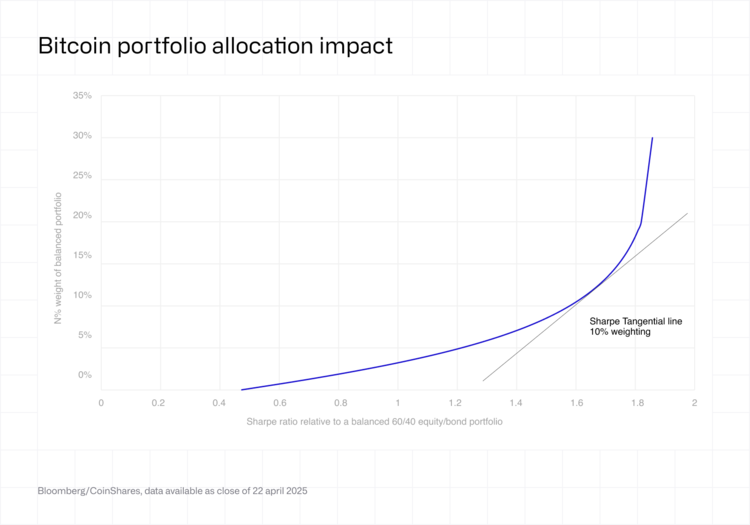
While adding bitcoin does slightly increase portfolio volatility (~2-3%), the improvements in returns and diversification meaningfully outweigh the risks. Our efficient frontier analysis suggests an optimal bitcoin allocation around 4–10%—well within comfort zones for most client risk profiles.
We modeled bitcoin integration into three resilient, real-world portfolios and based on CoinShares’ latest research, integrating Bitcoin into traditional portfolios can significantly enhance risk-adjusted returns without compromising overall portfolio resilience.
The team modeled Bitcoin allocations across three robust, real-world portfolio frameworks. In the All Weather Portfolio, replacing 7.5% of the gold allocation with Bitcoin led to a quadrupling of the Sharpe ratio, reflecting a substantial improvement in risk-adjusted performance.
In the Cockroach Portfolio, designed for defensive positioning, substituting 7% gold with Bitcoin delivered enhanced returns while preserving the portfolio’s protective characteristics—demonstrating Bitcoin’s potential as a complementary store of value.
Lastly, in the Yale Endowment-style portfolio, which emphasizes diversification and long-term growth, replacing a 7% allocation to REITs with Bitcoin resulted in higher annual returns and lower drawdowns, suggesting that even modest allocations to digital assets can meaningfully improve portfolio efficiency.
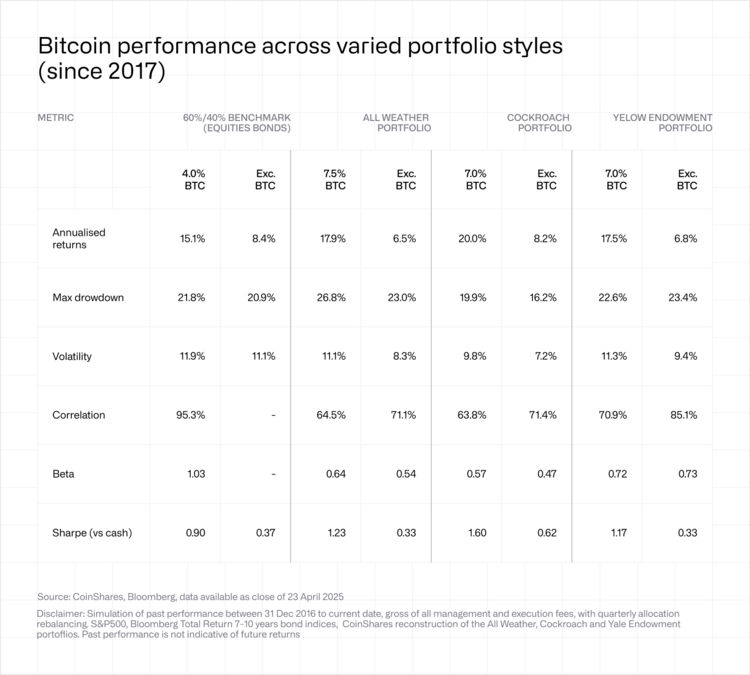
These findings reinforce Bitcoin’s growing role not just as a speculative asset, but as a strategic macro allocation within resilient, institutional-grade portfolios.
An asset that must be considered by Advisors
The 60/40 model no longer meets investors expectations for diversification or performance. US RIAs and financial advisors must evolve their strategies to meet new market realities.
A carefully sized bitcoin allocation—starting as low as 4%—can significantly improve portfolio efficiency without taking undue risk. For clients seeking inflation protection, non-correlated assets, and enhanced returns, bitcoin deserves serious consideration as part of a modern asset allocation framework.
Why This Matters to Advisors:
The historical reliability of the 60/40 portfolio has weakened in today’s market, pushing RIAs to rethink diversification strategies. Bitcoin offers low correlation, inflation resistance, and strong historical performance—even in volatile conditions. Advisors who understand how to incorporate it responsibly (via ETF exposure, for example) can enhance client outcomes, stay ahead of portfolio trends, and add value in a shifting financial landscape. As institutional flows grow, RIAs who lag behind may miss a key asset now backed by increasing data and product accessibility.

