

What You’ll Learn:
This article explains why ETFs offer a safer, simpler way to invest in crypto compared to exchanges. You’ll learn how ETFs work, the risks of self-custody, and why financial advisors are turning to SEC-approved spot Bitcoin ETFs for regulated, portfolio-friendly exposure to digital assets.
In the early days, investors could only gain exposure to crypto by purchasing it directly through an exchange like Binance or Coinbase and then storing it in a digital wallet, which required a certain amount of technical expertise. But it became more accessible in January 2024 when the Securities and Exchange Commission (SEC) approved 11 exchange-traded funds (ETFs) tracking the spot price of bitcoin, including several issued by major players such as BlackRock and Fidelity. These products allowed investors to hold bitcoin in their portfolios for the first time, and they responded with inflows of $65 billion in 2024.
To help advisors inform their clients about the most suitable way to invest in crypto, this article explains how exchanges and ETFs work, and explores the advantages and disadvantages of each approach.
The difference between centralized and decentralized exchanges
Centralized exchanges (CEXs), like their mainstream equivalents, are run by a central authority that serves as an intermediary, matching trades between buyers and sellers using an order book system. Many rely on market makers to provide liquidity by ensuring supply and demand for each asset, which helps keep spreads low. Binance and Coinbase, the largest crypto exchanges by trading volume, are centralized.
Decentralized exchanges (DEXs) are built on blockchain technology, meaning a decentralized network, so they don’t rely on a central authority. They facilitate crypto-to-crypto trades directly between buyers and sellers using smart contracts, programs that automatically execute when certain preconditions are met. Liquidity usually comes from pools automatically run by autonomous software (smart contracts). Some of the most popular DEXs, including Uniswap and Sushiswap, run on the Ethereum blockchain.
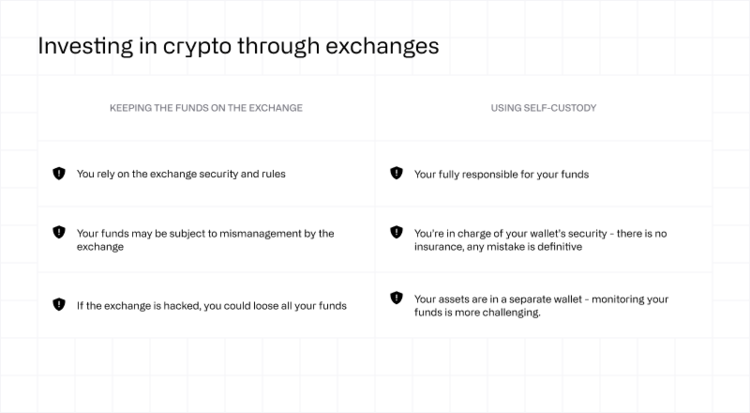
Once purchased, holders can store their crypto in a custodial or self-custody wallet, with the main difference being what happens to their private key, which authorizes transactions. Custodial wallets, favored by centralized exchanges, manage the key and assets on behalf of the user, while self-custody wallets put the holder in control.
There are two kinds of self-custody wallets:
- Hot wallets, such as browser-based MetaMask and mobile wallets, connect to the internet, so they’re convenient but more vulnerable to breaches.
- Cold wallets are physical devices that are offline, so they’re considered the safest way to store crypto.
ETFs- a more accessible way to access crypto
Like products tracking mainstream assets, crypto ETFs come in two forms- physical ETFs and synthetic ETFs. Physical ETFs buy and hold bitcoin, making them simple, transparent and less prone to counterparty risk. Synthetic ETFs use derivatives to replicate its performance. All of the spot bitcoin products approved by the SEC are physical.
They’re also structured in the same way:
- A provider such as BlackRock, CoinShares, or Fidelity issues the product.
- A trustee safeguards the assets and ensures the provider manages the ETF according to its terms and conditions.
- A custodian holds the assets.
- An administrator helps the provider manage the day-to-day operations of the ETF.
- Authorized participants create and redeem shares in the ETF by buying and selling the underlying asset, ensuring liquidity.
BlackRock’s iShares Bitcoin Trust (IBIT) is the biggest spot bitcoin ETF by some distance, holding just over $50 billion of assets under management (as of April 2025). Fidelity’s Wise Origin Bitcoin Fund (FBTC) and Grayscale’s Bitcoin Trust (GBTC) come a close second and third, with $17 billion and $16.6 billion respectively.
Exchanges vs ETFs- a risk-benefit analysis
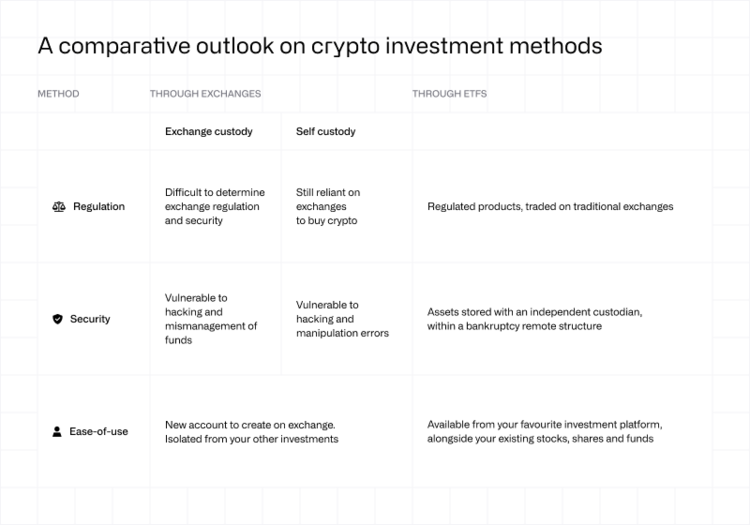
Trading on crypto exchanges involves significant risks, as many are either underregulated or unregulated. For instance, Mt. Gox was one of the earliest exchanges to gain traction, but it suffered multiple breaches over several years, which only came to light in 2014. Hackers stole nearly 750,000 bitcoin, and an additional 100,000 went missing, worth a total of $460 million at the time. More recently, in November 2022, leading exchange FTX collapsed after it was discovered that it was using customer funds to prop up trading firm and sister company Alameda Research. Investors rushed to withdraw their funds from FTX, forcing it to declare bankruptcy within a week. While creditors of both exchanges should be repaid, the process takes time – 10 years and counting in the case of Mt. Gox.
Storing crypto is also complex, regardless of what type of wallet a user chooses. A custodial wallet is vulnerable, as described above. Self-custody wallets shift the burden to the user, but they require technical expertise and come with cybersecurity risks too. And if the user loses the seed phrase issued when signing up for a self-custody wallet, they can’t recover their funds.
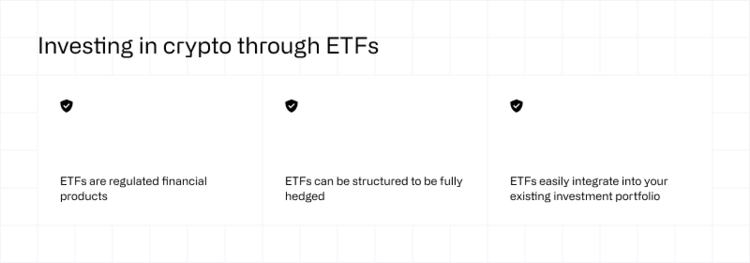
Crypto ETFs are a much easier way to gain exposure because they trade on mainstream exchanges so they offer similar benefits to traditional products: they’re accessible, can sit in an investor’s portfolio alongside assets like shares and bonds, and contribute to overall performance, and they’re subject to the same regulations enforced by the financial authorities, including reporting requirements and the rules governing exchanges
Conclusion
Thanks to ETFs, financial advisors have an accessible and regulated way for their clients to gain exposure to crypto. These products trade on traditional exchanges like shares, and they’re subject to the same reporting requirements as mainstream ETFs, offering greater investor protections than crypto purchased via exchanges and stored in digital wallets.
Physical ETFs buy and hold the underlying crypto, so they’re more transparent and easier to understand than synthetic ETFs which rely on derivatives. All of the spot bitcoin products approved by the SEC at the start of 2024 are physical.
Quick facts
- Investors can purchase crypto directly via centralized and decentralized exchanges, but they must either store it in a third party or self custodial wallet.
- Alternatively, they can purchase an ETF that trades on traditional exchanges, allowing investors to hold crypto in their portfolio alongside traditional assets so it contributes to overall performance.
- Crypto ETFs are structured exactly like mainstream products and offer the same protection.
- Physical ETFs are easy to understand because they buy and hold the underlying crypto.
Why This Matters for Advisors:
* ETFs reduce operational risk: No need for wallets, seed phrases, or crypto exchanges.
* They improve compliance: Regulated, reportable, and easier to integrate into traditional portfolios.
* They offer transparency and liquidity, helping advisors position crypto as part of a diversified, long-term strategy—without the complexity of direct ownership.

