

What You'll Learn
Financial advisors will understand how Bitcoin has shifted from a speculative asset to a strategic portfolio component, offering unique diversification benefits. The article covers Bitcoin’s institutional adoption, regulatory progress, and fit within evolving market infrastructures. Advisors will gain insights into Bitcoin’s risk profile, its role as an inflation hedge, awareness of centralized financial risks, and practical considerations for client portfolios.
If you’re advising clients who think Bitcoin is just speculative "hype, you’re not alone. But let’s dig into where the real-world traction is actually happening and why that matters. The U.S. financial system is undergoing a period of monetary change, marked by the formal Establishment of a Strategic Bitcoin Reserve and a United States Digital Asset Stockpile as part of the nation’s federal policy on March 06, 2025.
This transition from a traditional monetary framework to a digital asset-backed reserve comes amid persistent inflation through rising energy prices and food costs and growing uncertainty over economic policy, all while the national debt exceeds $36.2 trillion, as of 30 May 2025, according to Treasury.gov, with no path to fiscal consolidation. Consequently, long-term investors are watching how this shift, along with high debt and inflation, could affect the dollar’s strength and investment decisions.
Macro Instability and the Case for Decentralized Reserves
Geopolitical uncertainty continues to keep traditional safe-haven assets like gold relevant despite physical challenges in portability and custody. Tether, one of the largest stablecoin issuers, exemplifies this approach by holding over 50 tons of gold in reserves and committing to digital assets with more than 100,000 BTC. Tether’s dual approach combines gold’s stability with Bitcoin’s convex nature, its tendency to outperform during market stress or inflation, acting as an insurance hedge with strong upside potential. Bitcoin also functions as a long-duration digital asset, governed by a transparent protocol, capped at 21 million, making BTC attractive for institutions seeking an alternative reserve.
Bitcoin’s fundamental appeal lies in its programmable, censorship-resistant, and borderless design. Its robust security, demonstrated by record-high hashrates, further strengthens this value proposition. Bitcoin’s open, transparent architecture addresses traditional banking vulnerabilities, like account freezes, offering institutions a practical plan B and serving as a hedge against centralized financial systems. As a bearer asset, Bitcoin does not rely on any single nation-state, central bank, or corporate custodian.
Financial Access, Remittance Pressure, and Demand Dynamics
According to the Federal Deposit Insurance Corporation (FDIC), more than six million U.S. households remain unbanked or underbanked. Many of the globally unbanked rely on cross-border remittances to support essential needs. The World Bank reports that average remittance fees remain above 6%, disproportionately affecting low-income communities. In third world countries, remittances account for meaningful portions of GDP, yet users pay hundreds of millions annually in transfer fees to intermediaries. Bitcoin enables permissionless financial access, even without a traditional bank account.
Credit history and identification documents are not required to hold or use Bitcoin. As an open network, Bitcoin enables individuals to receive, store, and transmit value freely, without intermediaries.
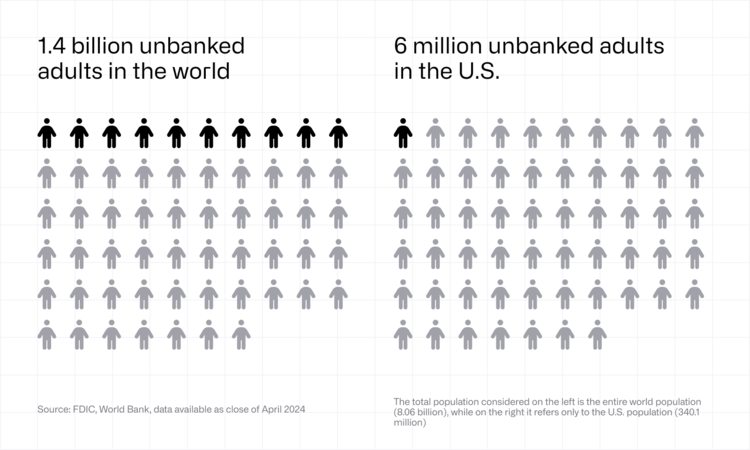
As demand for low-cost, decentralized transfer methods grows in underserved markets, Bitcoin and stablecoins are increasingly being viewed as practical payment options, not merely as hedges. This grassroots adoption in remittance corridors and unbanked populations will over time create a consistent and incremental pressure on Bitcoin’s finite supply, as more people adopt BTC globally
Until recently, sovereign wealth funds have ventured into direct cryptocurrency investments. Bhutan’s Druk Holding and Investments, ranked 76th globally, holds 10,635 BTC valued at over $1 billion. In the United States, Wisconsin’s state-level fund has acquired 6 million shares of the iShares Bitcoin Trust ETF, while Abu Dhabi’s Mubadala Investment Co. holds 8.2 million shares.
These developments mark a notable shift as sovereign funds, once cautious, are increasingly transitioning into Bitcoin portfolios, either through direct holdings or structured ETF vehicles, into sovereign portfolios.
Portfolio Role, Market Infrastructure, and Strategic Allocation
For financial advisors, Bitcoin’s role as an uncorrelated asset also introduces the potential for improved portfolio risk-adjusted returns.
In a portfolio, Bitcoin can offer diversification. A 3% allocation to Bitcoin held over ten years (2015–2025) would have grown to represent about 68% of the total portfolio value by May 2025. A hypothetical $100,000 portfolio beginning in 2015, allocating 3% to Bitcoin and the rest, equally, to the S&P 500, Microsoft, Apple, and gold, would have grown $100,000 to about $1.67 million by May 2025.
Bitcoin’s price increased from approximately $266 in January 2015 to $100,000 in December 2024, turning an initial $3,000 investment of 11 BTC into roughly $1.1 million in ten years. In comparison, the $24,250 allocations to the S&P 500, Microsoft, Apple, and gold, in 2015, rose to around $70,174, $236,308, $173,175, and $65,588, respectively.
This backtest highlights Bitcoin’s ability to outperform traditional assets and why financial managers might consider including it for long-term diversification.
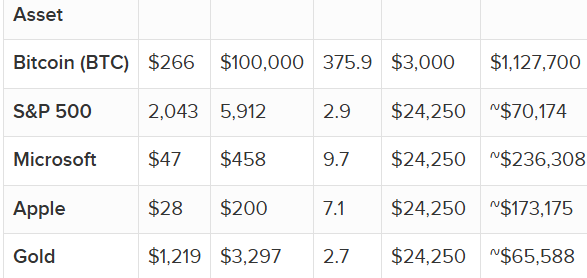
(opening price on 05 January 2015 vs closing price 30 May 2025 – TradingView)
Market Infrastructure, Custody, and Regulatory Maturation
The launch of spot Bitcoin ETFs and the growth of CME Bitcoin futures provide standardized tools for gaining exposure without direct asset ownership. Custody concerns have also been mitigated. Fidelity Digital Assets, Coinbase Custody, and Anchorage Digital offer multi-signature wallets, insured cold storage, and regulatory-compliant solutions. As a result, Bitcoin can now be integrated within institutional investment frameworks with established compliance and security processes.
Regulatory Landscape and Emerging Clarity H3
At the regulatory level, policy is maturing toward greater clarity. In the United States, oversight is shared among the Securities and Exchange Commission, the Commodity Futures Trading Commission, and the Financial Crimes Enforcement Network. In May 2024, the House of Representatives passed the Financial Innovation and Technology for the 21st Century Act (FIT21) with bipartisan support, marking another key step toward more explicit rules for digital assets.
What This Means for Client Portfolios
For client-focused financial professionals, Bitcoin is growing beyond a tactical allocation. Bitcoin is emerging as a distinct asset class, offering unique risk-return characteristics and supported by an increasingly robust market infrastructure.
Persistent debt accumulation, uncertain traditional monetary policy, and declining trust in intermediaries have shone a spotlight on assets operating outside conventional fiat systems. Bitcoin’s neutrality, transparent architecture, and technological foundation position BTC as a credible alternative reserve asset.
As fiduciaries consider exposures across inflation-sensitive and non-correlated assets, Bitcoin offers a low-allocation hedge with asymmetric upside potential. Its programmability and final settlement features add new dimensions for cross-border transactions and institutional settlement rails, already visible in payment networks, remittance corridors, and custody solutions.
Advisors and asset managers face a structural decision: integrate Bitcoin into long-term allocation models or risk underrepresenting an asset increasingly woven into global capital flows. While allocation sizes and strategies will vary, including Bitcoin in due diligence processes is increasingly pragmatic for constructing resilient portfolios.
Bitcoin’s utility has moved beyond early adoption, serving as a functional financial tool and an alternative monetary safe-haven. Regulatory progress and technological advances will continue driving global adoption and Bitcoin will likely keep steadily integrating into traditional economic systems, highlighting BTC’s role as a transparent and reliable hedge in complex monetary environments.
Why This Matters to Advisors
This article equips advisors to navigate client conversations around Bitcoin with confidence, armed with data and regulatory context. It clarifies Bitcoin’s role in portfolio construction, helping advisors justify its inclusion and meet fiduciary duties. By understanding Bitcoin’s integration into traditional finance and its potential upside, asset managers can make informed decisions that align with client goals amid macroeconomic uncertainty.
For more news, information, and strategy, visit the CoinShares Crypto ETF Hub.

