

What you’ll learn:
Once considered fringe, Bitcoin now stands as a viable strategic allocation. In this article, you will learn how its unique monetary design, its role as a settlement asset, and its characteristics make it one of the most robust assets in the world.
Bitcoin is a digitally native asset with no central issuer, no physical form, and no dependence on institutional infrastructure. It operates on a decentralized network governed by open-source code, with a fixed supply capped at 21 million coins. Since its launch in 2009, the protocol has been tested across market cycles, regulatory scrutiny, and global macro shifts, emerging with growing credibility as a monetary asset.
Bitcoin's monetary design and real-world utility
Bitcoin was created to be a new kind of money—one that isn’t controlled by any government or central bank. Its main goal is to let people send and store value anywhere in the world, safely and without needing permission from traditional financial institutions. It does this using blockchain technology, which is a public digital ledger: it records every transaction but it is nearly impossible to alter.
Importantly, Bitcoin has a built in limit supply—only 21 million will ever exist—which helps protect its value over time and is a key feature designed to preserve purchasing power over time. The primary goal is to be a secure and reliable foundation for monetary settlements. This means Bitcoin isn’t built to host complex applications – it is built to securely move value.
This design philosophy is evident in how the network is used. When we exclude activity tied to crypto exchanges – like deposits and withdrawals – we see the remaining transactions are largely peer-to-peer. The chart below highlights non-exchange-related transaction activity by filtering out deposits and withdrawals tied to centralized platforms. What remains are peer-to-peer transactions, which offer a clearer view of Bitcoin’s use as a settlement layer for real economic activity that is used to transfer value between parties.
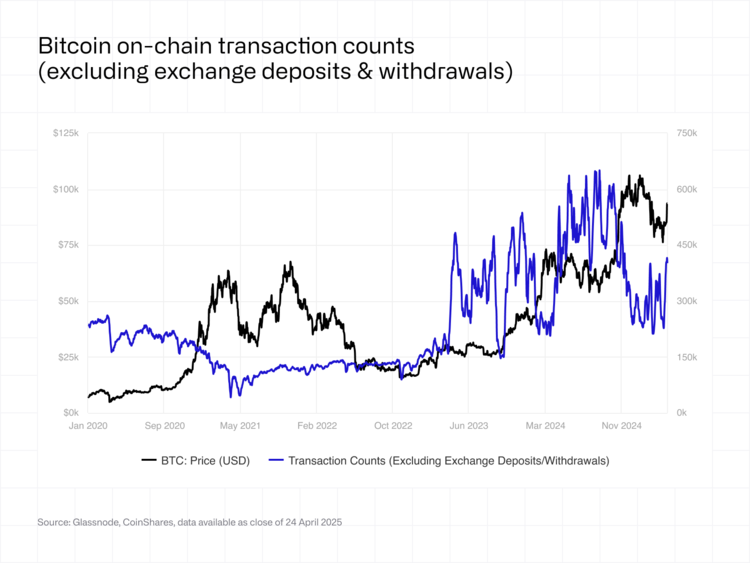
The above chart indicates that since late 2022, Bitcoin has seen a consistent rise in activity tied to wallet-to-wallet transfers. An increase in peer-to-peer activity indicates a shift away from speculative trading toward usage patterns more consistent with monetary settlement and long-term value transfer.
This includes savings, transfers, settlement of balances, and cross-border movement of value. While exchange-related activity has remained relatively flat, these peer-to-peer transactions have grown irrespective of periods of price volatility. This trend supports the view that Bitcoin is not only evolving as a tradable asset, but also serving as a functional monetary tool for settlement and value transfer.
This can be explained by Bitcoin’s resilience: did you know that the Bitcoin network has achieved 99.99% uptime? With only two interruptions in its 16-year history, totaling just 14 hours, and none since 2013, the network has operated continuously, making it the most reliable payment processor in the world. Thanks to carefully considered technical upgrades, implemented by network operators with broad consensus, the protocol remains stable, well-understood, and proven. With Bitcoin, users know exactly what they’re using.
Bitcoin: a truly scarce asset
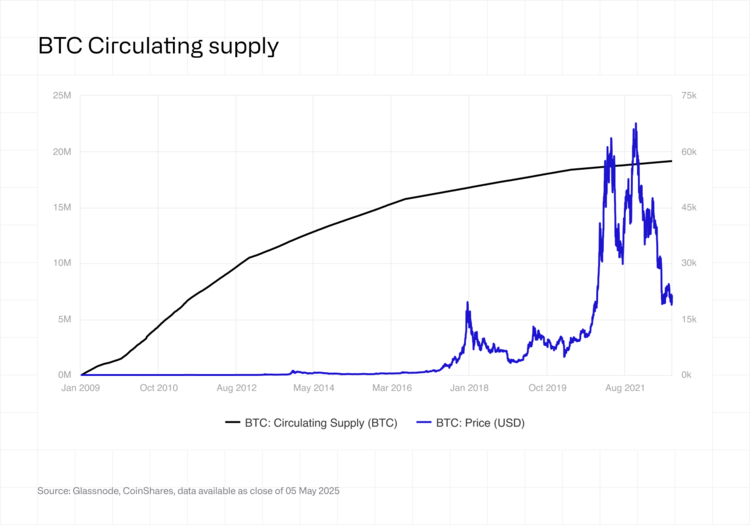
As of April 2025, around 19.8 million Bitcoin have already been mined, with fewer than 6 percent left to be issued. New bitcoins enter circulation as mining rewards, following a schedule that reduces issuance roughly every four years. In April 2024, Bitcoin’s daily issuance dropped from 900 to 450 coins, after its fourth halving, and it is set to decline again to 225 in 2028. By that point, only about 2.3% of the total supply will remain to be mined, approximately 488,000 bitcoins, gradually issued until the final fractions are mined around the year 2140: this amount is less than the total supply currently held by the publicly-listed company Strategy (formerly MicroStrategy).
This predictable and diminishing supply distinguishes Bitcoin from fiat currencies because fiat currencies can be expanded at the discretion of central banks. In contrast, Bitcoin’s scarcity is embedded within its protocol and operates independently of policy decisions.
And unlike gold, Bitcoin’s issuance is finite, exact, and will conclude entirely once the 21 million limit is reached.
Why This Matters To Advisors:
For financial advisors navigating an era of economic uncertainty, inflationary pressures, and shifting client expectations, Bitcoin offers a unique proposition: a digitally native, truly scarce, and globally accessible monetary asset with an unmatched record of operational resilience. Advisors who understand these structural advantages are better equipped to guide clients through a fast-evolving investment landscape, bridging the gap between traditional finance and the emerging digital economy with informed, forward-looking strategies.

