

What You’ll Learn
This article explores how Bitcoin’s structural design offers a compelling hedge against inflation and long-term monetary instability. You’ll gain perspective on Bitcoin’s monetary framework and an examination of the historical growth of the U.S. federal debate and its investment implications. You will gain an understanding of why Bitcoin’s decentralized architecture is uniquely suited to withstand fiscal and monetary pressures.
For financial advisors managing portfolios amid rising inflation and persistent volatility, the need for resilient assets has become more pressing in today’s environment. Among them, Bitcoin stands out, not only for its price performance but also for its underlying structural strengths as a hedge against ongoing monetary expansion.
In May 2010, two pizzas were purchased for 10,000 BTC marking Bitcoin’s first real-world transaction. At the time, this valued the entire order at roughly $41, or just $0.0041 per Bitcoin. While modest in hindsight, the transaction represented an early milestone in Bitcoin’s journey toward real-world utility. It helped demonstrate that Bitcoin could function as a medium of exchange, paving the way for broader adoption. From that point, Bitcoin gradually evolved into a globally recognized asset class, shaped by decentralized principles and a fixed monetary framework.
For financial advisors and registered investment advisers (RIAs), understanding what drives Bitcoin’s ability to recover from price drops is becoming more important, especially as clients look for assets that can withstand economic shocks and support portfolio diversification.
Bitcoin Architecture
In an environment where economic policy is increasingly reactive, Bitcoin offers a rare sense of monetary predictability. As of 2025, nearly 19.8 million Bitcoin are in circulation, with a hard cap of 21 million built into its code. Issuance follows a strict halving cycle every four years, creating a transparent and finite monetary supply. For financial professionals, this removes the guesswork around inflation risk. Unlike fiat currencies, where future supply is influenced by political agendas and emergency spending, Bitcoin’s design is fixed, visible, and immune to discretionary changes.
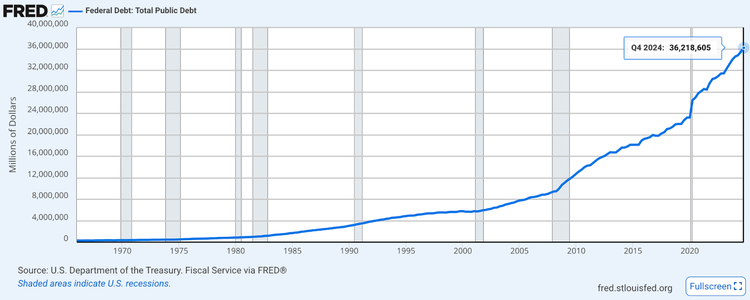
A Historical Comparison: Public Debt & Fiat Expansion
To appreciate the significance of Bitcoin’s decentralized architecture, it’s useful to contrast it with the trajectory of fiat currency expansion and the public debt.
- 1917–1981: U.S. federal debt grew from $1 billion to $1 trillion – a 99,900% increase – driven by war financing, social programs, and decades of monetary expansion.
- 1981–2000: Debt rose from $1T to $5.68T, a 468% increase in less than 20 years.
- 2000–2020: Federal debt increased from $5.68T to $27.75T, an additional 388% increase, fueled by recessions, tax cuts, and sustained spending growth.
- 2020–2025: Post pandemic, debt soared another $9T, reaching $36.86 trillion in May 2025.
Public debt highlights the structural pressure points of fiat-based systems, issues Bitcoin was designed to address. If current fiscal trends continue, U.S. federal debt could plausibly reach $90–105 trillion by 2040, representing a 150–185% increase from today’s levels. This is not just a matter of scale, but of compounding momentum in debt accumulation.
In May 2025, this fragility became more visible. The U.S. Treasury’s 20-year bond auction saw weaker-than-expected demand, pushing yields to 5.16%, the highest level in over a year. While higher yields often signal opportunity, in this context higher yields reflect growing investor caution rather than confidence as demand from foreign participants has cooled, which prompted concerns about who will absorb ongoing issuance.
In contrast, Bitcoin operates on a fixed, transparent monetary framework with no central authority capable of discretionary issuance. It is designed to be independent of political cycles and debt dynamics, a feature that increasingly sets it apart in today’s fiscal environment.
Why This Matters to Advisors
For financial advisors and executives responsible for long-term portfolio planning, the contrast between fiat currency and Bitcoin couldn’t be clearer. Traditional currencies are defined by unpredictable supply, reactive monetary policy, and declining purchasing power. Bitcoin, on the other hand, offers fixed supply, predictable issuance, and full transparency—features that foster long-term confidence and remove many of the uncertainties advisors face when constructing inflation-resistant portfolios. In a macroeconomic environment driven by debt expansion and policy shifts, Bitcoin provides a consistent, rule-based asset that can serve as a modern hedge and diversification tool in multi-decade investment strategies.

