

ETFdb Logo
  • ETF Database
  • Content Hubs
    • Themes
      • Active ETF
      • Alternatives
      • Artificial Intelligence
      • China Insights
      • Core Strategies
      • Crypto
      • Disruptive Technology
      • Energy Infrastructure
      • ETF Building Blocks
      • ETF Investing
      • ETF Strategist
      • Financial Literacy
      • Fixed Income
      • Free Cash Flow
      • Future ETFs
      • Innovative ETFs
      • Institutional Income Strategies
      • Leveraged & Inverse
      • Market Insights
      • Market Outlooks
      • Modern Alpha
      • Nuclear Energy
      • Portfolio Strategies
      • Sector Investing
      • Tax Efficient Income
      • Thematic Investing
    • Asset Class
      • Equity
        • U.S. Equity
        • Int'l Developed
        • Emerging Market Equities
      • Alternatives
        • Gold/Silver/Critical Materials
        • Cryptocurrency
        • Currency
        • Volatility
      • Fixed Income
        • Investment Grade Corporates
        • US Treasuries & TIPS
        • High Yield Corporates
        • Int'l Fixed Income
    • ETF Ecosystem
    • ETFs in Canada
    • Market Outlook
    • Crypto ETF Hub
  • Tools
    • ETF Screener
    • ETF Country Exposure Tool
    • ETF Database Categories
    • Indexes
    • Scenario Analysis
    • Watchlists
    • Head-To-Head ETF Comparison Tool
    • Mutual Fund To ETF Converter
    • ETF Stock Exposure Tool
    • ETF Issuer Fund Flows
  • Research
    • ETF Education
    • Equity Investing
    • Dividend ETFs
    • Leveraged ETFs
    • Inverse ETFs
    • Index Education
    • Index Insights
    • Top ETF Sectors
    • Top ETF Issuers
    • Top ETF Industries
  • Webcasts
  • Sectors
    • Sector Investing Content Hub
    • XLK
    • XLI
    • XLU
    • XLY
    • XLP
    • XLRE
    • Sector Power Rankings
    • XLE
    • XLC
    • XLF
    • XLV
    • XLB
  • Multimedia
    • ETF 360 Video Series
    • ETF of the Week Podcast
    • Gaining Perspective Podcast
    • ETF Prime Podcast
    • Video
  • Company
    • About VettaFi
  • PRO
    • Pro Content
    • Pro Tools
    • Advanced
    • FAQ
    • Free sign up
    • Login
  1. Core Strategies Content Hub
  2. Droughts Weaken Bees, Causing Crops to Suffer
Core Strategies Content Hub
Share

Droughts Weaken Bees, Causing Crops to Suffer

Karrie GordonAug 20, 2021
2021-08-20

North Dakota produces the most honey in the U.S., and is currently experiencing its worst drought since 1988, weakening bee colonies throughout the state. Without these colonies, crops in the state, as well as almonds and other crops in California are set to suffer in another cascade effect of a warming planet.

A shortage of bee colonies will have a larger effect, leaving almonds, apples, and plums at risk in California, according to bee experts, farmers, economists, and farm industry groups, reports Reuters. This is because the hives are usually taken from North Dakota to California in the wintertime to pollinate orchards and fruit crops.

The decrease in healthy bee populations is driving up costs for pollination services that will create an even greater financial burden on already struggling West Coast farmers contending with their own droughts and skyrocketing water costs. It’s a cost that will also be passed along to consumers who are already experiencing sharp rises in the price of honey.

The domino effects of climate change are widening in an increasingly larger chain, with bee populations one of the latest, and arguably highest priority victims. Bee populations are responsible for populating much of the country’s fruit crops, including peaches and cherries in addition to the others already mentioned.

Curtailing Climate Change with Sustainable Practices

The call for change by corporations to reduce emissions is an increasingly larger pressure from investors. Curtailing emissions would reduce harmful global weather patterns created by climate change.

The American Century Sustainable Growth ETF (ESGY B-) invests in large companies that are practicing sustainability and working towards measurable ESG goals.

ESGY is a non-diversified fund that invests in large cap companies with large growth and value potential while also ranking highly on ESG metrics.

ACI’s proprietary model assigns a score to each security for financial metrics as well as a score for ESG metrics, which are combined. The highest overall scoring securities are selected within each sector, creating a portfolio with strong performance and higher ESG ratings than the stocks in the Russell 1000 Growth Index.

The fund is a semi-transparent ETF, meaning that allocations are disclosed on a quarterly basis, not daily. As of its last quarterly rebalancing, it contained companies such as Target Corp, Beyond Meat, and NVIDIA Corp.

ESGY has a total annual fund operating expense of 0.39%.

Content continues below advertisement

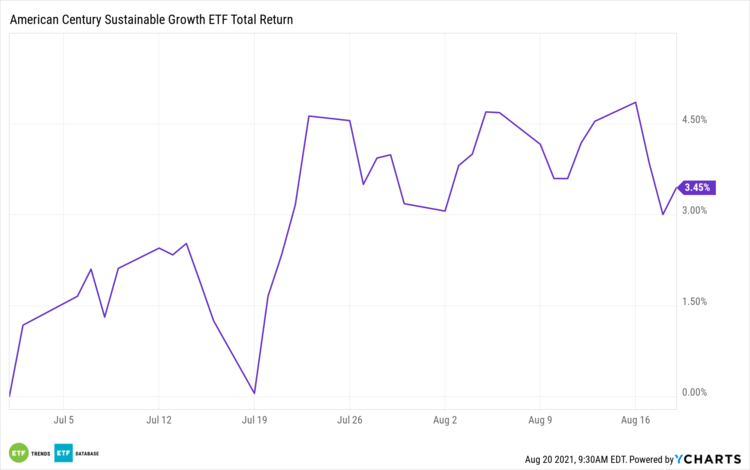
American Century Sustainable Growth ETF Total Return

For more news, information, and strategy, visit the Core Strategies Channel.

Loading Articles...

Advertisement

Is Your Portfolio Positioned With Enough Global Exposure?

ETF Education Channel

How to Allocate Commodities in Portfolios

Tom LydonApr 26, 2022
2022-04-26

A long-running debate in asset allocation circles is how much of a portfolio an investor should...

Core Strategies Channel

Why ETFs Experience Limit Up/Down Protections

Karrie GordonMay 13, 2022
2022-05-13

In a digital age where information moves in milliseconds and millions of participants can transact...

}
X
