

ETFdb Logo
  • ETF Database
  • Content Hubs
    • Themes
      • Active ETF
      • Alternatives
      • Artificial Intelligence
      • China Insights
      • Core Strategies
      • Crypto
      • Disruptive Technology
      • Energy Infrastructure
      • ETF Building Blocks
      • ETF Investing
      • ETF Strategist
      • Financial Literacy
      • Fixed Income
      • Free Cash Flow
      • Future ETFs
      • Innovative ETFs
      • Institutional Income Strategies
      • Leveraged & Inverse
      • Market Insights
      • Market Outlooks
      • Modern Alpha
      • Nuclear Energy
      • Portfolio Strategies
      • Sector Investing
      • Tax Efficient Income
      • Thematic Investing
    • Asset Class
      • Equity
        • U.S. Equity
        • Int'l Developed
        • Emerging Market Equities
      • Alternatives
        • Gold/Silver/Critical Materials
        • Cryptocurrency
        • Currency
        • Volatility
      • Fixed Income
        • Investment Grade Corporates
        • US Treasuries & TIPS
        • High Yield Corporates
        • Int'l Fixed Income
    • ETF Ecosystem
    • ETFs in Canada
    • Market Outlook
    • Crypto ETF Hub
  • Tools
    • ETF Screener
    • ETF Country Exposure Tool
    • ETF Database Categories
    • Indexes
    • Scenario Analysis
    • Watchlists
    • Head-To-Head ETF Comparison Tool
    • Mutual Fund To ETF Converter
    • ETF Stock Exposure Tool
    • ETF Issuer Fund Flows
  • Research
    • ETF Education
    • Equity Investing
    • Dividend ETFs
    • Leveraged ETFs
    • Inverse ETFs
    • Index Education
    • Index Insights
    • Top ETF Sectors
    • Top ETF Issuers
    • Top ETF Industries
  • Webcasts
  • Sectors
    • Sector Investing Content Hub
    • XLK
    • XLI
    • XLU
    • XLY
    • XLP
    • XLRE
    • Sector Power Rankings
    • XLE
    • XLC
    • XLF
    • XLV
    • XLB
  • Multimedia
    • ETF 360 Video Series
    • ETF of the Week Podcast
    • Gaining Perspective Podcast
    • ETF Prime Podcast
    • Video
  • Company
    • About VettaFi
  • PRO
    • Pro Content
    • Pro Tools
    • Advanced
    • FAQ
    • Free sign up
    • Login
  1. Core Strategies Content Hub
  2. This Hidden Cost of Mutual Funds That Boosts ETFs
Core Strategies Content Hub
Share

This Hidden Cost of Mutual Funds That Boosts ETFs

Nick Peters-GoldenApr 29, 2024
2024-04-29

Investors have increasingly moved away from mutual funds and towards ETFs in recent years. ETF investing offers a variety of benefits, whether active or passive. Of course, mutual fund AUM still looms large over ETF AUM, but that may not last forever. That’s because ETFs stand out when compared to the hidden cost of mutual funds.

See more: 9 Views on Adding Current Income in 2024

That cost? Taxes. Mutual funds struggle with how many taxable events they encounter as opposed to ETFs. That cost understood as the tax-cost ratio, can really hurt for the most tax-sensitive investors. Those nearing retirement, for example, need to limit tax burdens frequently.

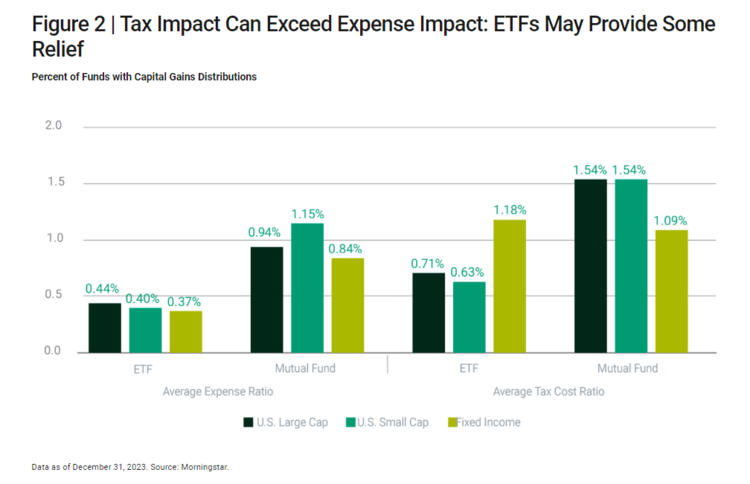
Mutual funds see more distributions than ETFs, which see more money lost to taxes. That hidden cost of mutual funds sees half of all U.S. equity mutual funds distributing capital gains, compared to just 2.5% of ETFs per American Century Investments. That already poses some challenges to investors, but what’s worse is that the average tax cost ratio of a mutual fund often outpaces its average expense ratio.
This Hidden Cost of Mutual Funds That Boosts ETFs
The cost of mutual funds in taxes vs. expenses, compared to ETFs.

For those investors who aren’t orbiting retirement, tax costs also limit reinvestment. Tax burden derailing that reinvestment can harm dividend strategies and other common investment approaches.

That’s why one strong option for addressing the hidden cost of mutual funds is ETFs. Active ETFs, particularly, offer flexibility, transparency, and tax mitigation.

For example, investors may want to consider a strategy like the American Century Focused Dynamic Growth ETF (FDG C+). FDG charges 45 basis points (bps) for its approach. It actively invests in large and mid-cap U.S. firms with potentially high profits and growth. The ETF has returned more than 40% over the last one-year period. On a YTD basis, it has returned more than 15%, per American Century Investments data.

FDG presents one strong option for mitigating tax issues. For investors concerned by taxable distributions, FDG and other ETFs may appeal.

For more news, information, and analysis, visit the Core Strategies Channel.


Content continues below advertisement

Loading Articles...

Advertisement

Is Your Portfolio Positioned With Enough Global Exposure?

ETF Education Channel

How to Allocate Commodities in Portfolios

Tom LydonApr 26, 2022
2022-04-26

A long-running debate in asset allocation circles is how much of a portfolio an investor should...

Core Strategies Channel

Why ETFs Experience Limit Up/Down Protections

Karrie GordonMay 13, 2022
2022-05-13

In a digital age where information moves in milliseconds and millions of participants can transact...

}
X
