


As reported by VettaFi, the SEC recently granted an order for the accelerated approval of eight spot ethereum ETFs to be traded on U.S. exchanges. Two spot ethereum ETFs on the list, Fidelity’s FETH & Invesco Galaxy’s ETHX.U, already trade on the Toronto Exchange. As most readers may know, Canada has always been a hub of ETF innovation. Europe has also led the way with several ethereum ETPs. However, what do we know about the eight new ETFs that will be on offer later this year in the U.S.?
Who Are the 8 Issuers?
In no particular order, the eight issuers and their tickers are:
- Grayscale (ETH)
- Bitwise (AETH)
- BlackRock iShares (ETHA)
- VanEck (EFUT)
- ARK 21 Shares (ARKY)
- Invesco Galaxy (unknown)
- Fidelity (FETH)
- Franklin Templeton (EZET)
How is spot ethereum different from spot BTC?
The underlying asset in this case is ethereum (or ether) and it distinguishes itself from bitcoin in a few distinct ways.
Protocols & Smart Contracts
Ethereum is both a cryptocurrency (ether) and a protocol/network. It puts as much emphasis on its programmatic, smart contract capabilities as it does on its cryptocurrency. Bitcoin does not offer a programmable smart contract capability. In simpler terms, the ethereum network can hold ether in escrow between counterparties before a condition is met (e.g., if my order is scanned for shipment by a third party, then pay XYZ vendor 0.05 ETH). Bitcoin does not have this capability.
Proof of Stake
In addition to the programmatic smart contract, ethereum offers a different consensus algorithm for settlement. It uses proof of stake instead of proof of work. Once again, in simpler terms, proof of stake is an approach where ledger consensus is reached by users that have a stake in ethereum by holding ether. These individuals have the privilege of helping to validate a block and receive a transaction fee as a reward. Proof of work, used by bitcoin, on the other hand, is a brute-force computation of a complex cryptographic puzzle. The first miner to solve the puzzle and validate a block wins some bitcoin in the process.
One key point to note is that most of the new spot ethereum ETFs initially planned to allow staking. This would have allowed investors to receive transaction fees — analogous to a dividend. However, just before filing with the SEC, all the issuers removed the relevant language that would have allowed them to stake the ether they hold.
One last item to note is that the ethereum approach for transaction settlement is much faster than the bitcoin approach. Ethereum can process approximately 30 transactions per second. And on average, settlement occurs withing 15 seconds. On the other hand, bitcoin can process seven transactions per second and requires about 10 minutes to validate a block.
What Do We Know About the 8 New Products Coming to Market?
The new ETFs should be ready for trading later this year. Based on previous time-to-market with spot bitcoin ETFs, we could see these products trading on U.S. exchanges in a matter of months.
The fees on these products are still a bit murky, but currently we are seeing proposed ranges from 0.60% to 2.50%. Although there is a wide dispersion in fees, it’s yet to be seen how these products will differentiate themselves beyond that.
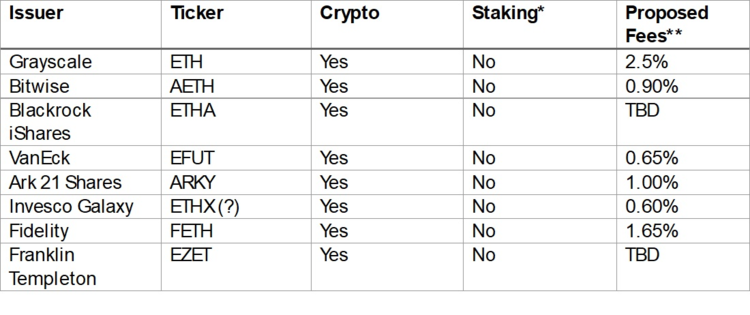
Staking – In this case, holders of the spot ethereum product would be involved in staking ether, yielding potential payments if the fund’s holders assist in block validation.
This information is still evolving and may be based on similar products recently released like spot BTC ETFs.
For more news, information, and analysis, visit the Crypto Channel.

