


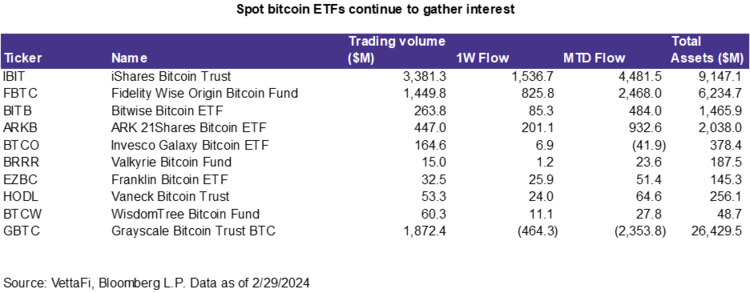
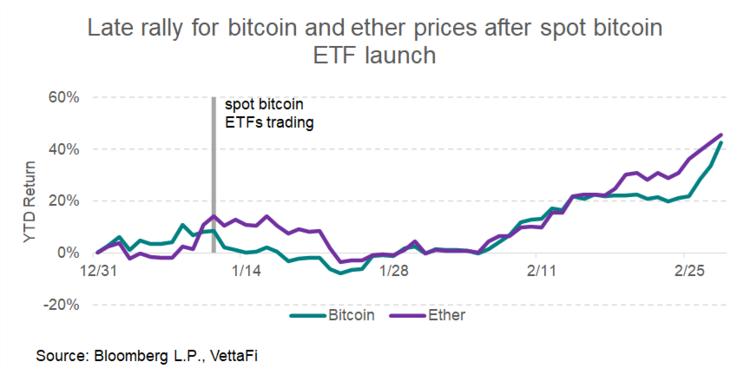
This week bitcoin prices reached over $60,000 — the highest level since November 2021. Since the launch of spot bitcoin ETFs in early January, demand continues to pile on. So far the nine new spot ETFs (ex-GBTC) have seen over $7 billion in net inflows.
Meanwhile, ether prices have quietly shot up to $3,300 — the highest level since April 2022. Spot ether ETFs, however, have received relatively less attention. There may be less demand given ether’s cryptomarket share versus bitcoin’s cryptomarket share. But there are some interesting drivers behind the spot ether launch. Like many other “fringe” ETF segments, there is a place in the market for these products.
Do retail investors need spot ether ETFs?
While ether and bitcoin are both cryptocurrencies, the two have very different use cases. Bitcoin was designed as a replacement for fiat currency. In contrast to other forms of digital payments, like credit cards, Apple Pay, etc., bitcoin is decentralized. That means it is not under control of a single company, bank, or government.
Ether is also a digital currency. But the Ethereum network uses smart contracts to support dApps (decentralized applications). The two digital assets, while related, have different use cases and investment theses. But this difference is probably more important to dedicated crypto investors, who don’t necessarily overlap with traditional retail investors.
With spot bitcoin ETFs, analysts often mentioned a type of retail investor interested in bitcoin who didn’t want to invest directly. ETFs opened a way for these investors to access bitcoin easily in their brokerage accounts through well-established entities like BlackRock and Fidelity. These investors are typically interested in bitcoin for several reasons. Those are: 1) diversifier and inflation hedge; 2) digital disruption; and 3) exciting returns.
If all three of these are found in both bitcoin and ether, most retail investors would not necessarily want to invest in both ether and bitcoin. There is still demand from institutional investors. But because there is not a compelling thesis for retail investors, these ETFs have stayed out of the mainstream media while spot bitcoin ETFs like the iShares Bitcoin Trust (IBIT ) and the Fidelity Wise Origin Bitcoin Fund (FBTC ) continue to gather interest.
Spot ether ETFs likely to be approved, but with stipulations
Even though they have stayed out of the spotlight relative to spot bitcoin ETFs, spot ether ETFs are still gathering attention from both the crypto and the ETF worlds. So far, eight issuers have filed for spot ether ETFs. Although Franklin Templeton filed in February, ether is more complex and less mainstream than bitcoin. Therefore, I don’t expect anyone new to file for spot ether ETFs that didn’t file for spot bitcoin ETFs. Out of the issuers that launched spot bitcoin ETFs, Bitwise, Valkyrie, and WisdomTree are the only ones who have not yet filed for spot ether ETFs.
The final decision deadline for the VanEck Ethereum ETF is May 23, followed by the Ark 21Shares Ethereum ETF on May 24. The SEC is likely to make a decision by then and approve multiple products as it did with ether futures ETFs and spot bitcoin ETFs. While I believe an approval is likely (same precedent that bitcoin futures ETF set for spot bitcoin ETFs applies to ether futures ETFs and spot ether ETFs), I think there will likely be more conversations required to get these ETFs on the same page. That includes cash redemptions and potentially certain guardrails around staking.

Staking in ether ETFs likely to be controversial with the SEC
Recently, the Ethereum network transitioned to a proof-of-stake model where validators stake ether to earn rewards. Currently, Coinbase’s reward for staking ether is 2.7% APY. Out of the eight spot ether ETFs that have been filed, only Ark 21Shares and Franklin Templeton have included language about staking in their filings. I don’t believe staking would make ether attractive to a new investor. That is especially so because investors can get higher yield in a much safer way through dividend ETFs, money market funds, or even high-yield savings accounts.
This also adds more controversy to an already controversial launch with the SEC. That is because staking is similar to features offered by securities like receiving interest or dividends. The SEC already had lawsuits with Kraken and Coinbase over this issue. I don’t think the SEC will be open to staking. But exchange-traded products in other countries offer ether staking products, so it isn’t unheard of. Canada, which was ahead of the U.S. with its spot bitcoin ETFs, has approved ether ETFs that include staking. 3iQ offers staking in both the 3iQ Ether Staking ETF (TSX: ETHQ) and the Ether Fund (TSX: QETH).
For more news, information, and analysis, visit the Crypto Channel.

