

ETFdb Logo
  • ETF Database
  • Content Hubs
    • Themes
      • Active ETF
      • Alternatives
      • Artificial Intelligence
      • China Insights
      • Core Strategies
      • Crypto
      • Disruptive Technology
      • Energy Infrastructure
      • ETF Building Blocks
      • ETF Investing
      • ETF Strategist
      • Financial Literacy
      • Fixed Income
      • Free Cash Flow
      • Future ETFs
      • Innovative ETFs
      • Institutional Income Strategies
      • Leveraged & Inverse
      • Market Insights
      • Market Outlooks
      • Modern Alpha
      • Nuclear Energy
      • Portfolio Strategies
      • Sector Investing
      • Tax Efficient Income
      • Thematic Investing
    • Asset Class
      • Equity
        • U.S. Equity
        • Int'l Developed
        • Emerging Market Equities
      • Alternatives
        • Gold/Silver/Critical Materials
        • Cryptocurrency
        • Currency
        • Volatility
      • Fixed Income
        • Investment Grade Corporates
        • US Treasuries & TIPS
        • High Yield Corporates
        • Int'l Fixed Income
    • ETF Ecosystem
    • ETFs in Canada
    • Market Outlook
    • Crypto ETF Hub
  • Tools
    • ETF Screener
    • ETF Country Exposure Tool
    • ETF Database Categories
    • Indexes
    • Scenario Analysis
    • Watchlists
    • Head-To-Head ETF Comparison Tool
    • Mutual Fund To ETF Converter
    • ETF Stock Exposure Tool
    • ETF Issuer Fund Flows
  • Research
    • ETF Education
    • Equity Investing
    • Dividend ETFs
    • Leveraged ETFs
    • Inverse ETFs
    • Index Education
    • Index Insights
    • Top ETF Sectors
    • Top ETF Issuers
    • Top ETF Industries
  • Webcasts
  • Sectors
    • Sector Investing Content Hub
    • XLK
    • XLI
    • XLU
    • XLY
    • XLP
    • XLRE
    • Sector Power Rankings
    • XLE
    • XLC
    • XLF
    • XLV
    • XLB
  • Multimedia
    • ETF 360 Video Series
    • ETF of the Week Podcast
    • Gaining Perspective Podcast
    • ETF Prime Podcast
    • Video
  • Company
    • About VettaFi
    • Get VettaFi’ed
  • PRO
    • Pro Content
    • Pro Tools
    • Advanced
    • FAQ
    • Free sign up
    • Login
  1. Disruptive Technology Content Hub
  2. A Base Hit: How Base Editing Is Transforming Genomics
Disruptive Technology Content Hub
Share

A Base Hit: How Base Editing Is Transforming Genomics

Tom LydonMay 26, 2021
2021-05-26

For growth investors seeking disruptive exposure in the healthcare sector, genomics is often a favored destination. The industry pushes an array of advances that can improve diagnoses, disease screening and treatment, and patient outcomes.

One frontier for investors to stay abreast of is base editing – the concept of shifting one DNA pair to another. Companies developing base editing technologies are accessible via the ARK Genomic Revolution Multi-Sector Fund (ARKG A-).

“Base editors directly convert one base or base pair into another, enabling the efficient installation of point mutations in non-dividing cells without generating excess undesired editing byproducts,” according to a 2018 study from the National Institutes of Health (NIH).
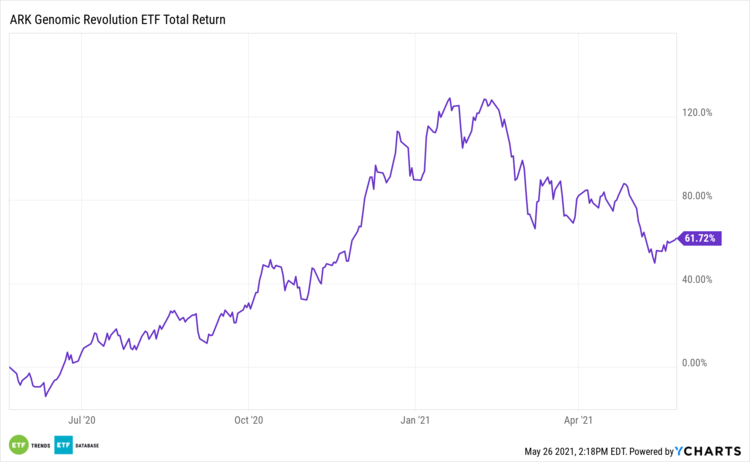
ARKG 1 Year Performance

Banking on Base Editing with 'ARKG'

A primary benefit offered by the $9.44 billion ARKG is that the fund is actively managed, meaning it can more nimbly allocate to emerging genomics trends, including base editing. Passive rivals often lack the ability to add to these positions.

In fact, ARKG’s active benefits have recently been on display.

“This year at the J.P. Morgan Healthcare Conference, Verve Therapeutics, a private cardiovascular gene editing company, presented interesting pre-clinical data on its use of Beam Therapeutics’ base editing technology,” writes ARK analyst Ali Urman. “In healthy non-human primates, Verve’s scientists discovered that inactivating the PCSK9 gene lowered the level of low-density lipoprotein (LDL), or bad cholesterol, reducing the probability of heart attacks.”

Beam Therapeutics (NASDAQ: BEAM) accounts for 1.57% of ARKG’s weight as of May 25, according to issuer data.

As Urman notes, recent data published by Verve indicates a single treatment of in vivo base editing used in a specific gene in non-human primates reduced LDL by 60% over an eight-month span with scant side effects.

“This updated data suggests that base editing could correct other ‘misspellings’, or point mutations, in base pairs of DNA, potentially addressing large unmet needs and curing a wide range of diseases,” adds the ARK analyst.

Base editing and many of the other concepts addressed in ARKG are complex, high-level endeavors that scientists and healthcare professionals digest on a daily basis. The ARK fund has outperformed the S&P 500 Health Care Index by a more than 3-to-1 margin over the past three years.

For more on disruptive technologies, visit our Disruptive Technology Channel.


Content continues below advertisement

Loading Articles...

Advertisement

Is Your Portfolio Positioned With Enough Global Exposure?

ETF Education Channel

How to Allocate Commodities in Portfolios

Tom LydonApr 26, 2022
2022-04-26

A long-running debate in asset allocation circles is how much of a portfolio an investor should...

Core Strategies Channel

Why ETFs Experience Limit Up/Down Protections

Karrie GordonMay 13, 2022
2022-05-13

In a digital age where information moves in milliseconds and millions of participants can transact...

}
X
