

ETFdb Logo
  • ETF Database
  • Content Hubs
    • Themes
      • Active ETF
      • Alternatives
      • Artificial Intelligence
      • China Insights
      • Core Strategies
      • Crypto
      • Disruptive Technology
      • Energy Infrastructure
      • ETF Building Blocks
      • ETF Investing
      • ETF Strategist
      • Financial Literacy
      • Fixed Income
      • Free Cash Flow
      • Future ETFs
      • Innovative ETFs
      • Institutional Income Strategies
      • Leveraged & Inverse
      • Market Insights
      • Market Outlooks
      • Modern Alpha
      • Nuclear Energy
      • Portfolio Strategies
      • Sector Investing
      • Tax Efficient Income
      • Thematic Investing
    • Asset Class
      • Equity
        • U.S. Equity
        • Int'l Developed
        • Emerging Market Equities
      • Alternatives
        • Gold/Silver/Critical Materials
        • Cryptocurrency
        • Currency
        • Volatility
      • Fixed Income
        • Investment Grade Corporates
        • US Treasuries & TIPS
        • High Yield Corporates
        • Int'l Fixed Income
    • ETF Ecosystem
    • ETFs in Canada
    • Market Outlook
    • Crypto ETF Hub
  • Tools
    • ETF Screener
    • ETF Country Exposure Tool
    • ETF Database Categories
    • Indexes
    • Scenario Analysis
    • Watchlists
    • Head-To-Head ETF Comparison Tool
    • Mutual Fund To ETF Converter
    • ETF Stock Exposure Tool
    • ETF Issuer Fund Flows
  • Research
    • ETF Education
    • Equity Investing
    • Dividend ETFs
    • Leveraged ETFs
    • Inverse ETFs
    • Index Education
    • Index Insights
    • Top ETF Sectors
    • Top ETF Issuers
    • Top ETF Industries
  • Webcasts
  • Sectors
    • Sector Investing Content Hub
    • XLK
    • XLI
    • XLU
    • XLY
    • XLP
    • XLRE
    • Sector Power Rankings
    • XLE
    • XLC
    • XLF
    • XLV
    • XLB
  • Multimedia
    • ETF 360 Video Series
    • ETF of the Week Podcast
    • Gaining Perspective Podcast
    • ETF Prime Podcast
    • Video
  • Company
    • About VettaFi
    • Get VettaFi’ed
  • PRO
    • Pro Content
    • Pro Tools
    • Advanced
    • FAQ
    • Free sign up
    • Login
  1. Disruptive Technology Content Hub
  2. Polymer Applications Could Be Potent for This 3D Printing ETF
Disruptive Technology Content Hub
Share

Polymer Applications Could Be Potent for This 3D Printing ETF

Tom LydonAug 02, 2021
2021-08-02

One of the primary forms of validation for a disruptive technology is its intersection with and utility in other industries.

Good news for the ARK 3D Printing ETF (PRNT B-): 3D printing isn’t just one of the original disruptive technologies. It’s also a master of proving its worth in other industries. That trend has been on display in aerospace and defense and healthcare, just to name a pair, but there other inroads for 3D printing technology are growing increasingly relevant.

Take the case of fiber-reinforced polymers.

“This is quickly becoming one of the most exciting and impactful areas of 3D printing; over the next decade the market will grow to $2 billion, the installed base and applications will expand, and technology will continue to mature,” according to IDTechEx’s “3D Printing Composites 2021-2031: Technology and Market Analysis” report.
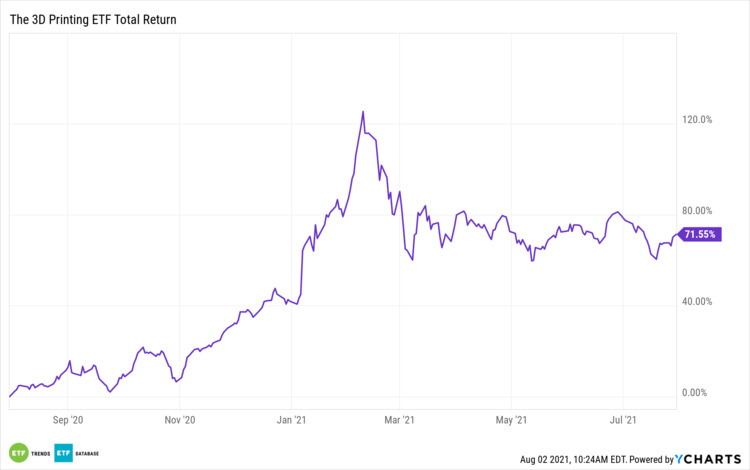
PRNT 1 Year Performance

The 3D Printing Opportunity Set

Also known as fiber-reinforced composites, these type of polymers have myriad industrial applications, highlighting ample opportunity for PRNT components to make progress in new areas.

For example, fiber-reinforced polymers have applications in aerospace and defensive sectors, automotive production, consumer goods, construction, the power generation field, the manufacturing of protective equipment, and maritime infrastructure, among others.

“FRPs are valuable as metal substitutes in the bodies of luxury automobiles and in truck and trailer body sidings. With higher fracture points than steel, these strong, stiff and light materials also improve fuel consumption while increasing the speed,” according to AZO Cleantech.

Moreover, 3D printing companies may offer polymers to consumers with the often elusive combination of a better product at a favorable price point.

“3D printing of polymer materials can have mechanical limitations that benefit from fiber reinforcement (or other functionalities), and composite manufacturing is known to be costly, and challenging this can benefit from the moldless, rapid prototyping, and automated approach that additive manufacturing enables,” adds IDTechEx.

The $556 million PRNT, which is one of ARK’s two passive ETFs, turned five years old last month and follows the Total 3D-Printing Index. That index holds 56 stocks with a median market value of $7 billion. PRNT charges 0.66% per year, or $66 on a $10,000 investment.

For more on disruptive technologies, visit our Disruptive Technology Channel.


Content continues below advertisement

Loading Articles...

Advertisement

Is Your Portfolio Positioned With Enough Global Exposure?

ETF Education Channel

How to Allocate Commodities in Portfolios

Tom LydonApr 26, 2022
2022-04-26

A long-running debate in asset allocation circles is how much of a portfolio an investor should...

Core Strategies Channel

Why ETFs Experience Limit Up/Down Protections

Karrie GordonMay 13, 2022
2022-05-13

In a digital age where information moves in milliseconds and millions of participants can transact...

}
X
