

ETFdb Logo
  • ETF Database
  • Content Hubs
    • Themes
      • Active ETF
      • Alternatives
      • Artificial Intelligence
      • China Insights
      • Core Strategies
      • Crypto
      • Disruptive Technology
      • Energy Infrastructure
      • ETF Building Blocks
      • ETF Investing
      • ETF Strategist
      • Financial Literacy
      • Fixed Income
      • Free Cash Flow
      • Future ETFs
      • Innovative ETFs
      • Institutional Income Strategies
      • Leveraged & Inverse
      • Market Insights
      • Market Outlooks
      • Modern Alpha
      • Nuclear Energy
      • Portfolio Strategies
      • Sector Investing
      • Tax Efficient Income
      • Thematic Investing
    • Asset Class
      • Equity
        • U.S. Equity
        • Int'l Developed
        • Emerging Market Equities
      • Alternatives
        • Gold/Silver/Critical Materials
        • Cryptocurrency
        • Currency
        • Volatility
      • Fixed Income
        • Investment Grade Corporates
        • US Treasuries & TIPS
        • High Yield Corporates
        • Int'l Fixed Income
    • ETF Ecosystem
    • ETFs in Canada
    • Market Outlook
    • Crypto ETF Hub
  • Tools
    • ETF Screener
    • ETF Country Exposure Tool
    • ETF Database Categories
    • Indexes
    • Scenario Analysis
    • Watchlists
    • Head-To-Head ETF Comparison Tool
    • Mutual Fund To ETF Converter
    • ETF Stock Exposure Tool
    • ETF Issuer Fund Flows
  • Research
    • ETF Education
    • Equity Investing
    • Dividend ETFs
    • Leveraged ETFs
    • Inverse ETFs
    • Index Education
    • Index Insights
    • Top ETF Sectors
    • Top ETF Issuers
    • Top ETF Industries
  • Webcasts
  • Sectors
    • Sector Investing Content Hub
    • XLK
    • XLI
    • XLU
    • XLY
    • XLP
    • XLRE
    • Sector Power Rankings
    • XLE
    • XLC
    • XLF
    • XLV
    • XLB
  • Multimedia
    • ETF 360 Video Series
    • ETF of the Week Podcast
    • Gaining Perspective Podcast
    • ETF Prime Podcast
    • Video
  • Company
    • About VettaFi
    • Get VettaFi’ed
  • PRO
    • Pro Content
    • Pro Tools
    • Advanced
    • FAQ
    • Free sign up
    • Login
  1. Disruptive Technology Content Hub
  2. A Robotics Revolution? Unpacking the ARKQ ETF
Disruptive Technology Content Hub
Share

A Robotics Revolution? Unpacking the ARKQ ETF

Tom LydonFeb 19, 2021
2021-02-19

Robotics is one of the more rapidly evolving various disruptive technology themes. Investors can join the party with the ARK Autonomous Technology & Robotics ETF (CBOE: ARKQ).

The actively managed ARKQ invests in companies that stand to benefit from the increased adoption and utilization of robotics and artificial intelligence (AI), including those involved with industrial robotics and automation, non-industrial robots, and autonomous vehicles.

Within the robotics landscape, manufacturing robots are emerging as yet another strong long-term catalyst for ARKQ.

“Robotics play a huge role in the manufacturing landscape today. A growing number of businesses use manufacturing robots to automate repetitive tasks, reduce errors, and enable their employees to focus on innovation and efficiency, causing the entire sector’s impressive growth,” notes Aksje Bloggen.

“According to data presented by Aksje Bloggen the global market value of conventional and advanced robotics in the manufacturing industry is expected to continue rising and hit $18.6bn in 2021, a 40% increase in three years.”
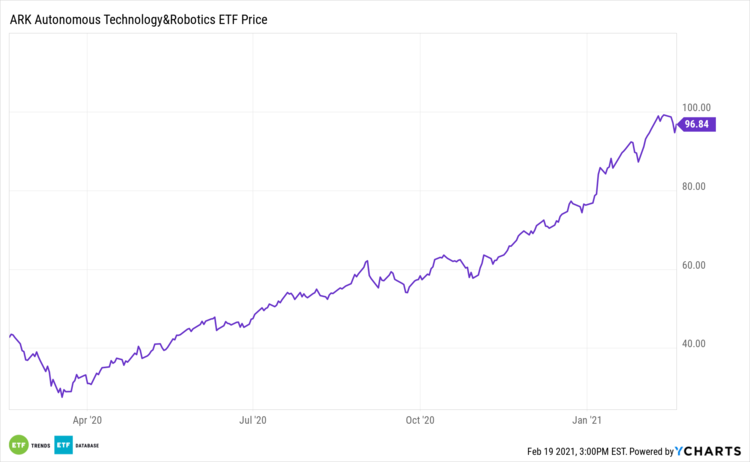
ARKQ 1 Year Performance

Innumerable Robotics Applications

Human capital might be invaluable, but robotics and artificial intelligence are starting to take over. The size of the industrial robotics market is expected to continue growing through 2025, according to data from Statista.

“Robots have numerous roles in manufacturing. They are mainly used for high-volume, repetitive processes where their speed and accuracy offer tremendous advantages. Other manufacturing automation solutions include robots used to help people with more complex tasks, like lifting, holding, and moving heavy pieces,” adds Aksje Bloggen. “Companies turn to robotics process automation to cut manufacturing costs, solve the shortage of skilled labor and keep their cost advantage in the market.”

The impact of robotics can be felt in many sectors. Social distancing measures brought on by Covid-19 only further facilitate their use, as businesses look for ways to continue operations without putting employees at risk.

As the cost of parts and labor to produce robots decreases, the machines becomes more accessible and less cost prohibitive for businesses of all sizes

“The market value of advanced manufacturing robots, which have a superior perception, adaptability, and mobility, tripled in the last three years and is expected to hit $3.7bn in 2021. Combined with big data analytics, advanced manufacturing robots allow companies to make intelligent decisions based on real-time data, which leads to lower costs and faster turnaround times,” concludes Aksje Bloggen.

For more on disruptive technologies, visit our Disruptive Technology Channel.


Content continues below advertisement

Loading Articles...

Advertisement

Is Your Portfolio Positioned With Enough Global Exposure?

ETF Education Channel

How to Allocate Commodities in Portfolios

Tom LydonApr 26, 2022
2022-04-26

A long-running debate in asset allocation circles is how much of a portfolio an investor should...

Core Strategies Channel

Why ETFs Experience Limit Up/Down Protections

Karrie GordonMay 13, 2022
2022-05-13

In a digital age where information moves in milliseconds and millions of participants can transact...

}
X
