

ETFdb Logo
  • ETF Database
  • Content Hubs
    • Themes
      • Active ETF
      • Alternatives
      • Artificial Intelligence
      • China Insights
      • Core Strategies
      • Crypto
      • Disruptive Technology
      • Energy Infrastructure
      • ETF Building Blocks
      • ETF Investing
      • ETF Strategist
      • Financial Literacy
      • Fixed Income
      • Free Cash Flow
      • Future ETFs
      • Innovative ETFs
      • Institutional Income Strategies
      • Leveraged & Inverse
      • Market Insights
      • Market Outlooks
      • Modern Alpha
      • Nuclear Energy
      • Portfolio Strategies
      • Sector Investing
      • Tax Efficient Income
      • Thematic Investing
    • Asset Class
      • Equity
        • U.S. Equity
        • Int'l Developed
        • Emerging Market Equities
      • Alternatives
        • Gold/Silver/Critical Materials
        • Cryptocurrency
        • Currency
        • Volatility
      • Fixed Income
        • Investment Grade Corporates
        • US Treasuries & TIPS
        • High Yield Corporates
        • Int'l Fixed Income
    • ETF Ecosystem
    • ETFs in Canada
    • Market Outlook
    • Crypto ETF Hub
  • Tools
    • ETF Screener
    • ETF Country Exposure Tool
    • ETF Database Categories
    • Indexes
    • Scenario Analysis
    • Watchlists
    • Head-To-Head ETF Comparison Tool
    • Mutual Fund To ETF Converter
    • ETF Stock Exposure Tool
    • ETF Issuer Fund Flows
  • Research
    • ETF Education
    • Equity Investing
    • Dividend ETFs
    • Leveraged ETFs
    • Inverse ETFs
    • Index Education
    • Index Insights
    • Top ETF Sectors
    • Top ETF Issuers
    • Top ETF Industries
  • Webcasts
  • Sectors
    • Sector Investing Content Hub
    • XLK
    • XLI
    • XLU
    • XLY
    • XLP
    • XLRE
    • Sector Power Rankings
    • XLE
    • XLC
    • XLF
    • XLV
    • XLB
  • Multimedia
    • ETF 360 Video Series
    • ETF of the Week Podcast
    • Gaining Perspective Podcast
    • ETF Prime Podcast
    • Video
  • Company
    • About VettaFi
    • Get VettaFi’ed
  • PRO
    • Pro Content
    • Pro Tools
    • Advanced
    • FAQ
    • Free sign up
    • Login
  1. Disruptive Technology Content Hub
  2. Robots Will Make Grocery Delivery Cheaper
Disruptive Technology Content Hub
Share

Robots Will Make Grocery Delivery Cheaper

Tom LydonAug 20, 2021
2021-08-20

One of the newer consumer trends stemming from the coronavirus pandemic is increased adoption of grocery delivery. Like other disruptive trends, this was underway prior to the global health crisis, but COVID-19 really helped moved it along.

Grocery delivery isn’t going anywhere. At the end of the day, grocery store visits are time-consuming for many individuals. Plus, avoiding stores may reduce the chances that a person contracts the coronavirus. Overall, the delivery of groceries is worth the added fee to many folks.

Predictably, there are investment implications, too, and those pertain to more than just Amazon (NASDAQ: AMZN) and grocery store operators. The ARK Autonomous Technology & Robotics ETF (ARKQ B-) is relevant in this conversation too. The actively managed ARKQ is one of the exchange traded funds best-equipped to address the increasing use of robotics across myriad industries, including food consumption and delivery.

“Dominos, FedEx, Kroger, Walmart, Alibaba, JD.com, and Meituan all use rolling robots today,” notes ARK analyst Tasha Keeney. “Previously, ARK estimated that a sidewalk robots could deliver food orders for as little as 6 cents per mile, 20 times less than the cost of human delivery.”
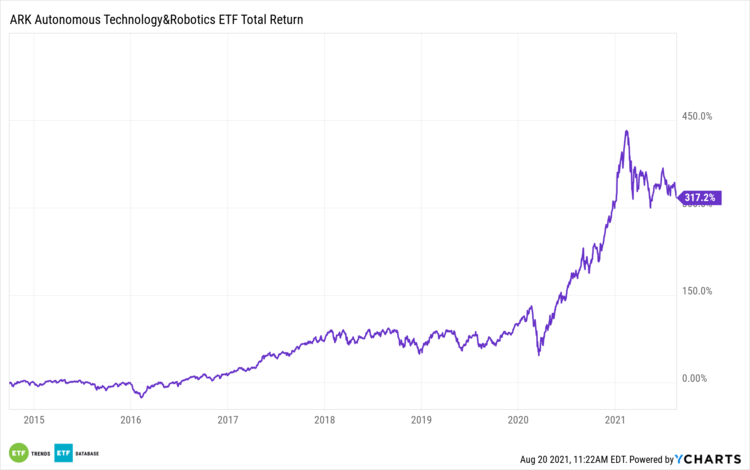
ARK Autonomous ETF Returns

ARKQ Angles on Grocery Delivery

As is the case with so many disruptive technologies, one of the most important factors robotics makers contend with is proving to end users that they will realize cost efficiencies.

When it comes to food delivery and robots, it’s clear there are cost benefits at the corporate level, but as the industry evolves, robot-delivered groceries will likely become more cost-effective than driving to the store. Plus, the eliminated drive is environmentally friendly.

“According to ARK’s latest research, integrated traffic robots similar to those from Nuro could deliver food for less than 40 cents per trip, six times less than the cost of a personal trip to the grocery store,” adds Keeney.

Not surprisingly, some folks may wonder about the impact of more robots delivering groceries on human jobs and wages. As Keeney points out, there are actually human-level benefits in the proliferation of grocery delivery robots.

“ARK estimates that robot delivery of groceries would commercialize roughly $40 billion in unpaid wages, converting previously unmeasured economic activity into paid services,” says the ARK analyst. “In addition, roughly $6 billion in gasoline demand would disappear as electric robots increasingly replace gas powered cars, eliminating roughly 18 million metric tons of carbon dioxide emissions, the equivalent of that associated with 4 million cars on the road.”


Content continues below advertisement

For more on disruptive technologies, visit our Disruptive Technology Channel.

Loading Articles...

Advertisement

Is Your Portfolio Positioned With Enough Global Exposure?

ETF Education Channel

How to Allocate Commodities in Portfolios

Tom LydonApr 26, 2022
2022-04-26

A long-running debate in asset allocation circles is how much of a portfolio an investor should...

Core Strategies Channel

Why ETFs Experience Limit Up/Down Protections

Karrie GordonMay 13, 2022
2022-05-13

In a digital age where information moves in milliseconds and millions of participants can transact...

}
X
