

ETFdb Logo
  • ETF Database
  • Content Hubs
    • Themes
      • Active ETF
      • Alternatives
      • Artificial Intelligence
      • China Insights
      • Core Strategies
      • Crypto
      • Disruptive Technology
      • Energy Infrastructure
      • ETF Building Blocks
      • ETF Investing
      • ETF Strategist
      • Financial Literacy
      • Fixed Income
      • Free Cash Flow
      • Future ETFs
      • Innovative ETFs
      • Institutional Income Strategies
      • Leveraged & Inverse
      • Market Insights
      • Market Outlooks
      • Modern Alpha
      • Nuclear Energy
      • Portfolio Strategies
      • Sector Investing
      • Tax Efficient Income
      • Thematic Investing
    • Asset Class
      • Equity
        • U.S. Equity
        • Int'l Developed
        • Emerging Market Equities
      • Alternatives
        • Gold/Silver/Critical Materials
        • Cryptocurrency
        • Currency
        • Volatility
      • Fixed Income
        • Investment Grade Corporates
        • US Treasuries & TIPS
        • High Yield Corporates
        • Int'l Fixed Income
    • ETF Ecosystem
    • ETFs in Canada
    • Market Outlook
    • Crypto ETF Hub
  • Tools
    • ETF Screener
    • ETF Country Exposure Tool
    • ETF Database Categories
    • Indexes
    • Scenario Analysis
    • Watchlists
    • Head-To-Head ETF Comparison Tool
    • Mutual Fund To ETF Converter
    • ETF Stock Exposure Tool
    • ETF Issuer Fund Flows
  • Research
    • ETF Education
    • Equity Investing
    • Dividend ETFs
    • Leveraged ETFs
    • Inverse ETFs
    • Index Education
    • Index Insights
    • Top ETF Sectors
    • Top ETF Issuers
    • Top ETF Industries
  • Webcasts
  • Sectors
    • Sector Investing Content Hub
    • XLK
    • XLI
    • XLU
    • XLY
    • XLP
    • XLRE
    • Sector Power Rankings
    • XLE
    • XLC
    • XLF
    • XLV
    • XLB
  • Multimedia
    • ETF 360 Video Series
    • ETF of the Week Podcast
    • Gaining Perspective Podcast
    • ETF Prime Podcast
    • Video
  • Company
    • About VettaFi
  • PRO
    • Pro Content
    • Pro Tools
    • Advanced
    • FAQ
    • Free sign up
    • Login
  1. Disruptive Technology Content Hub
  2. Why This Time Can Be Different for 3D Printing Tech
Disruptive Technology Content Hub
Share

Why This Time Can Be Different for 3D Printing Tech

Tom LydonApr 26, 2021
2021-04-26

The ARK 3D Printing ETF (PRNT B-) is higher by 24% year-to-date and has more than doubled in value over the past year, confirming that 3D printing stocks are roaring back to life.

However, some investors still remember the 2013 bust in 3D printing stocks, prompting thoughts about whether or not this time will be different. Back then, 3D printing equities were seen as one of the original disruptive technologies – a trait that holds true today. But hype permeated the market and the related stocks fell almost as rapidly as they surged.

Some investors are wagering that the coronavirus pandemic will lift PRNT and its components again this year.

“Fans are betting that the pandemic has forced companies to reconsider how they manufacture goods longer term, with some looking more toward onshore production to prevent supply issues and shortages,” reports Laura Forman for the Wall Street Journal.
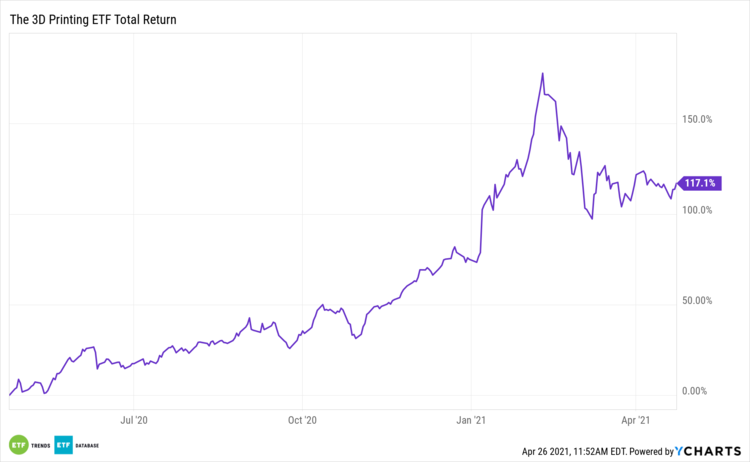
PRNT 1 Year Total Return

More on Ark's 'PRNT'

PRNT is the first U.S.-listed ETF dedicated to the 3D printing theme. The fund is one of two passively managed products from New York-based Ark Investment Management. ARK believes 3D printing will revolutionize manufacturing by collapsing the time between design and production, reducing costs, and enabling greater design complexity, accuracy, and customization than traditional manufacturing.

PRNT’s roster “is composed of equity securities and depositary receipts of exchange-listed companies from the U.S., non-U.S. developed markets and Taiwan that are engaged in 3D printing-related businesses within the following business lines: (i) 3D printing hardware, (ii) computer-aided design (‘CAD’) and 3D printing simulation software, (iii) 3D printing centers, (iv) scanning and measurement, and (v) 3D printing materials,” according to Ark.

Declining costs plays an integral role in 3D printing adoption, as well as the underlying investment thesis. The same goes for the wide variety of sector-level applications for the technology, including both healthcare and industrials.

“There are fundamental factors at play, too. 3-D printing companies saw renewed interest amid the pandemic from healthcare companies looking for help in producing medical supplies. The technology was able to help create nasal swabs, critical-care ventilators and face masks to bridge the gaps caused by supply shortages and delays from traditional manufacturers,” adds the Journal.

For more on disruptive technologies, visit our Disruptive Technology Channel.


Content continues below advertisement

Loading Articles...

Advertisement

Is Your Portfolio Positioned With Enough Global Exposure?

ETF Education Channel

How to Allocate Commodities in Portfolios

Tom LydonApr 26, 2022
2022-04-26

A long-running debate in asset allocation circles is how much of a portfolio an investor should...

Core Strategies Channel

Why ETFs Experience Limit Up/Down Protections

Karrie GordonMay 13, 2022
2022-05-13

In a digital age where information moves in milliseconds and millions of participants can transact...

}
X
