

ETFdb Logo
  • ETF Database
  • Content Hubs
    • Themes
      • Active ETF
      • Alternatives
      • Artificial Intelligence
      • China Insights
      • Core Strategies
      • Crypto
      • Disruptive Technology
      • Energy Infrastructure
      • ETF Building Blocks
      • ETF Investing
      • ETF Strategist
      • Financial Literacy
      • Fixed Income
      • Free Cash Flow
      • Future ETFs
      • Innovative ETFs
      • Institutional Income Strategies
      • Leveraged & Inverse
      • Market Insights
      • Market Outlooks
      • Modern Alpha
      • Nuclear Energy
      • Portfolio Strategies
      • Sector Investing
      • Tax Efficient Income
      • Thematic Investing
    • Asset Class
      • Equity
        • U.S. Equity
        • Int'l Developed
        • Emerging Market Equities
      • Alternatives
        • Gold/Silver/Critical Materials
        • Cryptocurrency
        • Currency
        • Volatility
      • Fixed Income
        • Investment Grade Corporates
        • US Treasuries & TIPS
        • High Yield Corporates
        • Int'l Fixed Income
    • ETF Ecosystem
    • ETFs in Canada
    • Market Outlook
    • Crypto ETF Hub
  • Tools
    • ETF Screener
    • ETF Country Exposure Tool
    • ETF Database Categories
    • Indexes
    • Scenario Analysis
    • Watchlists
    • Head-To-Head ETF Comparison Tool
    • Mutual Fund To ETF Converter
    • ETF Stock Exposure Tool
    • ETF Issuer Fund Flows
  • Research
    • ETF Education
    • Equity Investing
    • Dividend ETFs
    • Leveraged ETFs
    • Inverse ETFs
    • Index Education
    • Index Insights
    • Top ETF Sectors
    • Top ETF Issuers
    • Top ETF Industries
  • Webcasts
  • Sectors
    • Sector Investing Content Hub
    • XLK
    • XLI
    • XLU
    • XLY
    • XLP
    • XLRE
    • Sector Power Rankings
    • XLE
    • XLC
    • XLF
    • XLV
    • XLB
  • Multimedia
    • ETF 360 Video Series
    • ETF of the Week Podcast
    • Gaining Perspective Podcast
    • ETF Prime Podcast
    • Video
  • Company
    • About VettaFi
  • PRO
    • Pro Content
    • Pro Tools
    • Advanced
    • FAQ
    • Free sign up
    • Login
  1. Disruptive Technology Content Hub
  2. Wright’s Law Arrives In Key Space Investment Segment
Disruptive Technology Content Hub
Share

Wright's Law Arrives In Key Space Investment Segment

Tom LydonSep 29, 2021
2021-09-29

Recently, several companies, including Virgin Galactic (SPCE) and Elon Musk’s SpaceX, executed successful space flights.

Those headlines stoked interest in exchange traded funds, such as the ARK Space Exploration and Innovation ETF (ARKX ). While that’s a positive in terms of generating interest in the space investment thesis, investors should note that space is about much more than tourism. To that end, it’s important to locate assets that offer far-reaching space investing — a goal accomplished by ARKX.
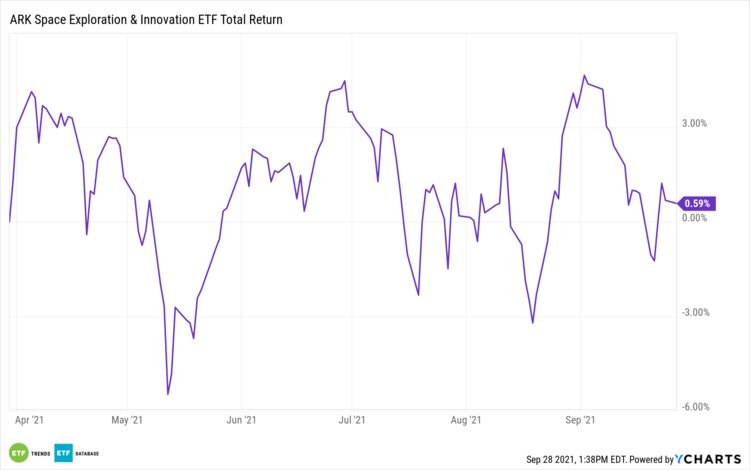
ARK Space Exploration Innovation ETF

ARKX’s reach throughout the space ecosystem is relevant at a time when the effects of Wright’s Law are becoming evident in the satellite bandwith industry, which ARKX has exposure to. Wright’s Law is used to forecast price declines that arise via increases in cumulative production. The core of Wright’s Law is that for every doubling in cumulative output, costs should decline by a fixed percentage.

“According to ARK’s research, since 2004 the cost of satellite bandwidth has dropped 7,500-fold from $300,000,000/Gigabits per second (Gbps) to $40,000/Gbps. ARK’s research suggests that it could fall another 40-fold during the next five years to ~$1,000/Gbps thanks to Starship, SpaceX’s next-generation rocket, and its next-generation satellites,” according to ARK Investment Management.

One of the groups the actively managed ARKX features exposure to is orbital aerospace companies, and that’s the source of the fund’s satellite exposure. For investors, that satellite exposure is relevant because the industry isn’t driven by space tourism and has myriad end markets, including expanding internet access to more of the world. Declining costs also play an important role here.

“We can measure the capital cost of satellite networks in terms of $/Gbps, pointing to the pricing necessary for a given return,” notes ARK. “Currently, SpaceX’s Starlink satellite service offers customers a download speed of roughly megabits per second (Mbps), each Gbps of capacity theoretically serving ten customers at 100 Mbps. Because users are not online 24/7, SpaceX is likely to ‘oversubscribe’ the service. We believe that at an oversubscription ratio of 20, 1 Gbps could serve 200 customers at a capital cost of ~$1,000/Gbps, suggesting that SpaceX could recoup its investment with a one-time charge of $5 per customer.”

As for the impact of Wright’s Law on the satellite bandwidth industry, it’s already at play, and that could bode well for AKRX going forward.

“Importantly, according to ARK’s research, since 2004 satellite bandwidth costs have dropped roughly 40% per year and will continue do so, potentially pushing satellite-delivered broadband toward mass-market adoption for the three billion people around the world who do not have access today,” concludes ARK.

For more news, information, and strategy, visit the Disruptive Technology Channel.


Content continues below advertisement

Loading Articles...

Advertisement

Is Your Portfolio Positioned With Enough Global Exposure?

ETF Education Channel

How to Allocate Commodities in Portfolios

Tom LydonApr 26, 2022
2022-04-26

A long-running debate in asset allocation circles is how much of a portfolio an investor should...

Core Strategies Channel

Why ETFs Experience Limit Up/Down Protections

Karrie GordonMay 13, 2022
2022-05-13

In a digital age where information moves in milliseconds and millions of participants can transact...

}
X
