


Artificial intelligence has brought about a paradigm shift in the diagnostics industry, enhancing the accuracy, speed, and efficiency of disease detection. AI can now process and analyze vast, complex datasets, from medical images and lab reports to genetic data, far beyond human capacity. While AI’s potential in healthcare is vast, one could argue its most significant impact to date has been in medical imaging. Here, algorithms can often outperform human radiologists, particularly in terms of early disease detection.
AI Represents the Latest Great Leap in Diagnostic Technology
| Period | Key Innovation | Impact on Diagnosis |
|---|---|---|
| 1895 | X-rays | Birth of non-invasive structural diagnosis; visualizing bone and foreign objects. |
| 1950s | Ultrasound | Safe, non-invasive visualization of soft tissues and blood flow. |
| 1970s | Computed Tomography (CT) | Cross-sectional imaging; dramatically improved visualization of soft tissue detail over 2D X-rays. |
| 1980s | Magnetic Resonance Imaging (MRI) | Gold standard for soft tissue contrast (brain, spine, joints); eliminated ionizing radiation risk. |
| 2000s | Hybrid Imaging (PET/CT) | Fusion of functional (PET) and anatomical (CT) data, enabling highly specific staging and monitoring in oncology. |
| 2010s–Present | Deep Learning/AI Algorithms | Automation of image analysis, detection of subtle anomalies at human or superhuman speed, and triage prioritization in high-volume settings. |
The U.S Food and Drug Administration (FDA) has approved over one-thousand AI-enabled medical devices, which are now able to provide highly accurate computer-aided detection for subtle findings, such as lung nodules on CT scans or microcalcifications in mammography. The technology can identify patterns that could have easily been missed by the unaided human eye. This capability is facilitating proactive diagnostic triage, ensuring critical cases that may require urgent intervention are prioritized for immediate human review.
This shift toward AI-enabled workflows is being driven by established players in the sector: GE HealthCare (GEHC), Siemens Healthineers (SHL), and Royal Philips (PHG). These companies have moved beyond simply manufacturing hardware (MRI, CT, PET scanners) to embedding augmented intelligence directly into their platforms.
This strategy focuses on two concepts: image acquisition enhancement and workflow optimization. Image acquisition enhancement uses AI to optimize the scanner, reduce noise, and cut scan times. Some of the products doing this today are GE HealthCare’s AIR Recon DL for MRI, which uses deep learning to produce clearer images, and Philips’ SmartSpeed acceleration technology, which can generate sharper images up to three times faster than previous methods. Workflow optimization can be seen in Siemens Healthineers’ AI-Rad Companion, a suite that automatically processes images, quantifies findings, and prioritizes urgent cases for the radiologist.
AI Delivers Faster Scans & Automated Insights for Maximum Image Usability
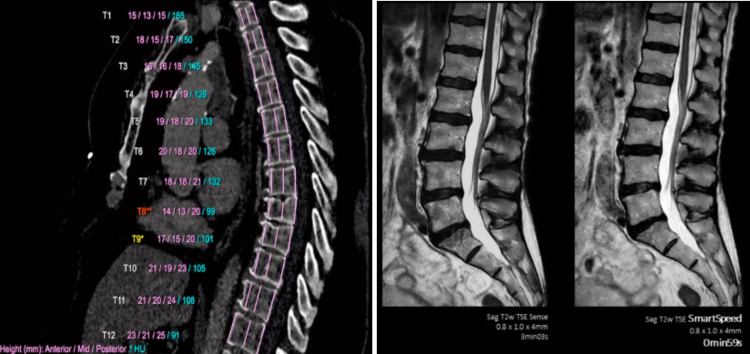
Smaller players, such as Hologic (HOLX), which specializes in women’s health, have also developed similar AI applications. Its Genius AI Detection Solution for 3D mammography provides a Case Score and Reading Priority Indicator to help clinicians quickly triage and review the most concerning cases.
This synergistic approach by these companies is key to automating repetitive tasks, and in turn achieving consistent diagnostic quality, maximizing asset utilization, and addressing the critical worker shortage.
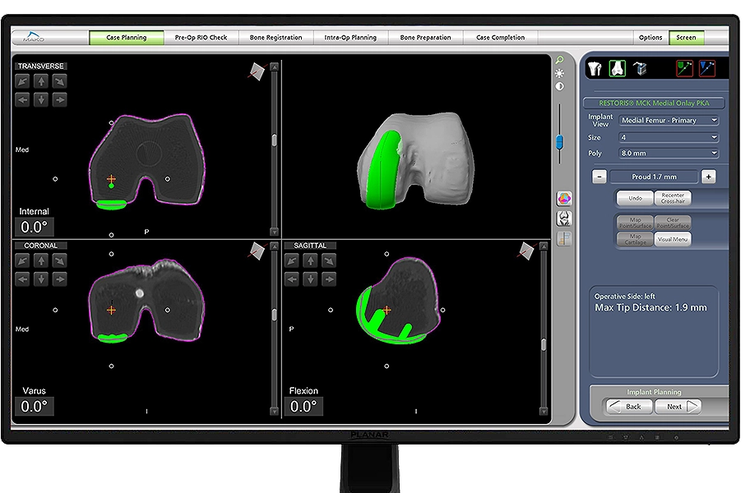
Other areas also feel the benefits of these advancements in imaging and system integration. In robotic surgeries, for example, surgical parameters are often established pre-operatively, using three-dimensional, highly accurate visualizations of the human body created by AI from medical scans. Systems like Stryker’s Mako and Intuitive’s da Vinci allow surgeons to overlay these surgical parameters on the patient’s anatomy, which then feed high-precision haptic feedback systems. This advanced planning drives faster, safer procedures, with better outcomes.
AI Imaging Software Allows Surgeons to Fully Pre-Plan Operations
The AI revolution has come at a crucial time for healthcare. The systemic challenges facing society are becoming ever more relevant. An aging population, labor shortages, and continuously increasing costs of care require new approaches and new technologies. AI will no doubt play a big role in solving these issues in the long run. However, its impact is already being felt today. Thanks to the AI-enabled advances in imaging technology, available resources can be used much more efficiently. This is translating into significant economic value, a lower total cost of care, and ultimately better patient outcomes.
The ROBO Global Healthcare Technology and Innovation Index (HTEC) delivers diversified exposure to companies at the forefront of leveraging AI across the entire healthcare spectrum. This includes core areas like diagnostics, drug discovery, and precision medicine, as well as other emerging technologies.
Related Research
An AI Fix for Healthcare’s $2 Trillion Flaw
RNAi: The Benefits of Shooting the Messenger
Looking for regular updates? Subscribe here for weekly insights on robotics, AI, and healthcare technology, delivered straight to your inbox.
For more news, information, and analysis, visit our Disruptive Technology Content Hub.
HTEC is the underlying index for the Robo Global Healthcare Technology & Innovation ETF (HTEC) and the L&G Healthcare Technology & Innovation UCITS ETF (DOCT.LN).
VettaFi is the index provider for HTEC ETF and DOCT.LN, for which it receives an index licensing fee. However, HTEC ETF and DOCT.LN are not issued, sponsored, endorsed, or sold by VettaFi. VettaFi and its affiliates have no obligation or liability in connection with the issuance, administration, marketing, or trading of HTEC ETF and DOCT.LN.

