

It may not have been on your investment bingo card, but one of the surprising outperforming investment themes this year has been clean energy. One catalyst has been the growing electricity demands related to the rise of AI. There has been a massive build-out of data centers and a ramp-up in electric transportation, and they all require more electricity. This has boosted demand for gas, solar, wind, and other alternative energy sources, including nuclear.
Continued technological advances are also making clean energy sources more cost-effective and efficient. 2024 saw record installation numbers for solar and battery storage. In the U.S., installed solar capacity grew to 50 gigawatts, a 21% YOY increase over 2023 levels. Solar and battery storage accounted for 84% of new electricity generation capacity added in 2024.
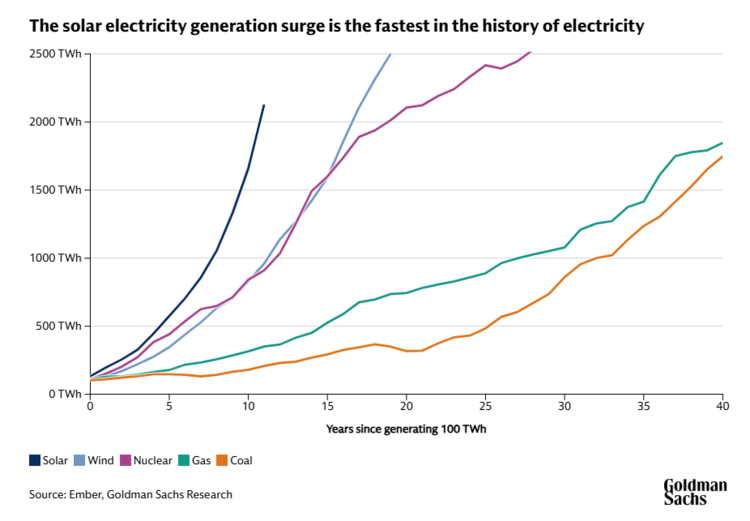
Globally, Goldman Sachs projects that global solar installations are set to increase to 914 Gigawatts by 2030, a 57% increase over 2024 levels. Solar and battery storage represent one of the cheapest near-term solutions, cheaper than coal and fossil fuels. The surge in solar electricity is the fastest in the history of electricity.
China is at the forefront of clean energy investment, pouring 6.8 trillion yuan ($940 billion USD) in 2024, a 40% increase over 2023 levels. The triad of EVs, batteries, and solar is attracting more than half of the clean energy investment in China, representing 10% of China’s GDP
Clean Energy ETFs
Clean energy ETFs invest in stocks in the alternative energy sector, including solar energy, wind, hydroelectric, and geothermal companies. Despite lackluster flows for clean energy investments amid backlash for ESG investments, there is a long list of clean energy ETFs that have delivered performance in excess of 20% this year. Focus and ETF compositions do vary, however, so let’s take a closer look.
| Symbol | ETF Name | Total Assets $ Millions | YTD Performance | Expense Ratio |
|---|---|---|---|---|
| FRNW | Fidelity Clean Energy ETF | $30 | 35.57% | 0.4 |
| VCLN | Virtus Duff & Phelps Clean Energy ETF | $8 | 34.15% | 0.59 |
| FAN | First Trust Global Wind Energy ETF | $4,191 | 30.94% | 0.6 |
| CTEC | Global X CleanTech ETF | $24 | 30.57% | 0.5 |
| ICLN | iShares Global Clean Energy ETF | $1,581 | 30.26% | 0.41 |
| KGRN | KraneShares MSCI China Clean Technology Index ETF | $61 | 29.22% | 0.79 |
| PBW | Invesco WilderHill Clean Energy ETF | $357 | 27.70% | 0.65 |
| PBD | Invesco Global Clean Energy ETF | $83 | 26.56% | 0.75 |
| TAN | Invesco Solar ETF | $723 | 26.48% | 0.71 |
| RNWZ | Elevation Series Trust - Trueshares Eagle Global Renewable Energy Income ETF | $3 | 23.89% | 0.75 |
| SOLR | SmartETFs Sustainable Energy II ETF | $4 | 22.80% | 0.79 |
| CTEX | Proshares S&P Kensho Cleantech ETF | 41.33 | 22.06% | 0.58 |
| CNRG | SPDR S&P Kensho Clean Power ETF | $150.10 | 21.78% | 0.45 |
FRNW and VCLN's Clean YTD Returns
At the top of this year’s clean energy performance board is the Fidelity Clean Energy ETF (FRNW ). This passively managed ETF may have only gathered $30 million in assets since its launch in October of 2021, but its year-to-date performance has been stellar, up more than 35%. The ETF invests in global companies producing or supporting clean energy such as solar, wind, and hydrogen. On a sector basis, the ETF has a significant allocation to utilities, comprising almost half of the fund.
Close behind in terms of YTD performance is the actively managed Virtus Duff & Phelps Clean Energy ETF (VCLN ), up 34%. The ETF is less utilities-focused, with its largest holding being a solar producer, First Solar. This ETF also launched in August 2021, and has failed to capture much in the way of inflows, with only $8 million in assets. But its approach has obviously delivered this year, from a return standpoint.
FAN Faces Headwinds, EVs Drive KGRN
Despite Trump Administration headwinds for wind power, First Trust’s Global Wind Energy ETF (FAN ) has been a big winner this year as well, up 31%. But the negative political environment for clean energy stocks in the U.S. is a valid risk consideration. President Trump just declared that his administration will not approve any new solar or wind power projects, escalating his campaign against renewable energy development. “We will not approve wind or farmer destroying Solar,” Trump posted on Truth Social
Given U.S. political headwinds against clean energy, the KraneShares MSCI China Clean Technology Index ETF (KGRN ) might offer an attractive alternative to gain exposure to the growth of this theme. China appears to be “all in” on clean energy investment, especially in the area of electric vehicles. KGRN’s largest holdings are EV car makers XPeng, Li Auto, Nio, and BYD, with additional considerable exposure to EV battery maker Contemporary Amperex Technology Ltd. (CATL).
At least in this year’s rearview mirror, clean energy ETFs have been surprising outperformers. Whether that is “sustainable” in the U.S., given the political climate, remains to be seen. Data center growth and electric transportation are expected to drive U.S. electricity demand 2% higher each year for the next quarter century, according to a new study completed for the National Electrical Manufacturers Association (NEMA). Regardless of the source, this will require a lot of investment in energy infrastructure.
For more news, information, and analysis, visit our Disruptive Technology Content Hub.

