


The pandemic was a wake-up call for many companies, highlighting the fragility of their supply chains. After the pandemic, nearshoring, or the act of moving business production closer to home to neighboring countries, has become an important disruptive theme. It has the potential to provide a more stable, faster, and economical method of production.
Helped by its close physical proximity to the U.S. and the U.S-Mexico-Canada Agreement (USMCA), the updated version of NAFTA passed on July 1, 2020, Mexico has become the biggest beneficiary of U.S. company efforts to nearshore. Mexico is also rich in natural resources and has many labor cost advantages. In general, wages in Mexico are higher than in China, but the closer proximity helps offset those costs.
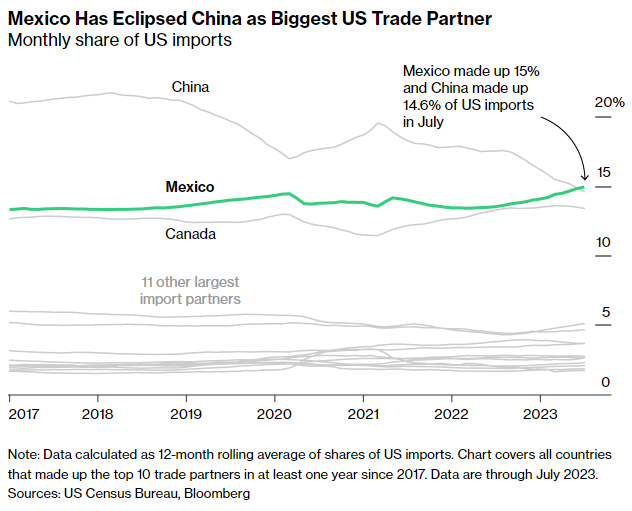
U.S. foreign direct investment in Mexico hit $30 billion last year, with money coming from a range of large multinationals. The list includes such names as LEGO, Honeywell, Mondelez, and Tesla. That’s right—LEGO has a huge factory and distribution center located in Monterrey, Mexico. Last July, Mexico displaced China as the leading trading partner to the United States, regaining a position it hasn’t held since 2003.
Outside of North America, nearshoring is also a theme benefiting regions such as Central and Eastern Europe, and North Africa as well. One example during the pandemic was Spanish fashion retailer Zara’s nearshoring strategy. By quickly leveraging production facilities in Europe as opposed to distant suppliers in Asia, it was able to avoid a lot of the logistical challenges of its competitors and gain market share.
Technology is also a key driver behind the nearshoring trend. By adopting new manufacturing technologies such as advanced robotics, automation, and artificial intelligence, companies can enhance their productive capacity and lower labor costs, allowing them to move production closer to home.
Nearshoring
VettaFi recently developed the North American Nearshoring Index and the European Nearshoring Index. Both give exposure to this growth trend, and a few ETF products in the marketplace also provide this exposure.
One such ETF is the Aztlan North America Nearshoring Stock Selection ETF (NRSH ), a passive ETF that invests in North America-based stocks that directly benefit from the nearshoring phenomenon. Tema has also launched an actively managed American Reshoring ETF (RSHO ) that attempts to capture what it calls the “renaissance of American industrial manufacturing and onshoring.”
Interestingly, the return profiles of these two ETFs are polar opposites, with NRSH down 7.2% YTD and RSHO up 6.8% for the same period. The ETFs only have a 2% overlap in holdings, with NRSH’s exposure all located geographically in North America, while RSHO has a 25% weight in Europe. This aligns with our index performance, which shows European nearshoring outpacing North American nearshoring YTD.
Over the last year, Tema’s active ETF RSHO has significantly outperformed in terms of performance and investor interest. NRSH, launched last November, has $10 million in assets under management, while RSHO, incepted in May 2023, has gathered $72 million.
Supply Chain
There are also many ETFs focused on the reimagining of the modern supply chain. These include the TCW Transform Supply Chain ETF (SUPP ), the ProShares Supply Chain Logistics ETF (SUPL ), and the Pacer Industrials and Logistics ETF (SHPP ). Among these offerings, SUPP is by far the winner in terms of YTD performance, up an impressive 14.2% YTD. But this active ETF, launched only a little over a year ago, in February 2023, has only attained slightly more than $15 million in assets.
Robotics and Automation
Finally, technologies that support more efficient manufacturing are an important part of the nearshoring theme, helping to reduce costs and improve output. There are many ETFs that provide exposure to the robotics and automation theme, including pure plays like the $1.2 billion ROBO Global Robotics and Automation ETF (ROBO ), which tracks a ROBO/VettaFi Index. There are also hybrid approaches that also include artificial intelligence with a predominant focus on robotics including the Global X Robotics & Artificial Intelligence ETF (BOTZ ) and the iShares Robotics and Artificial Intelligence ETF (IRBO ).
Performance-wise, this has been a massive year for AI-related stocks like Nvidia (NVDA) and Super Micro Computer (SMCI) in terms of returns. As a result, pure-play robotics ETFs have trailed their hybrid peers in performance but are more aligned with the nearshoring theme.
For more news, information, and analysis, visit our Disruptive Technology Channel.
VettaFi LLC (“VettaFi”) is the index provider for ROBO, for which it receives an index licensing fee. However, ROBO is not issued, sponsored, endorsed or sold by VettaFi, and VettaFi has no obligation or liability in connection with the issuance, administration, marketing, or trading of ROBO.

