


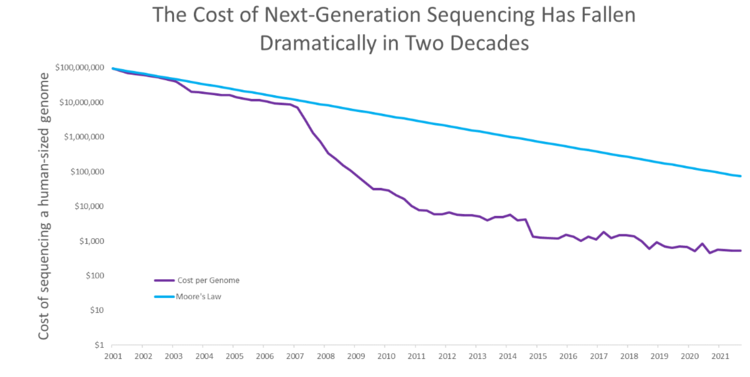
The future of healthcare is being forged at the intersection of biology and technology. Much like software and data analytics reshaped industries like finance and retail, a similar transformation is now creating a new landscape for investors in medicine. Genomics stands at the forefront of this revolution. For the last two decades, the defining story in this field was a race to slash the cost of sequencing a human genome, with prices plummeting at a rate that outpaced even Moore’s Law.
This achievement turned DNA sequencing from a billion-dollar research project into a powerful clinical tool available globally. However, the true value today has shifted from simply reading the genetic code to interpreting and acting on it. The investment opportunity lies with the innovators turning this data deluge into actionable medical insights.
The Sequencing Revolution & the Data Deluge
The engine behind this revolution is a technology known as Next-Generation Sequencing (NGS). The field is dominated by instrument makers like Illumina (ILMN). Its sequencing machines have become ubiquitous workhorses of research labs and clinics worldwide. By running millions of DNA sequencing reactions in parallel, these platforms created an entirely new global resource: a tsunami of biological data projected to reach into the exabytes. This success created a “high-class problem”: How can a clinician possibly sift through this mountain of information to find a single, clinically relevant mutation in a patient’s three-billion-letter genome? The answer lies not in more sequencing, but in smarter software and analytics.
The Liquid Biopsy: Finding Cancer in a Blood Draw
One of the most powerful applications of NGS is the liquid biopsy. For decades, the gold standard for diagnosing cancer was a tissue biopsy — an invasive and often painful procedure. Today, a similar, and in some cases better, result can be achieved with a simple blood draw.
Constituents of the ROBO Global Healthcare Technology and Innovation Index (HTEC) are applying this technology in two powerful ways. The first is for cancer detection and screening, where leaders like Guardant Health (GH) and GRAIL (GRAL) are at the forefront. Their powerful tests can provide deep genomic information on a patient’s tumor. They can also screen for dozens of cancer types from a single blood draw. The second is for post-treatment monitoring, where both Natera (NTRA) and Adaptive Biotechnologies (ADPT) are leaders in minimal residual disease testing. Their highly sensitive tests detect trace amounts of cancer that may remain. This provides the earliest possible sign of a potential recurrence.
By analyzing everything from circulating tumor DNA (ctDNA) to cancerous immune cells, these tests are unlocking a new frontier in oncology. This market is projected to grow at a CAGR of over 20% through 2030.
Companion Diagnostics: The Key to Precision Medicine's Lock
If a liquid biopsy is about finding the disease, a companion diagnostic (CDx) is about finding the right cure. Many of today’s most effective drugs are targeted therapies. But they create a “lock-and-key” problem. The drug is the key, but it’s useless without first finding the right lock. A CDx is the essential test that finds that lock by identifying a specific biomarker in a patient. This “test-and-treat” model is a core focus for HTEC constituents like Roche Holding AG (ROG) and Agilent Technologies (A). Roche develops CDx tests to guide treatments for specific breast and lung cancers. Agilent’s diagnostics are crucial for identifying biomarkers that predict a patient’s response to immunotherapies. By ensuring innovative drugs are given to the patients most likely to benefit, these firms have become indispensable partners to the biopharma industry.
A Broader Ecosystem of Innovation
The genomics revolution is supported by a broad ecosystem of enabling technologies. This includes foundational toolmakers like Twist Bioscience (TWST), which manufactures the synthetic DNA essential for research and development. It also depends on making sense of the data generated. Companies like Tempus AI (TEM) apply AI to structure vast clinical and molecular data sets. This helps physicians make faster, data-driven decisions via tools like their AI-enhanced pathology reviews. This innovation is also creating entirely new fields, such as genomics-based organ health, where firms like NTRA and CareDx (CDNA) have developed tests that help physicians assess the risk of organ transplant rejection.
A Targeted Approach to Innovation
The picture that emerges is not of a single breakthrough, but of a deeply interconnected ecosystem where advances in hardware, diagnostics, and software fuel one another. For investors, this underscores the rationale for a strategy that provides exposure across the entire value chain. An index like HTEC is constructed to capture this complete ecosystem, offering a targeted investment in the whole revolution, not just a single component. While still in its early innings, the convergence of genomics and advanced computation is charting the course for the future of medicine, moving us ever closer to a world where healthcare is truly predictive, personalized, and proactive.
Related Research:
Beyond Broad Healthcare: A Smarter Prescription for Growth
Looking for regular updates? Subscribe here for weekly insights on robotics, AI, and healthcare technology, delivered straight to your inbox.
For more news, information, and analysis, visit our Disruptive Technology Content Hub.
HTEC is the underlying index for the Robo Global Healthcare Technology & Innovation ETF (HTEC) and the L&G Healthcare Technology & Innovation UCITS ETF (DOCT.LN).
VettaFi is the index provider for HTEC ETF and DOCT.LN, for which it receives an index licensing fee. However, HTEC ETF and DOCT.LN are not issued, sponsored, endorsed, or sold by VettaFi. VettaFi and its affiliates have no obligation or liability in connection with the issuance, administration, marketing, or trading of HTEC ETF and DOCT.LN.

