


Artificial intelligence (AI) is no longer just a buzzword — it’s becoming an essential tool in industries worldwide, including wealth management. At our recent webcast, AI and Wealth Management: Tools, Trends, and Investment Opportunities, we surveyed financial advisors on three key questions:
- Where are advisors most interested in using AI?
- What’s stopping them from adopting AI?
- How long do they think it will take to get started with AI?
The following is what we learned from their responses — and what it means for the future of wealth management.
Where Advisors See the Most Potential in AI
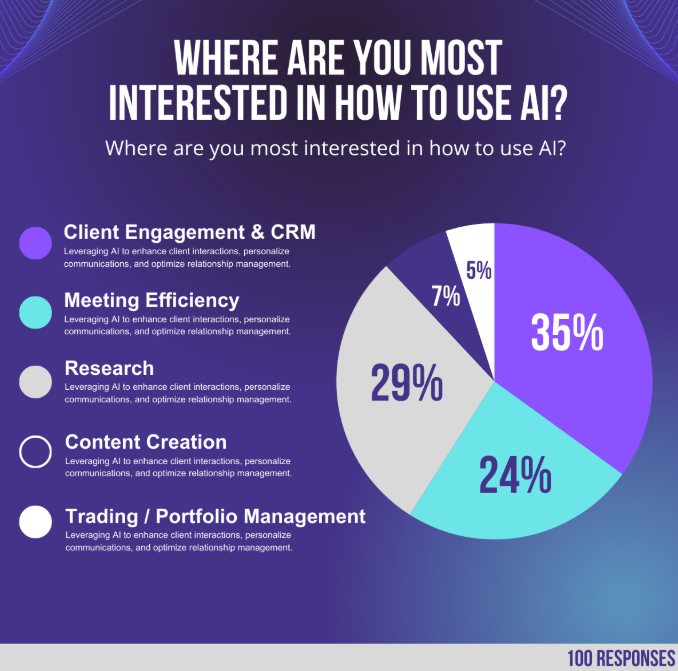
Advisors were asked which areas of their practice they’re most interested in enhancing with AI. The results? The majority pointed to client engagement and CRM tools (35%). These areas are ripe for transformation as advisors look for ways to enhance personalization, improve communication, and streamline workflows.
Other high-priority areas included:
- Research (29%) – Using AI for market analysis, trend forecasting, and identifying investment opportunities.
- Meeting efficiency (24%) – Streamlining preparation, scheduling, and follow-ups with AI tools.
Interestingly, only 5% of respondents saw AI’s immediate potential in trading and portfolio management. This aligns with current market readiness — AI tools for client engagement and administrative tasks are more mature and accessible than those for complex investment decisions.
Barriers to AI Adoption
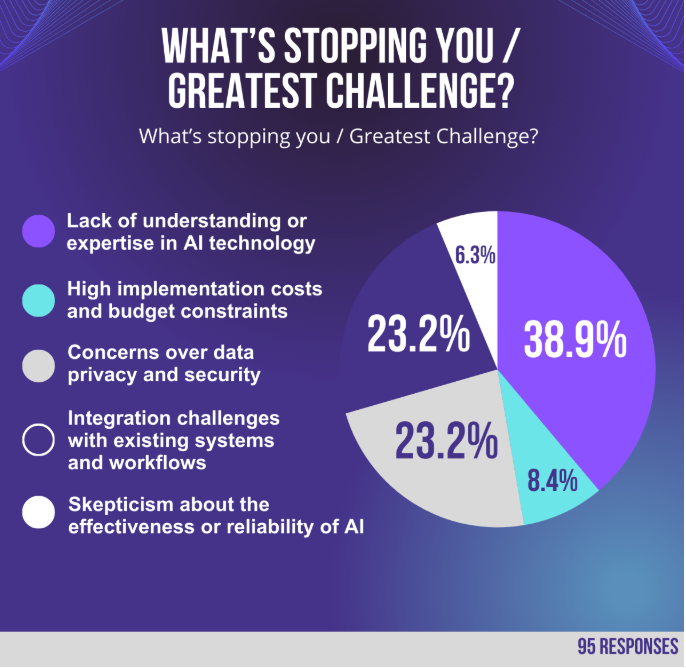
When asked about the biggest obstacles to implementing AI, a majority (39%) cited a lack of understanding or expertise in AI. This highlights a significant educational gap — many advisors are still learning what AI is, how it works, and how it can benefit their practices.
Other challenges included:
- Concerns over data privacy and security (23%)
- Integration challenges with existing systems (23%)
- Costs associated with AI tools (8%)
The hesitancy around privacy and security is well-founded, given the sensitive nature of financial data. However, advisors can take comfort in knowing that many large institutions, including Morgan Stanley and LPL, are already implementing compliant, secure AI tools successfully.
How Long Will It Take to Get Started?
Implementing AI might seem daunting, so we asked advisors how long they expect it would take to integrate an AI solution into their workflows.
Here’s the breakdown:
- 6 months: 55%
- 1 year: 20%
- 1 month: 14%
- 1 day: 9%
This shows that while advisors recognize the time investment required, many underestimate the availability of off-the-shelf tools that can be implemented quickly. For example, meeting-focused AI tools like Jump AI can be set up and running in just a day. On the other hand, larger projects — such as integrating AI into portfolio management or building custom solutions — may take six months to a year.

Key Takeaways for Advisors
- Start Small: Many AI solutions, like CRM integration and meeting transcription tools, are plug-and-play. They can save significant time and streamline processes without overhauling existing systems.
- Focus on Education: Advisors need more resources and training to understand AI’s potential. Partnering with experts or consultants, like Evo Wealth Consulting, can help identify practical applications and create a step-by-step adoption plan.
- Prioritize Data Security: Choose AI tools with robust compliance measures and privacy protections. Look for tools that align with your firm’s regulatory requirements to ensure peace of mind.
- Leverage Off-the-Shelf Tools: Don’t wait for the perfect solution. Tools like generative AI assistants for meeting prep and follow-up can deliver immediate benefits with minimal setup time.
Learn More & Get Started
AI holds transformative potential for wealth management, but adoption requires strategic planning and a willingness to start small. Advisors have the opportunity not only to use AI for efficiency and improved client relationships but also to invest in companies driving AI innovation, potentially capturing growth from this rapidly evolving field.
To dive deeper into the tools, trends, and strategies discussed, we invite you to watch the full webinar recording. You’ll learn from industry experts about practical AI applications, hear case studies of firms already leveraging AI, and discover ways to align your advisory practice with emerging investment opportunities in artificial intelligence.
For more news, information, and analysis, visit our Disruptive Technology Channel.

