


Nvidia (NVDA) has been one of the most interesting stocks of the year. The company isn’t new to disruptive technology and has been known for its innovations in computer graphics and gaming years before it became a household name. But recent growth in technology, particularly artificial intelligence has boosted its popularity and its outlook. Analysts and investors have been looking for reasons to call the stock overvalued, but the stock continues to soar and has so far been up around 170% YTD. Although the company already makes up a large portion of the S&P 500 (over 6%), many investors are investing directly in Nvidia stock to capture that additional growth. But for those who are looking beyond Nvidia or are looking for ways to supplement their existing investment, there is also strength in the broader semiconductor industry. This note starts with a brief overview of the semiconductor industry, individual companies, and ETF options for investors.
The semiconductor industry as a whole has high growth potential.
Semiconductors are the backbone of the technology sector and power devices from consumer electronics to heavy machinery. This growth has been propelled by greater connectivity — just think of how many electronic devices you own and how many of them are connected to the internet compared to ten years ago. Data centers, which support the growth of cloud computing and artificial intelligence, have also been a hot topic among investors recently (see my recent note on the utilities sector).
According to the latest data from the Semiconductor Industry Association, global semiconductor sales were $53.1 billion in August — a record for August and a 20.6% year-over-year increase. But not all of this growth is from Nvidia — which is why many investors choose to invest in the industry as a whole.
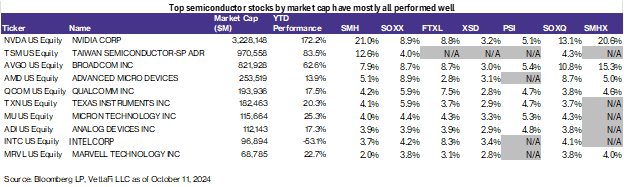
From a market cap perspective, Nvidia does have a strong lead against its peers. Nvidia’s market cap is $3.4 trillion—slightly less than Apple (AAPL) with $3.5 trillion. The next largest semiconductor companies are Taiwan Semiconductor (TSM) which has a market cap of $996 billion and Broadcom (AVGO) which has a market cap of $847 billion. But market capitalization is based on stock prices, which are largely based on investor sentiment.
From a revenue perspective, however, Nvidia doesn’t necessarily dominate. In its latest fiscal year, Nvidia’s gross revenues were just above $60 billion. Taiwan Semiconductor’s top-line revenues were just above $70 billion. While Nvidia has received the benefit of higher investor sentiment relative to its peers, the entire industry has potential growth opportunities.
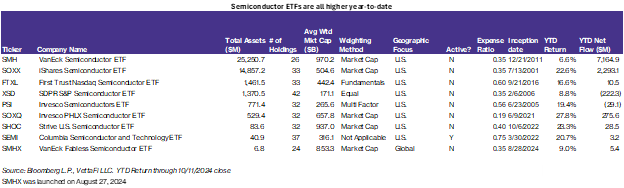
There are several semiconductor ETFs to choose from, including leveraged products:
- The VanEck Semiconductor ETF (SMH ): This is the largest ETF of the group with over $25 billion in assets. This is also the best-performing ETF out of its (unleveraged) peers — up over 47% YTD compared to its peers, which are up in the 20% range. It also has the most exposure to Nvidia (a 21% weighting). It tracks an index of the 25 largest and most liquid U.S.-listed companies (including depositary receipts) in the semiconductor industry. Constituents must generate at least 50% of their revenue from semiconductors. VanEck also offers the VanEck Fabless Semiconductor ETF (SMHX ) — similar to SMH, it includes only fabless companies (asset-light companies that focus on chip innovation while outsourcing manufacturing). This means that the ETF excludes some big names like Taiwan Semiconductor, Texas Instruments (TXN), and Intel Corp (INTC). The ETF is up only 9.0% this year; however, the ETF was launched on August 27, 2024. If you compare SMH vs. SMHX over that same period, SMHX actually outperformed SMH (up only 6.6%).
- iShares Semiconductor ETF (SOXX ): This is the oldest ETF of the group and is relatively straightforward. Like SMH, it follows a market-cap weighted index with slightly more (30) constituents. Holdings among the two look very similar besides some of the smaller holdings. One of the main differences, however, is capping. While SMH holds 21% of its weight in Nvidia, SOXX has approximately 9% weighting in each of Advance Micro Devices, Nvidia, and Broadcom.
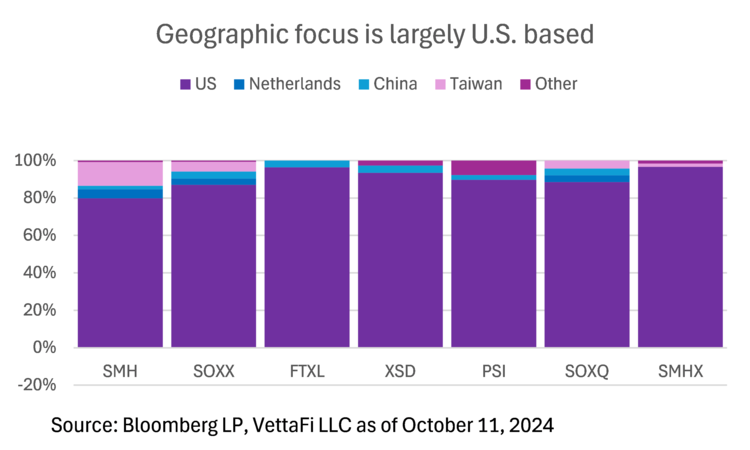
- First Trust Nasdaq Semiconductor ETF (FTXL ): Unlike the peers that we’ve discussed so far, FTXL uses a more complex modified factor weighted index which ranks securities based on: 1) trailing 12-month return on assets, 2) trailing 12-month gross income, and 3) momentum. These are weighted based on trailing 12-month cash flow with a max cap of 8%. This ETF also does not hold Taiwan Semiconductor.
- SPDR S&P Semiconductor ETF (XSD ): This ETF follows a modified equal-weight index, which gives it the least exposure to Nvidia among its peers and more exposure across large-, mid, and small-cap stocks.
- Invesco Semiconductors ETF (PSI ): This ETF contains 30 U.S. semiconductor companies that were selected based on factors like price momentum, earnings momentum, quality, management action, and value. Invesco also offers the Invesco PHLX Semiconductor ETF (SOXQ ) — another ETF of 30 U.S. semiconductor companies—but these are selected by market cap. SOXQ has an expense ratio 19 bps, while its next cheapest peer is 35 bps.
- Other smaller semiconductor ETFs include the Strive U.S. Semiconductor ETF (SHOC ) and the Columbia Semiconductor and Technology ETF (SEMI ). Notably, there are also several leveraged semiconductor ETFs. The largest is the Direxion Daily Semiconductors Bull 3X Shares ETF (SOXL ), which aims to produce 300% performance of the NYSE Semiconductor Index (the same index that SOXX tracks). Its short counterpart is the Direxion Daily Semiconductors Bear 3x Shares ETF (SOXS ). There are also several single-stock ETFs targeting Nvidia like the GraniteShares 2x Long NVDA Daily ETF (NVDL ).
For more news, information, and analysis, visit our Disruptive Technology Channel.

