

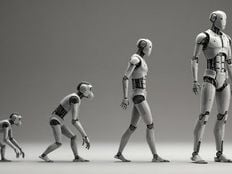
In 2000, a “robot” mostly meant a caged arm bolted to a car line, repeating one welded seam. Most could not see, none could leave their cells unsupervised, and a full installation ran into six figures. Twenty-six years later, robots place electronics faster than the eye can track, walk warehouse aisles beside people, assist in surgery, and drive paying passengers with no one in the seat. The clearest way to show the jump is with numbers, at four checkpoints: 2000, 2010, 2020, and today. They map closely onto the constituents of the ROBO Global Robotics & Automation Index (ROBO) and the ROBO Global Artificial Intelligence Index (THNQ).
Key Takeaways (as of June 2026):
- What a robot is has changed completely: in 2000 it was a blind, caged arm; today it sees, walks warehouse aisles beside people, assists surgeons, and drives passengers, placing electronic components several times faster than the machines of 2000.
- Whole categories that were not commercial in 2000 now ship at scale. Collaborative robots (Universal Robots, owned by Teradyne (TER) with 100,000+ sold) and surgical systems (Intuitive Surgical (ISRG), a da Vinci base of 11,395 systems as of Q1 2026), plus robotaxis, and humanoids.
- Scale shows in the base, about 4.66 million industrial robots in 2024 with an estimated 575,000 more installed in 2025, and in the index: ROBO holds 76 constituents, with FANUC and Yaskawa among its largest holdings at the Q4 2025 rebalance.
See more: ROBO and THNQ Index Rebalance Shifts Weight Toward AI Backbones and Physical Automation
The most telling column in each table below is the far right: the categories that did not exist in 2000 and bill customers now.
Making Things: Precision Assembly and Machine Vision Got Faster & Cheaper
Robots do their oldest job, assembly, far faster. Two decades ago the fastest pick-and-place heads were rated in the tens of thousands of placements per hour; today’s top machines advertise peak rates above 100,000 placements per hour under ideal conditions, with sustained output lower. The accuracy behind that speed comes from machine vision, which most 2000-era lines lacked, the reason Cognex (CGNX) anchors ROBO’s vision sleeve.
| Making things | 2000 | 2010 | 2020 | 2024-26 |
|---|---|---|---|---|
| High-speed component placement | tens of thousands/hr | faster multi-head lines | high-speed modular heads | 100,000+/hr at peak (ideal) |
| Machine vision on the line | rare, 2D, slow | 2D mainstream | 3D, deep-learning defect detection | AI vision standard, self-calibrating |
| Force/precision feedback | open-loop, caged | early force sensing | collaborative force limits | tactile + AI grasp planning |
Moving Things: Warehouse Robots and the Jump in Picks Per Hour
Logistics is where robots learned to move among people. A manual picker averages 60 to 80 picks an hour; an autonomous-mobile-robot goods-to-person station runs 300 to 400, and DHL has reported productivity gains of roughly 30% to 180% after deploying Locus robots. Amazon (AMZN, not an index constituent) went from no robots before its 2012 Kiva acquisition to more than 1 million deployed across its network by 2025.
| Moving things | 2000 | 2010 | 2020 | 2024-26 |
|---|---|---|---|---|
| Order picks per worker-hour | 60-80 (manual) | 100-120 (voice-directed) | 200-300 (goods-to-person) | 300-400+ per AMR station |
| Robots in one network (Amazon) | 0 | 0 (Kiva pre-acquisition) | ~200,000 (2019) | 1,000,000+ (2025) |
| Where the robot operates | bolted in a cell | fixed conveyor lines | caged + early AMRs | free-roaming beside people, increasingly in daily life |
What Did Not Exist in 2000: Cobots, Surgical Robots, Robotaxis, and Humanoids
The clearest evidence of progress is the categories that barely existed in 2000. Collaborative robots were not commercial until Universal Robots’ first sale in 2008; it has now sold more than 100,000 and sits in ROBO through parent Teradyne. Robotic surgery, newly cleared in 2000, is now routine: Intuitive Surgical’s da Vinci base reached 11,395 systems as of March 31, 2026, performing about 3.15 million procedures in 2025. Robotaxis were a DARPA research challenge; Waymo (a unit of Alphabet, not a constituent) passed 200 million fully autonomous miles by mid-2026 and runs about 500,000 paid rides a week. Humanoids were Honda’s ASIMO on a stage; in 2026 Morgan Stanley nearly doubled its forecast for China’s humanoid shipments to 50,000 units, and Figure (still private) robots work at a BMW plant.
| Category | 2000 | 2010 | 2020 | 2024-26 |
|---|---|---|---|---|
| Collaborative robots (cobots) | none | first units shipping | 50,000 sold (Universal Robots) | 100,000+ sold, Teradyne-owned |
| Surgical robots (da Vinci installed base) | newly cleared, near zero | 1,752 systems | 5,865 systems | 11,395 systems (Q1 2026) |
| Autonomous robotaxis | DARPA lab demo | test mules | limited geofenced pilots | 200M+ miles, ~500k rides/week |
| Humanoid robots | ASIMO research demo | research only | research + early prototypes | ~50,000 China shipments forecast (MS, 2026) |
Robot Adoption by the Numbers: Installed Base, Density and Falling Cost
Zoom out and the curve is the cleanest signal. The installed base of industrial robots roughly sextupled in two decades, helped by price: the average robot cost about $47,000 in 2011 and roughly $23,000 by 2022, tracking Wright’s Law. Annual installations have topped 500,000 since 2021, with the IFR’s preliminary 2025 read near 575,000. Robot density keeps setting records, reaching a global average of 177 per 10,000 manufacturing workers in 2024, led by South Korea at 1,220.
From Competitive Wedge to National Mandate: How Governments Now Fund Robotics
Automation used to be a private edge; now it is industrial policy. China has treated robotics as a strategic priority for over a decade, from Made in China 2025 through successive five-year plans, and its 2025 Humanoid Robot Action Plan targets 100,000 units by 2027, behind a state guidance fund slated to channel roughly $137 billion into AI and robotics over two decades. Japan’s focus is older still, rooted in its aging workforce, and its new 10.5 trillion yen (about $65 billion) physical-AI plan to 2040 boosts a decades-long effort. The newer entrants are catching up: South Korea unveiled an $880 billion, decade-long chips-and-physical-AI plan aiming to lift its humanoid share from 1% to 20%, the United States signed a 2025 order favoring domestic drones and is weighing a broader robotics order, and the European Union is still assembling its strategy.
When five governments subsidize the same supply chain, demand for industrial arms, machine vision, and motion components gains a policy floor under it.
The Consumer Robotics Cycle and a 2040 Call
The factory came first; the consumer is next, and 2026 is only the entry point. The robot vacuum, anywhere from about $300 to $1,400 depending on model, is still the only autonomous robot most homes actually run. The first consumer humanoids are only starting to appear, quoted around $20,000 for a unit like the 1X NEO and not yet available off the shelf, roughly where the robot vacuum sat in 2003. Goldman Sachs models the humanoid market (robots only) at $38 billion by 2035 and Morgan Stanley the full ecosystem near $5 trillion by 2050. Framed as a research view rather than a trade: by 2040 the consumer humanoid should be reaching into early-majority homes as unit prices fall toward the $15,000 to $50,000 band Morgan Stanley models for mid-century, on the same cheaper-and-more-capable flywheel that carried industrial robots from 757,000 units to 4.66 million.
| Consumer robotics | 2002-2010 | 2026 (entry) | ~2035 | ~2050 |
|---|---|---|---|---|
| Mainstream home robot | Robot vacuum debuts (Roomba, 2002) | Vacuum mature + first consumer humanoids | Humanoids scale in industry first | Humanoids as common as appliances |
| Humanoid units in service | none | early pilots | ~13 million, mostly industrial (Morgan Stanley) | ~930 million, mostly industrial (Morgan Stanley) |
| Humanoid unit price | n/a | ~$20,000 quoted (not yet off-shelf) | falling toward mass-market | ~$15,000 to $50,000 |
| Humanoid market size | n/a | pre-revenue at scale | $38 billion, robots only (Goldman Sachs, 2035) | ~$5 trillion ecosystem (Morgan Stanley, 2050) |
What This Means for ROBO and THNQ Investors
This shows up at the constituent level. The ROBO Global Robotics & Automation Index, the benchmark behind the ROBO Global Robotics & Automation ETF (ROBO), held 76 securities at its August 2025 reconstitution, with Teradyne, Intuitive Surgical, FANUC (6954.T), and Yaskawa (6506.T) among its largest holdings, spread by design across industrials and the enabling-technology layer rather than a few mega-caps. The June 2026 rebalance pushed both indices further toward physical AI, adding Ouster (OUST) and Schaeffler (SHA0 GR) to ROBO and Marvell (MRVL) to THNQ, the compute layer led by Nvidia (NVDA). That thesis was visible at the Automate 2026 conference last week, where FANUC demonstrated a cobot programmed in plain language and Yaskawa an adaptive robot line running on Nvidia software.
The Bottom Line
The 26-year arc is six-fold growth in the installed base, a halving of cost, four brand-new categories, and a shift from private edge to funded national mandate. The steepest part of the next decade’s curve sits in those four categories, with the consumer humanoid plausibly reaching homes around 2040, and ROBO and THNQ constituents have the clearest claim on it. For the deployment evidence, see Physical AI Goes Live: Takeaways From 2 Major Conferences.
ROBO is the underlying index for the ROBO Global Robotics & Automation ETF (ROBO). THNQ is the underlying index for the ROBO Global Artificial Intelligence ETF (THNQ).
Looking for regular updates? "Subscribe here for weekly insights on Healthcare Technology, AI, and Robotics, delivered straight to your inbox.":https://offer.vettafi.com/robo-index-subscribe
For more news, information, and analysis, visit our Disruptive Technology Content Hub.
VettaFi is the index provider for the funds referenced above and receives a licensing fee based on assets. The funds are not issued, sponsored, endorsed, or sold by VettaFi, and VettaFi has no obligation or liability in connection with their operation, marketing, trading, or sale.

