


On April 2, designated “Liberation Day” by the Trump Administration, the U.S. announced far-reaching new tariffs on nearly all U.S. trading partners, including a 34% tax on China and a 20% tax on the EU, with a 10% baseline tax on imports. The move sent markets into a two-day plunge.
While they currently show some signs of recovering as tariff negotiations proceed, some firms are concerned about a greater likelihood of recession. Goldman Sachs lowered its GDP forecasts and put the odds of a recession at 45% (down from 65% after some backtracking by the administration). Meanwhile, JP Morgan raised its probability of a recession to 60%.
The Fed remains more focused on economic growth than inflation from the tariffs. The CME FedWatch Tool is now pricing an 85% chance of more than three cuts this year, up from expectations for two cuts before the tariff announcement. The Fed is in a tough spot. The tariff announcements were larger than expected, and as a result, the potential economic effects — such as higher inflation and slower growth — could be as well. But at least for now, the Fed will rely on the data to confirm any negative effects, with a watchful eye on the job market and inflation indicators.
Powell emphasized. last week that the central bank is “well positioned to wait for greater clarity” and for the full effect of trade policy to become clear before making any changes to its current policies. At the same time, President Trump is calling for rate cuts. “Oil prices are down, interest rates are down (the slow-moving Fed should cut rates!), food prices are down, there is NO INFLATION..” said Trump on his Truth Social social media platform.
At this point, it is uncertain how prolonged and far-reaching tariff effects will be. So here are some investment themes to consider that should be more resilient or direct beneficiaries of the tariff policies, and a few ETFs to help get that exposure.
Domestic Manufacturing
One of the professed goals of Trump’s tariff policy is to promote U.S. manufacturing. The administration wants to “make America the manufacturing superpower of the world once again.”
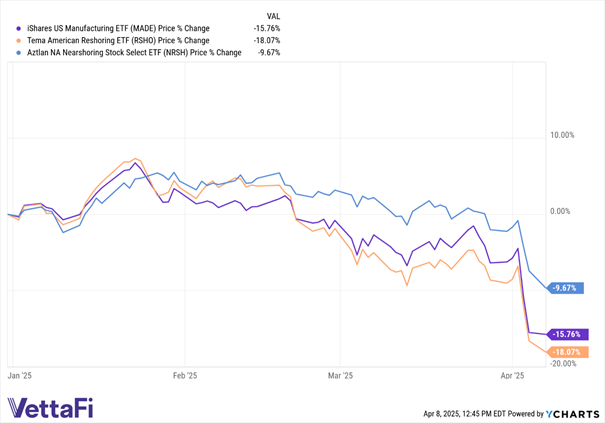
A few ETFs focused on this theme include the iShares US Manufacturing ETF (MADE ), the Tema American Reshoring ETF (RSHO ), and the Aztlan North American Nearshoring ETF (NRSH ). So, how have these ETFs fared so far in the current market environment?
While RSHO was a clear performance winner last year, up 17% in 2024, this year, it is down an equivalent 12.5% YTD. Meanwhile, MADE is down 10.9% YTD. From a performance standpoint, the YTD winner has been NRSH, down only 6.7% this year. Ironically, its returns have been helped by its North American focus, which means it currently has a 25% weight in Canada and a 15% allocation to Mexico.
At least so far this year, domestic manufacturing ETFs have yet to be rewarded as a tariff trade, but they seem a logical beneficiary of Trump’s manufacturing agenda.
Robotics & Automation
Although robotics stocks and ETFs are down for the year, they will ultimately be a key beneficiary of U.S. manufacturing plans to build more items at home at a reasonable cost.
Top Robotics ETFs to consider include the ROBO Global Robotics & Automation Index (ROBO ), which offers pure-play exposure to this theme; the First Trust NASDAQ Artificial Intelligence ETF (ROBT ); and the GlobalX Robotics & Artificial Intelligence ETF (BOTZ ), which offers exposure to both AI and robotics.
Again, while each of these ETFs are down about 15% YTD, to use a hockey analogy, this is an area where the “puck is going to go.”
Utilities
Utilities are a sector that tends to be resilient and recession-proof, positioning them as a “tariff-resistant” trade. Another benefit is that most utility funds pay nice dividends, which could be attractive in an environment of declining interest rates. Regulated utilities are also somewhat inflation-proof as they can pass on inflation to customers without damaging their business. And, lower energy input prices, with WTI oil prices sitting now at $60 per barrel, could benefit electric utilities as well.
Indeed, Utility ETFs have held up well in the current market environment. The First Trust AlphaDex Utilities Fund (FXU ), with $1.4 billion in assets under management, utilizes a quantitative stock selection process via its underlying index. It is up 5.3% YTD, with an annual dividend yield of 2.40%.
Global markets have not been left unscathed by the recent tariff-related market sell-off. But the iShares Global Utilities ETF (JXI ) has held up quite well, up 6.1% and has an attractive annual dividend yield of 2.91%.
Real Estate/REITs
Another sector likely to benefit from lower interest rates is real estate — as well as real estate-related themes. In addition, down the line, specific segments of the real estate market will also benefit from manufacturing capacity and infrastructure construction spending, including data center REITs.
Data Center REITs
The Trump Administration announced, prior to its tariff programs, a commitment to data center infrastructure spending. Before being sworn in as president, Trump said that Damac Properties had committed to building data centers in the U.S. via a $20 billion investment. DAMAC is based in the United Arab Emirates.
There is also the Stargate joint venture split between OpenAI, Oracle, and Softbank. The partnership plans to invest as much as $500 billion in the construction of data centers over the next four years. The administration has also identified 16 sites for the development of AI data centers currently on land owned by the Department of Energy.
Some of these plans are on hold until there is better visibility on the impact of tariffs on the supply chain, data centers, and AI infrastructure investment, which remains a top investment priority.
Some top ETFs to play this trend include the Global X Data Center & Digital Infrastructure ETF (DTCR ) and the Pacer Data and Infrastructure Real Estate ETF (SRVR ). The ETFs are down 7% and 5.7%, respectively. However, they could be strong performers for the remainder of the year, given the massive planned investment into data centers.
Other REITs
The actively managed ALPS Active REIT ETF (REIT ) also provides exposure to data center REITs and other opportunities in the REIT sector. The ETF is down nearly 7% this year but offers a 3.26% annual dividend yield.
Another interesting yield option with broad REIT exposure is the Global X SuperDividend REIT ETF (SRET ), which pays a “super” annual dividend yield of 9.3%.
And for those with the thesis that lower interest rates could provide a “shot in the arm” to the housing market, there is the iShares Residential and Multisector Real Estate ETF (REZ ) to consider. YTD, the ETF is down only 1.7%.
VettaFi LLC (“VettaFi”) is the index provider for ROBO, for which it receives an index licensing fee. However, ROBO are not issued, sponsored, endorsed or sold by VettaFi, and VettaFi has no obligation or liability in connection with the issuance, administration, marketing, or trading of ROBO.
For more news, information, and analysis, visit our Disruptive Technology Channel.

