


There is a lot for advisors to worry about. During an early March ETF Trends webcast, attendees were asked to cite their biggest concern for 2022. Inflation topped the list, with 38% of respondents worried that persistence of rising prices would negatively impact their portfolios. Geopolitical tension was the second most selected response, followed by market valuations, finding income, and rising rates.
It should be little surprise that inflation was on the minds of respondents, as the annual inflation rate accelerated to 7.9% in February, from 7.5% a month earlier, the highest level since 1982, which was before many advisors working today were born. Advisors are building portfolios that they manage differently than they did a year ago.
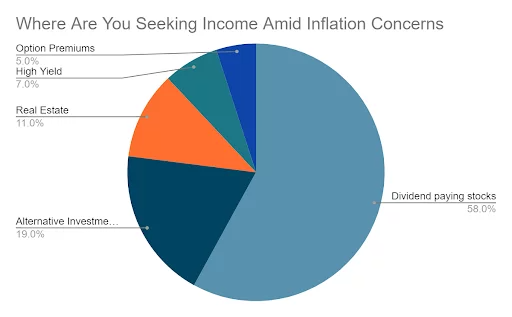
During the same webinar, a follow-up poll question asked attendees to share where they are seeking income for their portfolios amid mounting concerns around inflation. The overwhelming choice was through dividend-paying stocks, with this selection garnering 58% of the poll results, significantly ahead of alternative investments, high-yield bonds, option premium strategies, and real estate.
With the Federal Reserve raising interest rates in March for the first time in years, and poised to hike six more times in 2022, equity income is likely to have a more meaningful effect on client portfolios. But it is particularly important to understand that not unlike ETFs tracking the S&P 500 Index from iShares, State Street Global Advisors, and Vanguard, dividend strategies perform differently from one another as they are constructed uniquely.
The Vanguard Dividend Appreciation ETF (VIG ) and the Vanguard High Dividend Dividend Yield ETF (VYM ) are the largest of the dividend ETFs as classified by ETF Database. Despite being part of the same fund family, they take distinct approaches. VIG holds companies such as Microsoft (MSFT) and UnitedHealth Group (UNH) that have at least a decade of history of annually raising dividend payments. It tends to have more of a growth tilt. Meanwhile, VYM is built based on the dividend yield of potential candidates and has more of a value tilt, with JPMorgan Chase (JPM) and Procter & Gamble (PG) among its top holdings.
Despite both charging miniscule 0.06% expense ratios, VYM has been the much stronger performer, outperforming by more than 600 basis points year-to-date in 2022 through March 22, but lagging behind over the past three years.
The Schwab US Dividend ETF (SCHD ) and the *iShares Select Dividend ETF (DVY )* are the third- and fourth-largest dividend ETFs available. SCHD is more similar to VIG with a dividend growth focus, while DVY is closer to VYM in construction with a yield orientation, but yet these “smaller” ETFs perform distinctly. Relative to other dividend ETFs, DVY, which was up 3.6% to start 2022, has more exposure to utilities stocks like Edison International (EIX) and Entergy (ETR).
It is prudent that advisors are seeking out dividend-based ETF strategies to offset the inflationary pressures on the portfolios they build for clients. However, before choosing among the wide array of dividend strategies, it is important to understand what is inside and why.
For more news, information, and strategy, visit the Dividend Channel.

