

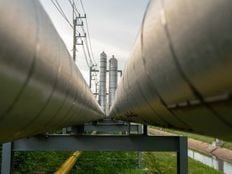
North American midstream energy companies play a critical shipping and handling role in the energy value chain, operating pipelines, storage terminals, export terminals, and facilities that process natural gas into a usable form.
Key Takeaways
- The midstream space generates highly stable, fee-based cash flows that insulate it from volatile oil and gas prices.
- Geopolitical tensions are positioning the U.S. and Canada as preferred global energy suppliers.
- Rising LNG exports and AI data center expansions are serving as powerful new demand drivers for natural gas infrastructure.
Cash Flow Stability and Geopolitical Tailwinds
U.S. and Canadian midstream companies provide services under long‑term contracts that often include annual inflation adjustments.
“What’s really unique about the midstream space is that it generates stable cash flows,” Stacey Morris, head of research at VettaFi, said during a recent interview with Proactive Investors. Morris said midstream is more stable than other energy subsectors that depend heavily on volatile oil and gas prices, due to midstream’s fee-based structure.
Geopolitical tensions in the Middle East are reshaping global energy flows, which is creating structural advantages for North American suppliers. “The U.S. and Canada are going to be preferred energy suppliers for the rest of the world,” Morris said. She pointed to energy importers who are “suffering because [they] can’t get the volumes that [they] were supposed to get from the Middle East.”
Rising LNG Capacity and AI Data Center Demand
On the North American liquefied natural gas (LNG) front, U.S. projects advance, with construction already set to double U.S. LNG export capacity by 2031, while Canada develops LNG projects on its west coast. Another positive update for midstream investors is a more constructive oil futures curve, with prices for 2027 to 2028 rising from under $60 coming into the year to about $75 per barrel now. This supports higher production growth into 2027.
AI and data centers are serving as powerful demand drivers. Many data centers are turning to natural gas for power, given its reliability, Morris said. Furthermore, hyperscalers are working directly with midstream companies to secure gas supplies and build lateral pipelines. Morris pointed to Enbridge’s (ENB) pursuit of over 50 data center opportunities and Williams’ (WMB) nearly $10 billion in data‑center‑related projects.
Long-Term Outlook and Midstream ETF Offerings
Looking ahead, midstream is positioned to benefit from rising electricity demand due to coal‑to‑gas switching, electrification, and AI data centers. Alongside opportunities from the ongoing LNG buildout, power demand constitutes much of the robust project backlogs in natural gas infrastructure.
With U.S. oil production now expected to grow by about 400 thousand barrels per day (MBpd) year over year for 2027, Morris said she sees many opportunities for both natural gas and oil infrastructure.
For investors worried about inflation, Morris notes that midstream offers real‑asset exposure, inflation‑linked contracts, growing dividends, and buybacks. This makes the current environment a compelling time to look at this space.
The Alerian MLP ETF (AMLP ), the industry’s largest MLP ETF, provides concentrated exposure to MLPs. Meanwhile, the Alerian Energy Infrastructure ETF (ENFR ) offers a more diversified approach, incorporating C-corps. ENFR is the lowest-fee ETF in the midstream segment. The underlying indexes for AMLP and ENFR were yielding 7.0% and 4.7%, respectively, as of June 11.
Looking for midstream insights in your inbox? Subscribe here to keep a pulse on midstream investing through our weekly updates.
For more news, information, and analysis, visit the Energy Infrastructure Content Hub.
vettafi.com is owned by VettaFi LLC (“VettaFi”). VettaFi is the index provider for AMLP and ENFR for which it receives an index licensing fee. However, AMLP and ENFR are not issued, sponsored, endorsed, or sold by VettaFi, and VettaFi has no obligation or liability in connection with the issuance, administration, marketing, or trading of AMLP or ENFR.

