

Summary
- Electricity demand in the U.S. is poised for meaningful growth after being relatively flat for 20 years.
- LNG exports are a clear driver of growing U.S. natural gas demand. However, the potential demand growth related to power generation is less straightforward, with varying estimates as data centers remain somewhat of a wild card.
- Midstream companies continue to announce new growth projects related to natural gas demand from power plants, data centers, and LNG facilities.
Natural gas continues to be the most important driver of midstream growth opportunities in North America. The anticipated step change in natural gas demand is largely being driven by exports of liquefied natural gas (LNG). LNG demand is fairly straightforward given export capacity takes years to construct, and is backed by long-term sales agreements.
Natural gas demand for power generation should be additive, but there is a wider range of possible outcomes to 2030. Data centers continue to be a wild card. Today’s note discusses the outlook for growing power demand and implications for midstream as it relates to natural gas demand.
US electricity demand is growing for the first time in a long time
U.S. electricity demand is poised for meaningful growth after being effectively flat for 20 years. A rising population and growing economy were largely offset by more efficiency and a move away from manufacturing toward services.
Going forward, total electricity use in the U.S. is forecasted to rise by 8% to 2030 according to the Energy Information Administration’s Annual Energy Outlook. The expected growth in electricity demand has likely played a role in recent M&A in the utility space. As announced in recent weeks, Blackstone is acquiring TXNM Energy (TXNM), NRG (NRG) is acquiring LS Power, and Vistra Energy (VST) is acquiring natural gas power generation facilities.
Electricity demand growth is broad-based. The commercial and industrial sectors are expected to drive the greatest increase, though residential demand is also rising. Data centers are included in commercial demand, while industrial demand includes manufacturing. U.S. construction spending on manufacturing has been growing given the push toward onshoring and reshoring.
Data centers are also topical, as AI transforms our world (read more). Last week, Elon Musk indicated AI developments could have power generation constraints by the middle or end of 2026. The International Energy Agency (IEA) estimates that data centers are on track to represent almost half the growth in U.S. electricity demand to 2030. Globally, the IEA expects data centers to be 3% of worldwide electricity demand by 2030, compared to 1.5% in 2024. Renewables and natural gas are expected to be the leading sources of energy for data centers, according to the IEA.
To put data center energy usage into context, a typical hyperscale AI center uses the same amount of electricity annually as 100,000 homes per the IEA. The largest data center under construction will use as much electricity annually as 2 million homes, and the energy consumption of the largest proposed data center would be on par with 5 million homes. Clearly, data centers can be needle moving for power demand and consequently natural gas demand.
Power demand and natural gas
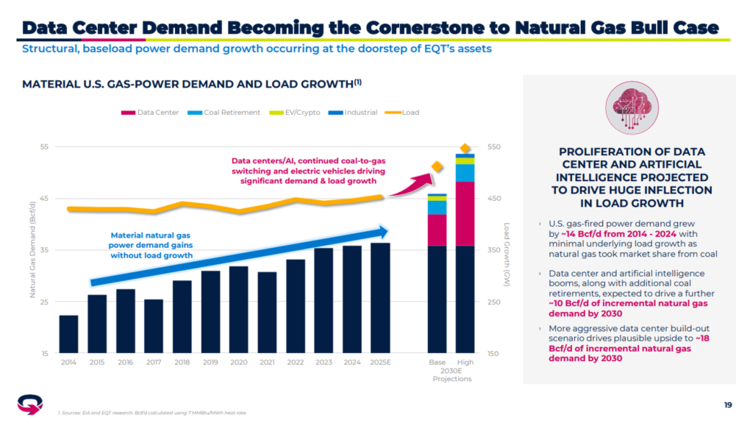
In the U.S., natural gas consumption by power plants increased by 14 billion cubic feet per day (Bcf/d), or 66% from 2014 to 2024. This growth coincided with flat electricity demand (orange line) as shown in the slide below from natural gas producer EQT Corp (EQT). Natural gas gained share as coal plants were retired and accounted for 42% of U.S. electricity generation in 2024. Estimates for future natural gas demand growth tied to power generation vary, with EQT citing a base case of ~10 Bcf/d and a high case of ~18 Bcf/d to 2030.
Producer Antero Resources (AR) points to 32 Bcf/d of U.S. natural gas demand growth in total by the end of this decade, including 9 Bcf/d for power (data centers, electrification) and 23 Bcf/d for exports.
On the more conservative side, Kinder Morgan KMI forecasts 3 Bcf/d of growth in natural-gas-fired power demand by 2030. That said, the company is pursuing over 5 Bcf/d in power opportunities. KMI notes rising power demand is not fully reflected in many natural gas outlooks. Understandably, power demand has been in focus for investors (read more).
Midstream benefiting from rising natural gas demand
While the exact level of natural gas demand in 2030 remains an open question, midstream’s backlog of natural gas growth opportunities continues to grow. Projects range in size and scope, from adding laterals (i.e., smaller pipelines off a larger pipeline) to expansion projects to new-build pipelines. Expansions tend to be most common and are more capital efficient. Companies have generally cited 20-year contracts with take-or-pay features for larger projects.
To give some examples, Williams (WMB) is pursuing multiple expansions of its Transco system, including the recently announced ~1 Bcf/d Power Express project to supply Virginia with targeted startup in 2030. KMI is expanding and extending some of its existing systems but is also building the new Trident pipeline in Texas, which will help supply Golden Pass LNG. KMI’s natural gas project backlog is up almost $6 billion since the end of 2023 to $8 billion. DT Midstream (DTM) is constructing a lateral from its Midwestern Gas Transmission pipeline to a power plant in Indiana, which is switching from coal to natural gas.
Midstream has also been active with data center opportunities. WMB is proceeding with the Socrates power generation project in Ohio, where it will invest $1.6 billion to provide power generation and related pipeline infrastructure under a 10-year fixed-price power agreement. WMB is working on two similar projects. TC Energy (TRP CN) announced the Northwoods pipeline project earlier this month, which will help meet power generation demand in the Midwest, including for data centers. Energy Transfer (ET) announced a data center supply agreement back in February. ET management said they were looking at 150 data centers in Texas alone and alluded to announcements in the coming weeks on their recent earnings call.
WMB, KMI, DTM, TRP CN, and ET are constituents of the Alerian Midstream Energy Select Index (AMEI). Companies focused on natural gas infrastructure account for ~70% of AMEI by weighting. Midstream continues to be an interesting way to gain exposure to the growth in natural gas demand given attractive yields and fee-based businesses that are relatively insulated from the volatility and seasonality in natural gas prices. As of May 22, AMEI was yielding 5.5%.
AMEI is the underlying index for the Alerian Energy Infrastructure ETF (ENFR) and the Alerian Energy Infrastructure Portfolio (ALEFX).
Related notes:
Raymond James Analyst Shares Stock Picks & Constructive Midstream Outlook
US LNG Dealmaking Picks Up with Benefits for Midstream
MIT Expert: AI Transformation Just Beginning
For more news, information, and analysis, visit the Energy Infrastructure Channel.
Vettafi.com is owned by VettaFi LLC (“VettaFi”). VettaFi is the index provider for ENFR and ALEFX for which it receives an index licensing fee. However, ENFR and ALEFX are not issued, sponsored, endorsed or sold by VettaFi, and VettaFi has no obligation or liability in connection with the issuance, administration, marketing or trading of ENFR and ALEFX.

