


Summary
- The U.S. has been energy independent since 2019, when it became a net energy exporter for the first time in decades.
- The U.S. has become a major energy supplier to the rest of the world, with important benefits for our allies.
- Continued production and export growth should allow the U.S. to maintain energy independence, regardless of election outcomes in November.
With Independence Day this week and an election in November, it is timely to revisit the path to U.S. energy independence and the important role the U.S. now plays in global energy markets. Today’s note discusses the growth in U.S. energy production and exports, and the outlook for U.S. energy independence.
The Energy Independence Milestone Is Behind Us
U.S. oil and natural gas production grew significantly beginning around 2010 as the “shale revolution” started to take hold. This transformative growth was supported by widescale application of horizontal drilling and hydraulic fracturing. The U.S. became the world’s largest producer of natural gas in 2009. It became the leading producer of oil in 2018. Production growth allowed for more exports. And a lifting of the crude export ban in December 2015 paved the way for the U.S. to become a major oil supplier to the rest of the world.
U.S. energy independence, defined as greater energy exports than imports, was achieved in 2019, according to the Energy Information Administration (EIA). Before 2019, the U.S. had been a net energy importer going back to 1952. To be clear, the U.S. continues to import energy and likely will for years to come. But exports surpass imports. Energy refers to crude oil, natural gas, coal, petroleum products like gasoline, and natural gas liquids (NGLs) like propane.
Exports: Up Across the Board and Growing
Export growth has been broad-based as oil and natural gas production have grown. In 2023, the U.S. produced more energy than was consumed by the widest margin on record, according to the EIA. Liquefied natural gas (LNG) exports have surged since 2015, and the U.S. became the world’s largest LNG exporter 2023. Natural gas pipeline exports have seen significant growth as well, driven by growing demand from Mexico (read more). Meanwhile, exports of crude oil have skyrocketed since the export ban was lifted in late 2015. And petroleum product exports have been rising steadily for two decades. Both oil and LNG are also seeing significant investments in new export infrastructure. Exports of NGLs more than tripled between 2014 and 2023. And energy infrastructure companies are looking to add even more export capacity (read more).
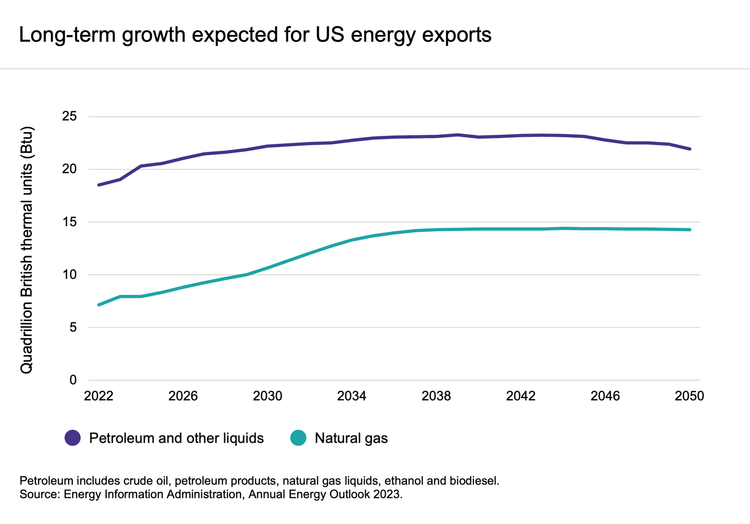
As shown in the chart below, U.S. energy exports are expected to grow over the coming years and stabilize in the 2040’s at levels well above today’s volumes. With growing export capacity across hydrocarbons, the U.S. is well-positioned to continue supplying the world with energy and maintain its energy independence. Exports allow domestic producers to benefit from growing demand for energy from developing economies around the globe.
The US as a Strategic Energy Partner for Allies
The abundance of energy supplies in the U.S. is not only beneficial for our own energy security but for that of our allies. As geopolitical tensions have escalated in recent years, the role of the U.S. as a global energy supplier has become increasingly important. For example, demand for U.S. LNG spiked in 2022, following Russia’s invasion of Ukraine (read more). Europe’s need to replace Russian supplies has largely been met by the U.S. And in 2023, Europe was again the top destination). for U.S. LNG. The immediate impact on energy markets was substantial in 2022. But the situation would have been even worse if not for significant U.S. oil and LNG exports.
As shown in the chart above, the U.S. has a long runway for growing energy exports. This is important for allies struggling with energy security in Europe and other parts of the world. This is particularly so as some regions see declining domestic production of oil and gas. The U.S. not only provides secure supply, but the volume of exports from the U.S. helps with global affordability of energy as well.
The Upcoming Election Unlikely to Change Things
With the upcoming election in November, energy independence could become more topical in the next few months. Energy independence has become a political talking point. But it is important to note the outcome of the election is unlikely to meaningfully impact U.S. energy production or exports. And energy independence is expected to continue.
The growth in U.S. oil and gas production was more structural (drilling improvements mentioned above, better economics, greater efficiencies) than it was political. The policy of a president or political party generally has limited influence on U.S. energy production, particularly in the near term. Exports can be more subject to political impacts. Projects require permits and licenses and President Obama and Congress were necessary for repealing the crude export ban. However, once facilities are up and running, exports are more a function of company decisions and the market environment. Politics are not expected to derail expected export growth. Stay tuned for more commentary on the election and impacts to the energy space.
Bottom Line:
With significant growth in oil and gas production and exports, the U.S. is positioned to remain energy independent for the foreseeable future, enhancing energy security for us and our allies.
Related Research:
Midstream Connects US Gas With Growing Mexican Demand
Midstream Investing in NGLs Amid Record Exports
Playing the Long Game: Offshore Crude Export Terminals
U.S. LNG Export Capacity to Rise 80% by 2028
US LNG Expects a Mixed Bag Despite Strong Backdrop
2024 Outlook: Macro Uncertainty Favors Midstream/MLPs
For more news, information, and analysis, visit the Energy Infrastructure Channel.

