

ETFdb Logo
  • ETF Database
  • Content Hubs
    • Themes
      • Active ETF
      • Alternatives
      • Artificial Intelligence
      • China Insights
      • Core Strategies
      • Crypto
      • Disruptive Technology
      • Energy Infrastructure
      • ETF Building Blocks
      • ETF Investing
      • ETF Strategist
      • Financial Literacy
      • Fixed Income
      • Free Cash Flow
      • Future ETFs
      • Innovative ETFs
      • Institutional Income Strategies
      • Leveraged & Inverse
      • Market Insights
      • Market Outlooks
      • Modern Alpha
      • Nuclear Energy
      • Portfolio Strategies
      • Sector Investing
      • Tax Efficient Income
      • Thematic Investing
    • Asset Class
      • Equity
        • U.S. Equity
        • Int'l Developed
        • Emerging Market Equities
      • Alternatives
        • Gold/Silver/Critical Materials
        • Cryptocurrency
        • Currency
        • Volatility
      • Fixed Income
        • Investment Grade Corporates
        • US Treasuries & TIPS
        • High Yield Corporates
        • Int'l Fixed Income
    • ETF Ecosystem
    • ETFs in Canada
    • Market Outlook
    • Crypto ETF Hub
  • Tools
    • ETF Screener
    • ETF Country Exposure Tool
    • ETF Database Categories
    • Indexes
    • Scenario Analysis
    • Watchlists
    • Head-To-Head ETF Comparison Tool
    • Mutual Fund To ETF Converter
    • ETF Stock Exposure Tool
    • ETF Issuer Fund Flows
  • Research
    • ETF Education
    • Equity Investing
    • Dividend ETFs
    • Leveraged ETFs
    • Inverse ETFs
    • Index Education
    • Index Insights
    • Top ETF Sectors
    • Top ETF Issuers
    • Top ETF Industries
  • Webcasts
  • Sectors
    • Sector Investing Content Hub
    • XLK
    • XLI
    • XLU
    • XLY
    • XLP
    • XLRE
    • Sector Power Rankings
    • XLE
    • XLC
    • XLF
    • XLV
    • XLB
  • Multimedia
    • ETF 360 Video Series
    • ETF of the Week Podcast
    • Gaining Perspective Podcast
    • ETF Prime Podcast
    • Video
  • Company
    • About VettaFi
  • PRO
    • Pro Content
    • Pro Tools
    • Advanced
    • FAQ
    • Free sign up
    • Login
  1. Entrepreneur ETF Content Hub
  2. Concentration Issues? Lower Correlations with ‘ERSX’
Entrepreneur ETF Content Hub
Share

Concentration Issues? Lower Correlations with 'ERSX'

Tom LydonFeb 01, 2021
2021-02-01

Many investors think their portfolios are diverse, but what’s the point of diversifying investments that are highly correlated to each other? International small caps are a prime mechanism for investors looking to trim intra-portfolio correlations.

Enter the ERShares International Equity ETF (ERSX B+).

ERSX selects the most entrepreneurial, primarily Non-US Small Cap companies, that meet the thresholds embedded in its proprietary Entrepreneur Factor (EF). ERShares’ ETF delivers strong performance across a variety of investment strategies without disrupting investors’ underlying risk profile metrics. Their geographic diversity enables them to harness global advantages through additional returns associated with currency fluctuations, strategic geographic allocations, comparative trade imbalances, and relative supply/demand strengths.

“International small cap stocks have had a consistently lower correlation with U.S. stocks than have large cap international stocks.  This makes sense in that smaller companies are typically more focused on their local economies and less influenced by global factors,” according to Sapient Investments.
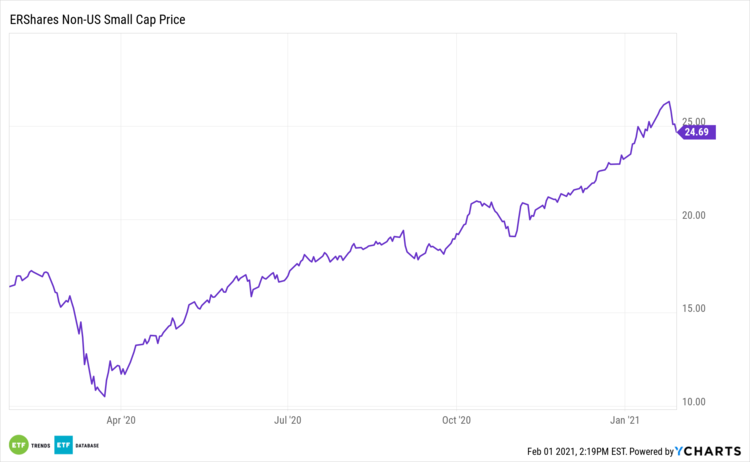
ERSX 1 Year Performance

Lower Correlations with ERSX

There are an array of benefits attributable to ex-US small caps.

“Small cap stocks typically do not have as large a percentage in global sales as large cap stocks.  Most of their business is in their local economies.  In an era of rising trade tensions, this may be a significant plus,” notes Sapient.

Small cap investors already know that looking at equities outside the large cap universe can yield substantial gains, but one area they may not have considered is looking abroad.

International small caps are generally export-oriented, globally structured, innovative, and have a high to dominant share of a niche market, often one in which the U.S. counterparts don’t compete effectively.

“Although small cap stocks have had a higher level of volatility, their higher returns have more than compensated for that.  The same is even more true of international small cap stocks—note in the graph below that the return/risk tradeoff between small cap and large cap is much steeper for international than for U.S. stocks,” concludes Sapient.

For more on entrepreneurial strategies, visit our Entrepreneur ETF Channel.


Content continues below advertisement

Loading Articles...

Advertisement

Is Your Portfolio Positioned With Enough Global Exposure?

ETF Education Channel

How to Allocate Commodities in Portfolios

Tom LydonApr 26, 2022
2022-04-26

A long-running debate in asset allocation circles is how much of a portfolio an investor should...

Core Strategies Channel

Why ETFs Experience Limit Up/Down Protections

Karrie GordonMay 13, 2022
2022-05-13

In a digital age where information moves in milliseconds and millions of participants can transact...

}
X
