


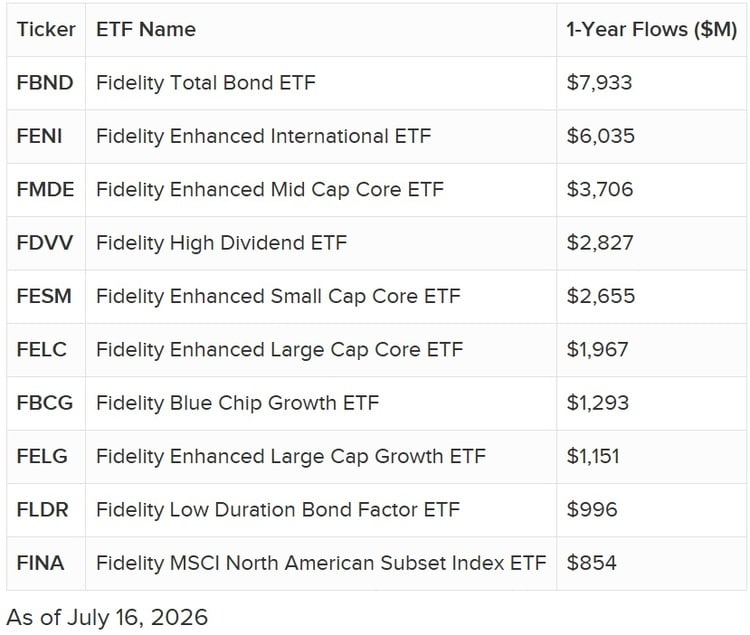
Fidelity has put together a strong 12-month stretch of asset gathering. An impressive $35 billion recently flowed into the Fidelity ETF lineup. The three most popular Fidelity ETFs over the past year were active. However, a newly launched ESG ETF has disrupted the trend. The Fidelity MSCI North American Subset Index ETF (FINA) began trading in early July. FINA is already one of Fidelity’s 10 most popular ETFs over the past year. The ETF caught our attention at VettaFi this week by hauling in a massive $850 million.
Key Takeaways
- Despite launching weeks ago, ESG ETF FINA gathered $850 million in a single day.
- FINA holds a 4% stake in energy, unlike some peer ESG ETFs.
- Fidelity’s active ETF lineup has led the charge to gather $35 billion in the past year.
Active ETF Party Crashed By an Index Based ESG ETF
The firm’s recent ETF growth has been driven by its active lineup. The Fidelity Total Bond ETF (FBND ) pulled in $7.9 billion in the past year. Meanwhile, the Fidelity Enhanced International ETF (FENI ) added $6.0 billion. Small- and midcap equity ETFs also are participating in the active ETF party
Yet, a newly launched passive offering has joined the leader board. FINA began trading on July 7, but one week later gathered $854 million in a single day. VettaFi believes an institutional investor almost certainly drove the massive inflow.
Fidelity ETF Flows Leaderboard
A Transition-Friendly Fidelity ESG ETF Strategy
FINA tracks the MSCI Global Select 500 – North America Subset Index. The fund focuses on large- and midcap U.S. and Canadian stocks that meet emissions reduction targets approved by the Science Based Targets initiative (SBTi). It screens out controversial activities like thermal coal but avoids broad-brush sector exclusions.
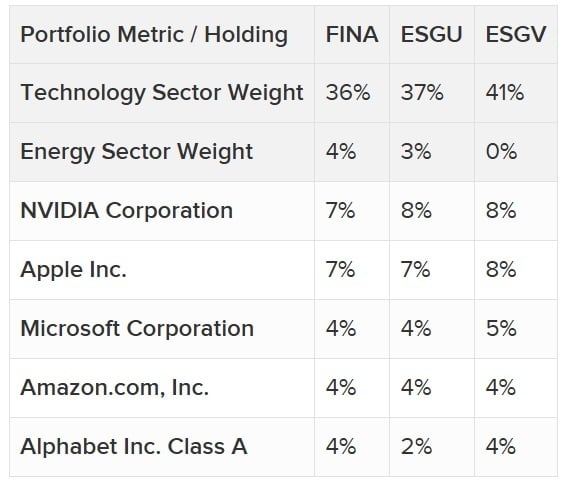
This methodology positions FINA alongside established climate-focused ESG ETFs. Advisors frequently look at the $18 billion iShares ESG MSCI USA ETF (ESGU ) and the Vanguard ESG U.S. Stock ETF (ESGV ). While these ESG ETFs share similar megacap technology holdings, FINA takes a different approach. Unlike ESGV, which completely divests from the energy sector, FINA currently has a 4% allocation to energy stocks. This brings its profile much closer to ESGU’s transition-oriented model.
Comparing FINA to Competitor ESG ETFs
Inflows Signal Resilient Demand for ESG ETF Options
Negative headlines might suggest that climate-focused investing is out of favor, but actual asset flows tell a far more resilient story. Specifically, over the past year, ESGU and ESGV pulled in $1.1 billion and $270 million, respectively.
FINA’s rapid $854 million start shows that appetite for climate-aligned core equity remains healthy. For advisors looking to limit carbon risk without completely abandoning traditional energy exposure, FINA is new one to watch. The ETF has a modest 0.09% expense ratio.
For more news, information, and analysis, visit the Equity ETF Content Hub.

