


While the Federal Reserve has held rates steady since its December 2025 meeting, investor expectations for future interest rate decisions have shifted drastically over the course of the year. Early expectations for 2026 rate cuts quickly faded as stubborn inflation fueled interest rate volatility, heavily impacting real estate ETFs.
Key Takeaways:
- Despite volatility driven by shifting interest rate sentiment, broad real estate funds like XLRE, VNQ, and SCHH have consistently outpaced broader market indexes such as the S&P 500 in 2026.
- Demand for AI infrastructure and cloud computing has fueled a surge in data center REITs, which have become a primary driver of real estate sector ETF performance this year.
- While early-year expectations for rate cuts have faded, the real estate sector remains sensitive to the Federal Reserve’s evolving policy, leaving performance in the second half of 2026 heavily dependent on upcoming interest rate decisions.
This constant shift in sentiment has triggered sharp volatility across the real estate sector, an area of the market uniquely vulnerable to the changing cost of capital. The industry heavily relies on debt financing to fund new construction and property acquisitions. For instance, any fluctuation in interest rates immediately raises overall financing cost, which impacts the bottom lines of homebuilders and REITs alike.
Investors often view REITs as alternatives to bonds, as they are mandated to distribute at least 90% of taxable income back to shareholders. When yields on fixed-income markets rise, investors will often rotate capital away from REITs into less volatile fixed-income markets, driving REIT share prices down.
Real Estate ETFs' Resilient Run
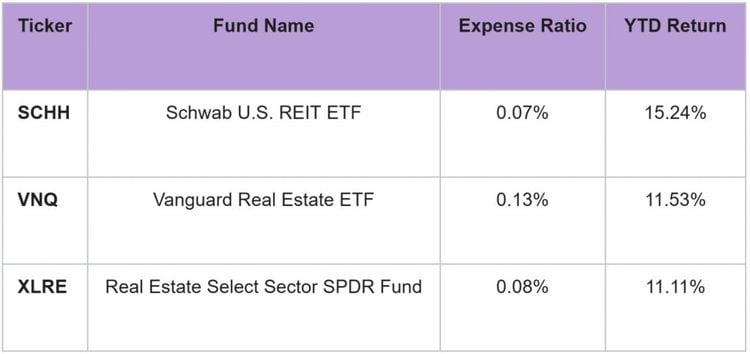
Despite" interest rate dynamics sparking volatility":https://www.etftrends.com/fed-rate-hike-fears-rippling-through-etf-flows/ in the sector, broad real estate funds have often outperformed broad market indexes such as the S&P 500. The State Street Real Estate Select Sector SPDR ETF (XLRE ) — with an expense ratio of 8 basis points — has returned 11.1% this year with inflows of $190.6 million. This is notably higher than the 9.6% return yielded by the S&P 500. The fund tracks the S&P Real Estate Select Sector Index, investing a large majority of assets in a concentrated portfolio of roughly 30 REITs from the S&P 500, excluding mortgage REITs.
The Vanguard Real Estate ETF (VNQ ) and Schwab US REIT ETF (SCHH ) take similar approaches to XLRE also outperforming broad market indexes. The funds feature an expense ratio of 13 basis points and 7 basis points, respectively.
VNQ tracks the MSCI US Investable Market Real Estate 25/50 Index, providing investors exposure to a diversified portfolio of REITs oriented towards investors seeking a combination of current income and moderate long-term capital appreciation. The fund has climbed 11.5% this year, recording inflows of $1.46 billion.
Similarly, SCHH seeks to replicate the performance of the Dow Jones Equity All REIT Capped Index, holding a broad selection of REITs that own and operate income-producing real estate. The fund has returned 15.2% in 2026, receiving inflows of $1.18 billion. This includes a staggering $1 billion in flows in late June, likely due to a weaker than expected job report, and various corporate actions and M&A deals across top holdings.
Data Center REITs Surging
While interest rates remain a pivotal factor in REIT performance, data center REITs have uplifted real estate sector ETF performance in 2026. Driven by increasing physical demand for high-speed data and AI infrastructure, the data center REIT sector climbed more than 37% year to date through May.
Leading the charge in this digital infrastructure boom are Equinix (EQIX) and Digital Realty Trust (DLR), both of which serve as major weightings within XLRE, VNQ, and SCHH. These firms have benefited from the insatiable demand for AI workloads and cloud computing. EQIX reported revenue of $2.47 billion in Q1 2026, up 12.1% from the same period last year and DLR announced $1.63 billion in revenue with a 16.7% increase year over year. As a result, both REITs have surged to date this year with returns of 33.9% and 13.2%, respectively.
Navigating a New Rate Reality
As investors enter the second half of 2026, expectations for near-term interest rate cuts have shifted radically. Despite a weaker-than-expected jobs report and flat interest rates through June, the market narrative has pivoted from pricing in rate cuts to bracing for at least one rate hike later this year, according to CNBC.
Given that interest rates historically move in prolonged directional cycles rather than one-off policy adjustments, the Fed’s actions in the upcoming months will heavily dictate the performance of real estate ETFs through the remainder of 2026 and beyond.
For more news, information, and strategy, visit ETFdb.

