ETFdb Logo
  • ETF Database
  • Content Hubs
    • Themes
      • Active ETF
      • Alternatives
      • Artificial Intelligence
      • China Insights
      • Core Strategies
      • Crypto
      • Disruptive Technology
      • Energy Infrastructure
      • ETF Building Blocks
      • ETF Investing
      • ETF Strategist
      • Financial Literacy
      • Fixed Income
      • Free Cash Flow
      • Future ETFs
      • Innovative ETFs
      • Institutional Income Strategies
      • Leveraged & Inverse
      • Market Insights
      • Market Outlooks
      • Modern Alpha
      • Nuclear Energy
      • Portfolio Strategies
      • Sector Investing
      • Tax Efficient Income
      • Thematic Investing
    • Asset Class
      • Equity
        • U.S. Equity
        • Int'l Developed
        • Emerging Market Equities
      • Alternatives
        • Gold/Silver/Critical Materials
        • Cryptocurrency
        • Currency
        • Volatility
      • Fixed Income
        • Investment Grade Corporates
        • US Treasuries & TIPS
        • High Yield Corporates
        • Int'l Fixed Income
    • ETF Ecosystem
    • ETFs in Canada
    • Market Outlook
    • Crypto ETF Hub
  • Tools
    • ETF Screener
    • ETF Country Exposure Tool
    • ETF Database Categories
    • Indexes
    • Scenario Analysis
    • Watchlists
    • Head-To-Head ETF Comparison Tool
    • Mutual Fund To ETF Converter
    • ETF Stock Exposure Tool
    • ETF Issuer Fund Flows
  • Research
    • ETF Education
    • Equity Investing
    • Dividend ETFs
    • Leveraged ETFs
    • Inverse ETFs
    • Index Education
    • Index Insights
    • Top ETF Sectors
    • Top ETF Issuers
    • Top ETF Industries
  • Webcasts
  • Sectors
    • Sector Investing Content Hub
    • XLK
    • XLI
    • XLU
    • XLY
    • XLP
    • XLRE
    • Sector Power Rankings
    • XLE
    • XLC
    • XLF
    • XLV
    • XLB
  • Multimedia
    • ETF 360 Video Series
    • ETF of the Week Podcast
    • Gaining Perspective Podcast
    • ETF Prime Podcast
    • Video
  • Company
    • About VettaFi
    • Get VettaFi’ed
  • PRO
    • Pro Content
    • Pro Tools
    • Advanced
    • FAQ
    • Free sign up
    • Login
  1. The Responsible Investing Content Hub
  2. Clients Asking About ESG More Frequently
The Responsible Investing Content Hub
Share

Clients Asking About ESG More Frequently

Karrie GordonSep 28, 2021
2021-09-28

Environmental, social, and governance (ESG) practices aren’t just a hot button topic amongst regulators and corporations; investors are becoming more educated about this particular field of investing and are requesting investment into ESG more often. Advisors continue to play an integral role in helping guide ESG investing into the right avenues based on individual clients’ priorities.

Recent research from Aegon, a global asset manager, revealed that 41% of advisors are being asked more often by clients about ESG investing, reported Financial Times. Guy Rainbird, public affairs director at the Association of Investment Companies, believes that climate change issues as well as ESG in general are “featuring strongly” as important topics for investors.

“We’re aware that many advisers are proactively raising the issue of ESG or ethical preferences with clients,” said Rainbird.

This is a trend that’s playing out globally. Invesco advisors in January performed a survey regarding ESG investment and found that 51% ask investors if they would “prefer to invest sustainably or not.” However, it’s important to go just beyond that initial interest and actually dig into clients’ motives behind investing in ESG, as well as what areas are important to them.

“Each client will have their own personal view on ESG and therefore advisers need to ask follow up questions,” said Paul Chilver, an associate and financial planning manager at Birkett Long IFA. “For example, I have clients who have an interest in funds that aim to fund solutions to the climate crisis, while other clients are wanting to invest in funds that screen out certain areas, for example tobacco.”

SPDR Offers Investing That Screens Out Fossil Fuels

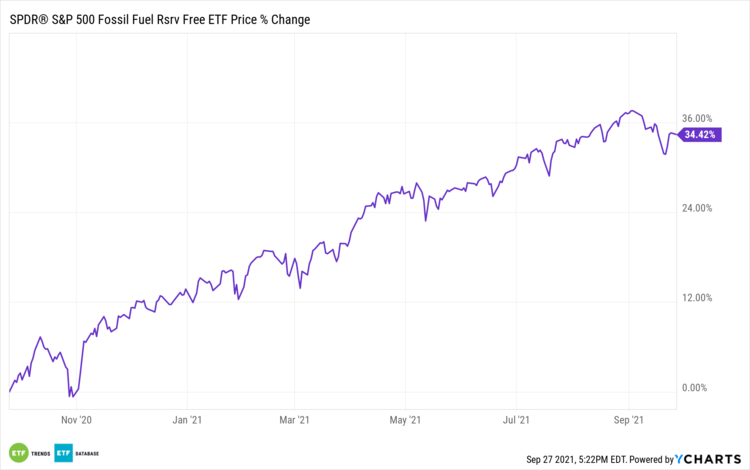
Investors looking to reduce exposure to fossil fuels in their investments need only turn to the SPDR S&P 500 Fossil Fuel Reserves Free ETF (SPYX A-). The investment is a core allocation to the large-cap equities of the S&P 500, except with much-reduced carbon footprints.

Content continues below advertisement

SPDR SP500 Fossil Fuel Reserve

The fund tracks the S&P 500 Fossil Fuel Free Index, a benchmark of companies within the S&P 500 that are “fossil fuel free,” defined as companies that don’t own fossil fuel reserves (thermal coal reserves and coal reserve biproducts, as well as oil or gas reserves).

That’s not the same as being devoid of all oil stocks. The fund still has minor allocations to traditional energy companies, such as Valero (VLO) and Halliburton (HAL). But without exposure to companies actually holding the physical oil, coal, or gas reserves, the fund’s energy allocation is much reduced. Energy comprises just 0.72% of the ETF’s sector make-up, as compared to 2.60% of the SPDR S&P 500 ETF Trust (SPY A-).

Top sector allocations of SPYX include information technology at 28.04%, healthcare at 13.29%, and consumer discretionary at 12.31%.

SPYX has an expense ratio of 0.20%.

For more news, information, and strategy, visit the ESG Channel.

Loading Articles...

Advertisement

Is Your Portfolio Positioned With Enough Global Exposure?

ETF Education Channel

How to Allocate Commodities in Portfolios

Tom LydonApr 26, 2022
2022-04-26

A long-running debate in asset allocation circles is how much of a portfolio an investor should...

Core Strategies Channel

Why ETFs Experience Limit Up/Down Protections

Karrie GordonMay 13, 2022
2022-05-13

In a digital age where information moves in milliseconds and millions of participants can transact...

}
X
