ETFdb Logo
  • ETF Database
  • Content Hubs
    • Themes
      • Active ETF
      • Alternatives
      • Artificial Intelligence
      • China Insights
      • Core Strategies
      • Crypto
      • Disruptive Technology
      • Energy Infrastructure
      • ETF Building Blocks
      • ETF Investing
      • ETF Strategist
      • Financial Literacy
      • Fixed Income
      • Free Cash Flow
      • Future ETFs
      • Innovative ETFs
      • Institutional Income Strategies
      • Leveraged & Inverse
      • Market Insights
      • Market Outlooks
      • Modern Alpha
      • Nuclear Energy
      • Portfolio Strategies
      • Sector Investing
      • Tax Efficient Income
      • Thematic Investing
    • Asset Class
      • Equity
        • U.S. Equity
        • Int'l Developed
        • Emerging Market Equities
      • Alternatives
        • Gold/Silver/Critical Materials
        • Cryptocurrency
        • Currency
        • Volatility
      • Fixed Income
        • Investment Grade Corporates
        • US Treasuries & TIPS
        • High Yield Corporates
        • Int'l Fixed Income
    • ETF Ecosystem
    • ETFs in Canada
    • Market Outlook
    • Crypto ETF Hub
  • Tools
    • ETF Screener
    • ETF Country Exposure Tool
    • ETF Database Categories
    • Indexes
    • Scenario Analysis
    • Watchlists
    • Head-To-Head ETF Comparison Tool
    • Mutual Fund To ETF Converter
    • ETF Stock Exposure Tool
    • ETF Issuer Fund Flows
  • Research
    • ETF Education
    • Equity Investing
    • Dividend ETFs
    • Leveraged ETFs
    • Inverse ETFs
    • Index Education
    • Index Insights
    • Top ETF Sectors
    • Top ETF Issuers
    • Top ETF Industries
  • Webcasts
  • Sectors
    • Sector Investing Content Hub
    • XLK
    • XLI
    • XLU
    • XLY
    • XLP
    • XLRE
    • Sector Power Rankings
    • XLE
    • XLC
    • XLF
    • XLV
    • XLB
  • Multimedia
    • ETF 360 Video Series
    • ETF of the Week Podcast
    • Gaining Perspective Podcast
    • ETF Prime Podcast
    • Video
  • Company
    • About VettaFi
    • Get VettaFi’ed
  • PRO
    • Pro Content
    • Pro Tools
    • Advanced
    • FAQ
    • Free sign up
    • Login
  1. The Responsible Investing Content Hub
  2. Tesla Creeps into the S&P 500 ESG Index
The Responsible Investing Content Hub
Share

Tesla Creeps into the S&P 500 ESG Index

Tom LydonMay 27, 2021
2021-05-27

In one of the most widely anticipated additions to the benchmark domestic equity gauge in years, electric vehicle (EV) giant Tesla (NASDAQ: TSLA) finally joined the S&P 500 last December.

Despite Tesla’s status as a leading clean technology company and one of the largest EV manufacturers in the world, its addition to the S&P 500 didn’t mean immediate inclusion in the S&P 500 ESG Index and exchange traded funds tracking that index, such as the S&P 500 ESG ETF (EFIV B+).

EFIV’s underlying index rebalanced earlier this month, with Elon Musk’s company finally getting the membership nod. As of May 25, Tesla is the seventh-largest component in the State Street ETF at a weight of 1.73%, according to issuer data.
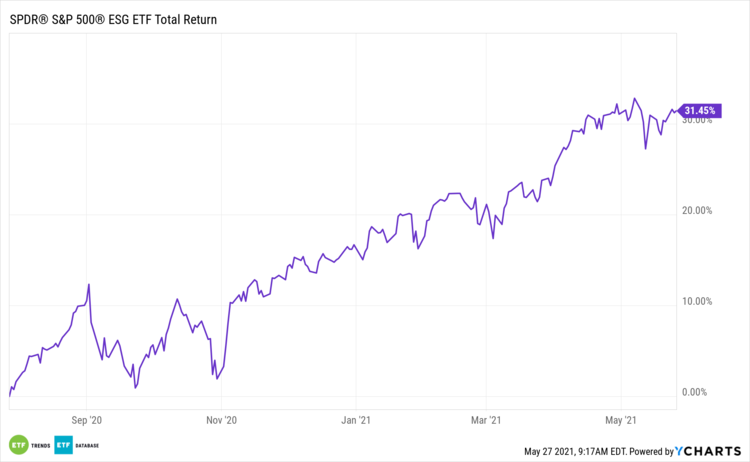
EFIV 1 Year Performance

Why It Took So Long

In theory, Tesla is a natural choice for inclusion in any number of environmental, social, and governance (ESG) indices. At least that’s the conventional wisdom, but the EV company took awhile to join the EFIV roster, due in large part to the underlying index’s methodology.

“Tesla’s entry into the S&P 500 ESG Index could be due to the index methodology as much as Tesla’s own improvement from a sustainability perspective,” said S&P Dow Jones Indices. “Tesla’s S&P DJI ESG Score was 22 out of 100 (up 8 points from last year’s score), driven by its ESG Dimension Scores, including an Environmental score of 28 (up 1 point), a Social score of 6 (up 2 points), and a Governance score of 49 (up 21 points).”

Said differently, Tesla made improvements where necessary, boosting its various scores and made the cut for inclusion in the S&P 500 ESG Index. One lesson for investors: although EFIV is a passively managed fund, its roster may turn over more than traditional index-based strategies.

Likewise, it’s possible for companies’ ESG scores to decline to point that they’re removed. Tesla may be an EFIV holding today, but there can be no assurances that’s a permanent scenario. It’s got work to do to keep that membership up.

“Its current size does not ensure it will stay a constituent in the index in perpetuity—the company must still pass the minimum ESG score threshold eligibility criterion at each annual rebalance, and of course must not become involved in controversial weapons, tobacco, or thermal coal,” according to S&P. “The company must also remain in good standing with the UN Global Compact.”


Content continues below advertisement

For more news, information, and strategy, visit the ESG Channel.

Loading Articles...

Advertisement

Is Your Portfolio Positioned With Enough Global Exposure?

ETF Education Channel

How to Allocate Commodities in Portfolios

Tom LydonApr 26, 2022
2022-04-26

A long-running debate in asset allocation circles is how much of a portfolio an investor should...

Core Strategies Channel

Why ETFs Experience Limit Up/Down Protections

Karrie GordonMay 13, 2022
2022-05-13

In a digital age where information moves in milliseconds and millions of participants can transact...

}
X
