ETFdb Logo
  • ETF Database
  • Content Hubs
    • Themes
      • Active ETF
      • Alternatives
      • Artificial Intelligence
      • China Insights
      • Core Strategies
      • Crypto
      • Disruptive Technology
      • Energy Infrastructure
      • ETF Building Blocks
      • ETF Investing
      • ETF Strategist
      • Financial Literacy
      • Fixed Income
      • Free Cash Flow
      • Future ETFs
      • Innovative ETFs
      • Institutional Income Strategies
      • Leveraged & Inverse
      • Market Insights
      • Market Outlooks
      • Modern Alpha
      • Nuclear Energy
      • Portfolio Strategies
      • Sector Investing
      • Tax Efficient Income
      • Thematic Investing
    • Asset Class
      • Equity
        • U.S. Equity
        • Int'l Developed
        • Emerging Market Equities
      • Alternatives
        • Gold/Silver/Critical Materials
        • Cryptocurrency
        • Currency
        • Volatility
      • Fixed Income
        • Investment Grade Corporates
        • US Treasuries & TIPS
        • High Yield Corporates
        • Int'l Fixed Income
    • ETF Ecosystem
    • ETFs in Canada
    • Market Outlook
    • Crypto ETF Hub
  • Tools
    • ETF Screener
    • ETF Country Exposure Tool
    • ETF Database Categories
    • Indexes
    • Scenario Analysis
    • Watchlists
    • Head-To-Head ETF Comparison Tool
    • Mutual Fund To ETF Converter
    • ETF Stock Exposure Tool
    • ETF Issuer Fund Flows
  • Research
    • ETF Education
    • Equity Investing
    • Dividend ETFs
    • Leveraged ETFs
    • Inverse ETFs
    • Index Education
    • Index Insights
    • Top ETF Sectors
    • Top ETF Issuers
    • Top ETF Industries
  • Webcasts
  • Sectors
    • Sector Investing Content Hub
    • XLK
    • XLI
    • XLU
    • XLY
    • XLP
    • XLRE
    • Sector Power Rankings
    • XLE
    • XLC
    • XLF
    • XLV
    • XLB
  • Multimedia
    • ETF 360 Video Series
    • ETF of the Week Podcast
    • Gaining Perspective Podcast
    • ETF Prime Podcast
    • Video
  • Company
    • About VettaFi
  • PRO
    • Pro Content
    • Pro Tools
    • Advanced
    • FAQ
    • Free sign up
    • Login
  1. The Responsible Investing Content Hub
  2. What Trump-Era Rollbacks on ESG Investments Mean
The Responsible Investing Content Hub
Share

What Trump-Era Rollbacks on ESG Investments Mean

Karrie GordonDec 16, 2021
2021-12-16

The Department of Labor has just concluded its 60-day public comment period on the rollback of two different rules adopted under the Trump administration that made sustainable investing impossible for retirement plan issuers, reported E&E News.

The old rules put in place by Trump’s administration placed a high degree of regulatory scrutiny on advisors and financial institutions that chose to align their investments with climate change concerns by forcing proof that any ESG funds invested in would not affect profits for clients. The other rule required financial institutions to justify any support of ESG proposals that were put forth by shareholders.

The rollbacks are being increasingly supported not just by environmentalists but also the financial industry broadly and some of the largest financial institutions. The new language takes the opposite stance in that any retirement plan issuers not only can support climate change initiatives but also should support such initiatives.

“The Labor Department’s rule proposal corrects the misperception that fiduciaries are at risk if they include any [environmental, social or governance] factors in the financial evaluation of plan investments — treating ESG factors the same as any other economic factors,” said Susan Olson, general counsel at the Investment Company Institute, a trade group with members such as BlackRock, Vanguard and JPMorgan Chase.

Long-term, climate change advocates believe that the rulings will have to go further and require active participation by all issuers, not just retirement, within the ESG arena, but for now, they believe it’s a step in the right direction.

Investing in ESG with SPDR

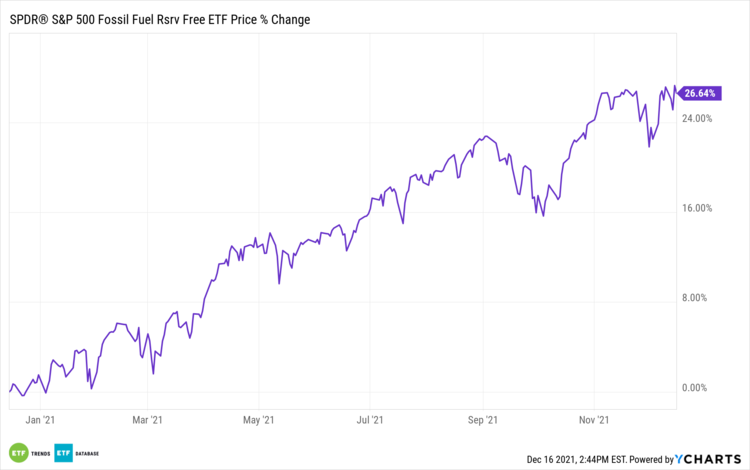
The ability of retirement plans to participate in ESG investing could bring a flood of new funding to the market. For investors looking for a way to invest broadly in the S&P 500 but tilted towards an exclusionary lens for fossil fuel exposure, they need only turn to the SPDR S&P 500 Fossil Fuel Reserves Free ETF (SPYX A-).


Content continues below advertisement

SPDR SP500 Fossil Fuel

The fund tracks the S&P 500 Fossil Fuel Free Index, a benchmark of companies within the S&P 500 that are “fossil fuel free,” defined as companies that don’t own fossil fuel reserves (thermal coal reserves and coal reserve byproducts, as well as oil or gas reserves).

That’s not the same as being devoid of all oil stocks. The fund still has minor allocations to fossil fuel companies, including Valero (VLO) and Halliburton (HAL). But without exposure to companies actually holding the physical oil, coal, or gas reserves, the fund’s energy allocation is much reduced. Energy comprises just 0.69% of the ETF’s sector make-up, as compared to 2.66% of the SPDR S&P 500 ETF Trust (SPY A-).

SPYX has an expense ratio of 0.20%.

For more news, information, and strategy, visit the ESG Channel.

Loading Articles...

Advertisement

Is Your Portfolio Positioned With Enough Global Exposure?

ETF Education Channel

How to Allocate Commodities in Portfolios

Tom LydonApr 26, 2022
2022-04-26

A long-running debate in asset allocation circles is how much of a portfolio an investor should...

Core Strategies Channel

Why ETFs Experience Limit Up/Down Protections

Karrie GordonMay 13, 2022
2022-05-13

In a digital age where information moves in milliseconds and millions of participants can transact...

}
X