ETFdb Logo
  • ETF Database
  • Content Hubs
    • Themes
      • Active ETF
      • Alternatives
      • Artificial Intelligence
      • China Insights
      • Core Strategies
      • Crypto
      • Disruptive Technology
      • Energy Infrastructure
      • ETF Building Blocks
      • ETF Investing
      • ETF Strategist
      • Financial Literacy
      • Fixed Income
      • Free Cash Flow
      • Future ETFs
      • Innovative ETFs
      • Institutional Income Strategies
      • Leveraged & Inverse
      • Market Insights
      • Market Outlooks
      • Modern Alpha
      • Nuclear Energy
      • Portfolio Strategies
      • Sector Investing
      • Tax Efficient Income
      • Thematic Investing
    • Asset Class
      • Equity
        • U.S. Equity
        • Int'l Developed
        • Emerging Market Equities
      • Alternatives
        • Gold/Silver/Critical Materials
        • Cryptocurrency
        • Currency
        • Volatility
      • Fixed Income
        • Investment Grade Corporates
        • US Treasuries & TIPS
        • High Yield Corporates
        • Int'l Fixed Income
    • ETF Ecosystem
    • ETFs in Canada
    • Market Outlook
    • Crypto ETF Hub
  • Tools
    • ETF Screener
    • ETF Country Exposure Tool
    • ETF Database Categories
    • Indexes
    • Scenario Analysis
    • Watchlists
    • Head-To-Head ETF Comparison Tool
    • Mutual Fund To ETF Converter
    • ETF Stock Exposure Tool
    • ETF Issuer Fund Flows
  • Research
    • ETF Education
    • Equity Investing
    • Dividend ETFs
    • Leveraged ETFs
    • Inverse ETFs
    • Index Education
    • Index Insights
    • Top ETF Sectors
    • Top ETF Issuers
    • Top ETF Industries
  • Webcasts
  • Sectors
    • Sector Investing Content Hub
    • XLK
    • XLI
    • XLU
    • XLY
    • XLP
    • XLRE
    • Sector Power Rankings
    • XLE
    • XLC
    • XLF
    • XLV
    • XLB
  • Multimedia
    • ETF 360 Video Series
    • ETF of the Week Podcast
    • Gaining Perspective Podcast
    • ETF Prime Podcast
    • Video
  • Company
    • About VettaFi
    • Get VettaFi’ed
  • PRO
    • Pro Content
    • Pro Tools
    • Advanced
    • FAQ
    • Free sign up
    • Login
  1. ETF Building Blocks Content Hub
  2. The REIT ETF: Steering Clear of Office Ghost Towns
ETF Building Blocks Content Hub
Share

The REIT ETF: Steering Clear of Office Ghost Towns

Tom LydonMay 18, 2021
2021-05-18

One of the sectors experiencing the most profound alterations due to the coronavirus pandemic is commercial real estate.

By now, many investors know about the punishment hotel and retail real estate investment trusts (REITs) endured during COVID-19 lockdowns, but there’s more to the story, and the changing face of the real estate sector today could be a sign active management is worth considering in this space. Enter the ALPS Active REIT ETF (REIT A-).

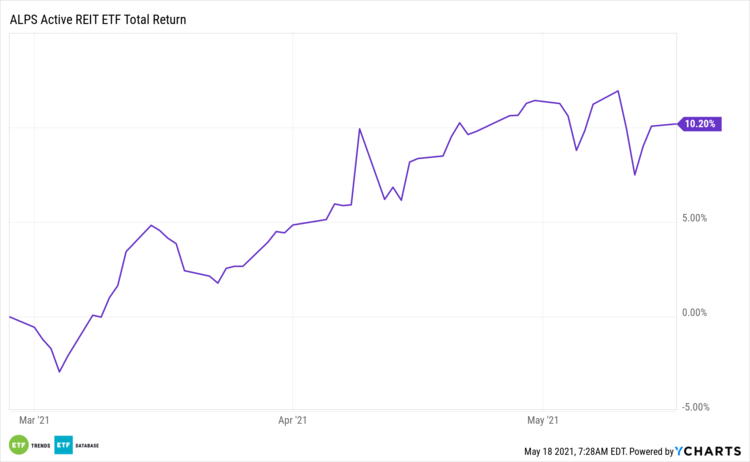
REIT YTD Performance

Empty Offices Downtown

As an actively managed real estate exchange traded fund, REIT isn’t restrained by an index. That means the managers can make geographic and industry bets, additions, and subtractions that passive funds cannot compete with. The current state of Bay Area real estate is a prime example of why investors may want to get active with the ALPS fund.

“By the end of the first quarter of 2021, the amount of vacant sublease space in San Francisco had soared to 9.7 million square feet, up from about 3 million in late 2019, and accounted for 40% of all available commercial space in the city, according to commercial real estate firm Avison Young,” reports Ari Levy for CNBC.

Granted, San Francisco is just one region, but it’s real estate woes are twofold. First, many technology companies are realizing staff are just as productive working from home or on flex schedules as compared to the traditional five-day office work week.

Second, the city’s lease rates are among the highest in the country, and perhaps still too lofty for this point in the economic cycle. A traditional real estate index fund usually features heaping allocations to office REITs, making those products vulnerable to work-from-home trends and a lack of geographic qualifiers. REIT can avoid those pitfalls.

“While software and internet companies continued their stratospheric ascent in 2020, the plush offices they call home sat dormant, leaving San Francisco’s commercial real estate market with an unfamiliar supply glut. Much of the financial fallout was borne by the very tech companies that led a decade-plus bull market and expansion spree,” according to CNBC.

For now, it’d be hasty to write obituaries for the Bay Area real estate market, yet real estate investors may want to steer clear of the region for awhile.

Other REIT ETFs include the Schwab US REIT ETF (SCHH A+) and the Pacer Benchmark Data & Infrastructure Real Estate SCTR ETF (SRVR C+).


Content continues below advertisement

For more on cornerstone strategies, visit our ETF Building Blocks Channel.

Loading Articles...

Advertisement

Is Your Portfolio Positioned With Enough Global Exposure?

ETF Education Channel

How to Allocate Commodities in Portfolios

Tom LydonApr 26, 2022
2022-04-26

A long-running debate in asset allocation circles is how much of a portfolio an investor should...

Core Strategies Channel

Why ETFs Experience Limit Up/Down Protections

Karrie GordonMay 13, 2022
2022-05-13

In a digital age where information moves in milliseconds and millions of participants can transact...

}
X