
ETFdb Logo
  • ETF Database
  • Content Hubs
    • Themes
      • Active ETF
      • Alternatives
      • Artificial Intelligence
      • China Insights
      • Core Strategies
      • Crypto
      • Disruptive Technology
      • Energy Infrastructure
      • ETF Building Blocks
      • ETF Investing
      • ETF Strategist
      • Financial Literacy
      • Fixed Income
      • Free Cash Flow
      • Future ETFs
      • Innovative ETFs
      • Institutional Income Strategies
      • Leveraged & Inverse
      • Market Insights
      • Market Outlooks
      • Modern Alpha
      • Nuclear Energy
      • Portfolio Strategies
      • Sector Investing
      • Tax Efficient Income
      • Thematic Investing
    • Asset Class
      • Equity
        • U.S. Equity
        • Int'l Developed
        • Emerging Market Equities
      • Alternatives
        • Gold/Silver/Critical Materials
        • Cryptocurrency
        • Currency
        • Volatility
      • Fixed Income
        • Investment Grade Corporates
        • US Treasuries & TIPS
        • High Yield Corporates
        • Int'l Fixed Income
    • ETF Ecosystem
    • ETFs in Canada
    • Market Outlook
    • Crypto ETF Hub
  • Tools
    • ETF Screener
    • ETF Country Exposure Tool
    • ETF Database Categories
    • Indexes
    • Scenario Analysis
    • Watchlists
    • Head-To-Head ETF Comparison Tool
    • Mutual Fund To ETF Converter
    • ETF Stock Exposure Tool
    • ETF Issuer Fund Flows
  • Research
    • ETF Education
    • Equity Investing
    • Dividend ETFs
    • Leveraged ETFs
    • Inverse ETFs
    • Index Education
    • Index Insights
    • Top ETF Sectors
    • Top ETF Issuers
    • Top ETF Industries
  • Webcasts
  • Sectors
    • Sector Investing Content Hub
    • XLK
    • XLI
    • XLU
    • XLY
    • XLP
    • XLRE
    • Sector Power Rankings
    • XLE
    • XLC
    • XLF
    • XLV
    • XLB
  • Multimedia
    • ETF 360 Video Series
    • ETF of the Week Podcast
    • Gaining Perspective Podcast
    • ETF Prime Podcast
    • Video
  • Company
    • About VettaFi
    • Get VettaFi’ed
  • PRO
    • Pro Content
    • Pro Tools
    • Advanced
    • FAQ
    • Free sign up
    • Login
  1. ETF Building Blocks Content Hub
  2. Renewable Energy Cost-Benefit Analysis is Highly Favorable
ETF Building Blocks Content Hub
Share

Renewable Energy Cost-Benefit Analysis is Highly Favorable

Tom LydonSep 02, 2021
2021-09-02

When it comes to deploying and investing in renewable energy, market participants frequently hear about costs.

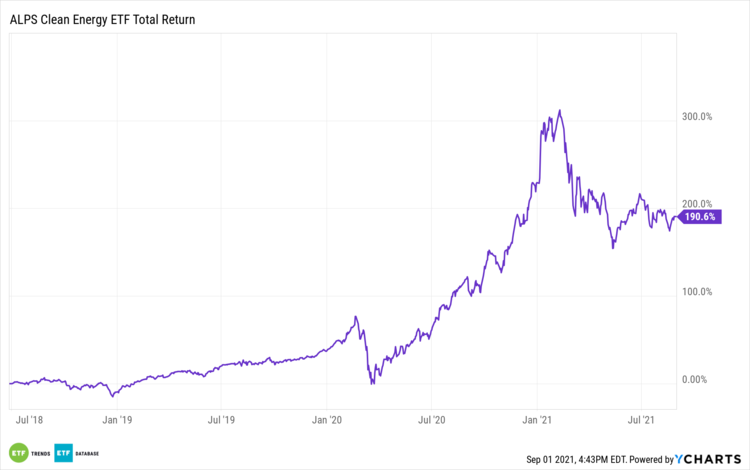
As in, the point at which the costs of installing solar and wind systems will decline to the point that adoption increases. Good news: That’s already happening. However, there’s still work to be done. Beyond this consideration, there are other forms of costs that investors in exchange traded funds like the ALPS Clean Energy ETF (ACES B) should consider.

One of those considerations is whether the costs of going green outweigh the benefits. Again, good news, because the answer is “no.” At least, that’s the case with wind energy.

“The health and climate benefits of wind generation installed in the US in 2020 were more than twice the levelized cost of energy (LCOE) of the facilities, according to data released by the US Department of Energy (DOE) 30 August,” notes IHS Markit.

That’s directly relevant to ACES investors because wind equities account for 19.70% of the ETF’s weight. Only solar commands a larger allocation with its 24.18%.
ALPS Clean Energy ETF Total Return

“DOE valued the health and climate benefits of wind energy installed in the US in 2020 at $76/MWh, while the nationwide LCOE—or the lifetime cost divided by production—for wind was $33/MWh, it said in a report on onshore wind energy, one of three on wind the agency issued concurrently,” adds IHS Markit.

Of added benefit to ACES investors is the fact that as more customers become aware of the fact that cost-benefit is in favor of wind, adoptions correspondingly rise.

“A record 16.836 GW of US wind capacity was installed in 2020, bringing the cumulative total at the end of the year to 121.96 GW, DOE said. The momentum isn’t slowing, as projects totaling 34.76 GW were under construction (17.3 GW) or in advanced development (17.46 GW) at the end of 2020 in the US, the American Clean Power Association said in February,” notes IHS Markit.

In fact, new wind installations in 2020 outpaced solar for the first time on record. As Markit notes, wind accounts for 10% of generated power in 16 states and nearly a third or more in four states. That’s another sign ACES’ wind exposure is a potentially attractive trait for long-term investors.

Other alternative energy ETFs include the First Trust Global Wind Energy ETF (FAN A-) and the SPDR Kensho Clean Power ETF (CNRG B).

For more news, information, and strategy, visit the ETF Building Blocks Channel.


Content continues below advertisement

Loading Articles...

Advertisement

Is Your Portfolio Positioned With Enough Global Exposure?

ETF Education Channel

How to Allocate Commodities in Portfolios

Tom LydonApr 26, 2022
2022-04-26

A long-running debate in asset allocation circles is how much of a portfolio an investor should...

Core Strategies Channel

Why ETFs Experience Limit Up/Down Protections

Karrie GordonMay 13, 2022
2022-05-13

In a digital age where information moves in milliseconds and millions of participants can transact...

}
X
