
ETFdb Logo
  • ETF Database
  • Content Hubs
    • Themes
      • Active ETF
      • Alternatives
      • Artificial Intelligence
      • China Insights
      • Core Strategies
      • Crypto
      • Disruptive Technology
      • Energy Infrastructure
      • ETF Building Blocks
      • ETF Investing
      • ETF Strategist
      • Financial Literacy
      • Fixed Income
      • Free Cash Flow
      • Future ETFs
      • Innovative ETFs
      • Institutional Income Strategies
      • Leveraged & Inverse
      • Market Insights
      • Market Outlooks
      • Modern Alpha
      • Nuclear Energy
      • Portfolio Strategies
      • Sector Investing
      • Tax Efficient Income
      • Thematic Investing
    • Asset Class
      • Equity
        • U.S. Equity
        • Int'l Developed
        • Emerging Market Equities
      • Alternatives
        • Gold/Silver/Critical Materials
        • Cryptocurrency
        • Currency
        • Volatility
      • Fixed Income
        • Investment Grade Corporates
        • US Treasuries & TIPS
        • High Yield Corporates
        • Int'l Fixed Income
    • ETF Ecosystem
    • ETFs in Canada
    • Market Outlook
    • Crypto ETF Hub
  • Tools
    • ETF Screener
    • ETF Country Exposure Tool
    • ETF Database Categories
    • Indexes
    • Scenario Analysis
    • Watchlists
    • Head-To-Head ETF Comparison Tool
    • Mutual Fund To ETF Converter
    • ETF Stock Exposure Tool
    • ETF Issuer Fund Flows
  • Research
    • ETF Education
    • Equity Investing
    • Dividend ETFs
    • Leveraged ETFs
    • Inverse ETFs
    • Index Education
    • Index Insights
    • Top ETF Sectors
    • Top ETF Issuers
    • Top ETF Industries
  • Webcasts
  • Sectors
    • Sector Investing Content Hub
    • XLK
    • XLI
    • XLU
    • XLY
    • XLP
    • XLRE
    • Sector Power Rankings
    • XLE
    • XLC
    • XLF
    • XLV
    • XLB
  • Multimedia
    • ETF 360 Video Series
    • ETF of the Week Podcast
    • Gaining Perspective Podcast
    • ETF Prime Podcast
    • Video
  • Company
    • About VettaFi
    • Get VettaFi’ed
  • PRO
    • Pro Content
    • Pro Tools
    • Advanced
    • FAQ
    • Free sign up
    • Login
  1. ETF Building Blocks Content Hub
  2. Renewables Are Closing In on the Coal Industry
ETF Building Blocks Content Hub
Share

Renewables Are Closing In on the Coal Industry

Tom LydonMay 06, 2021
2021-05-06

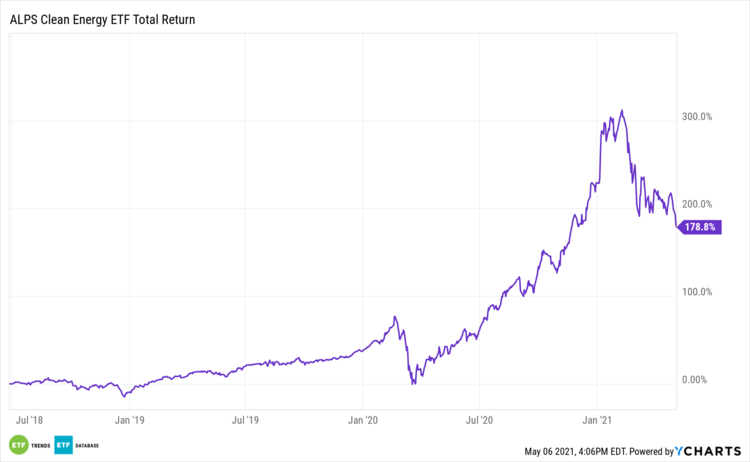
Like any other industry, energy has a new and old guard. Today, those factions are competing on pricing. The current state of that competition bodes well for assets like the ALPS Clean Energy ETF (ACES B).

Over the evolution of the renewable energy industry, a primary point of scrutiny for producers and investors alike is when price parity with traditional fuel sources will be achieved. When it will be more economical to power the world with wind, solar, and the like over dirty fuels? That period is arriving in real time.

“About 80% of U.S. coal plants are now more expensive to keep running than to swap out for new wind and solar capacity, according to a report from Energy Innovation, a non-partisan climate and energy think tank,” reports Leslie Kaufman for Bloomberg.

Though dwindling, coal still accounts for a significant percentage of power generation in the U.S. However, as ACES components, namely those in the solar and wind arenas, continue tilting costs in their favor, coal’s slice of the domestic energy mix will continue to decline.
ACES 3 Year Total Return

Coal's Pain Is Renewables' Gain

Data confirm coal is dying a slow death in the U.S.

“Coal has been steadily declining as a fixture of the U.S. energy mix for more than a decade due to combined pressure from activists and market forces. The Sierra Club, which runs the Beyond Coal campaign aimed at eliminating coal power in the U.S., says that 339 plants have either been retired or are on their way to retirement since 2010, leaving just 191 still operating indefinitely,” according to Bloomberg.

The $921.74 million ACES allocates more than 44% of its combined weight to wind and solar stocks, according to issuer data. Those are the fund’s second- and third-largest industry exposures, respectively, behind efficiency/LED/smart grid.

“Coal use has dropped so precipitously that it’s no longer the leading stationary source of air pollution, according to another new study out Wednesday. The report from researchers at Harvard University found that as of 2017, burning biomass and wood for energy led to more detrimental health effects than coal. That same year, burning gas caused more deaths than coal in at least 19 states,” concludes Bloomberg.

For more on cornerstone strategies, visit our ETF Building Blocks Channel.


Content continues below advertisement

Loading Articles...

Advertisement

Is Your Portfolio Positioned With Enough Global Exposure?

ETF Education Channel

How to Allocate Commodities in Portfolios

Tom LydonApr 26, 2022
2022-04-26

A long-running debate in asset allocation circles is how much of a portfolio an investor should...

Core Strategies Channel

Why ETFs Experience Limit Up/Down Protections

Karrie GordonMay 13, 2022
2022-05-13

In a digital age where information moves in milliseconds and millions of participants can transact...

}
X
