

ETFdb Logo
  • ETF Database
  • Content Hubs
    • Themes
      • Active ETF
      • Alternatives
      • Artificial Intelligence
      • China Insights
      • Core Strategies
      • Crypto
      • Disruptive Technology
      • Energy Infrastructure
      • ETF Building Blocks
      • ETF Investing
      • ETF Strategist
      • Financial Literacy
      • Fixed Income
      • Free Cash Flow
      • Future ETFs
      • Innovative ETFs
      • Institutional Income Strategies
      • Leveraged & Inverse
      • Market Insights
      • Market Outlooks
      • Modern Alpha
      • Nuclear Energy
      • Portfolio Strategies
      • Sector Investing
      • Tax Efficient Income
      • Thematic Investing
    • Asset Class
      • Equity
        • U.S. Equity
        • Int'l Developed
        • Emerging Market Equities
      • Alternatives
        • Gold/Silver/Critical Materials
        • Cryptocurrency
        • Currency
        • Volatility
      • Fixed Income
        • Investment Grade Corporates
        • US Treasuries & TIPS
        • High Yield Corporates
        • Int'l Fixed Income
    • ETF Ecosystem
    • ETFs in Canada
    • Market Outlook
    • Crypto ETF Hub
  • Tools
    • ETF Screener
    • ETF Country Exposure Tool
    • ETF Database Categories
    • Indexes
    • Scenario Analysis
    • Watchlists
    • Head-To-Head ETF Comparison Tool
    • Mutual Fund To ETF Converter
    • ETF Stock Exposure Tool
    • ETF Issuer Fund Flows
  • Research
    • ETF Education
    • Equity Investing
    • Dividend ETFs
    • Leveraged ETFs
    • Inverse ETFs
    • Index Education
    • Index Insights
    • Top ETF Sectors
    • Top ETF Issuers
    • Top ETF Industries
  • Webcasts
  • Sectors
    • Sector Investing Content Hub
    • XLK
    • XLI
    • XLU
    • XLY
    • XLP
    • XLRE
    • Sector Power Rankings
    • XLE
    • XLC
    • XLF
    • XLV
    • XLB
  • Multimedia
    • ETF 360 Video Series
    • ETF of the Week Podcast
    • Gaining Perspective Podcast
    • ETF Prime Podcast
    • Video
  • Company
    • About VettaFi
    • Get VettaFi’ed
  • PRO
    • Pro Content
    • Pro Tools
    • Advanced
    • FAQ
    • Free sign up
    • Login
  1. ETF Building Blocks Content Hub
  2. Why Wall Street Is Smitten with ACES ETF Holdings
ETF Building Blocks Content Hub
Share

Why Wall Street Is Smitten with ACES ETF Holdings

Tom LydonDec 31, 2020
2020-12-31

The ALPS Clean Energy ETF (ACES B) emerged as one of this year’s best-performing exchange traded funds, regardless of asset class. That’s saying something when you consider that many other renewable energy funds more than doubled.

ACES follows the CIBC Atlas Clean Energy Index. That benchmark is comprised of U.S.- and Canada-based companies that primarily operate in the clean energy sector. Constituents are companies focused on renewables and other clean technologies that enable the evolution of a more sustainable energy sector.

More than 120 clean energy names now trade on major exchanges, and now have combined market values of $1.5 trillion, according to analysts at Raymon James.

“With 123 clean-tech companies now trading in US markets, the choice for investors is ‘practically limitless,’ the analysts wrote in a report published Wednesday. About half of those companies — from wind giants to electric-car makers — trade on a well-known exchange and are worth more than $1 billion in market value, they said,” reports Business Insider.
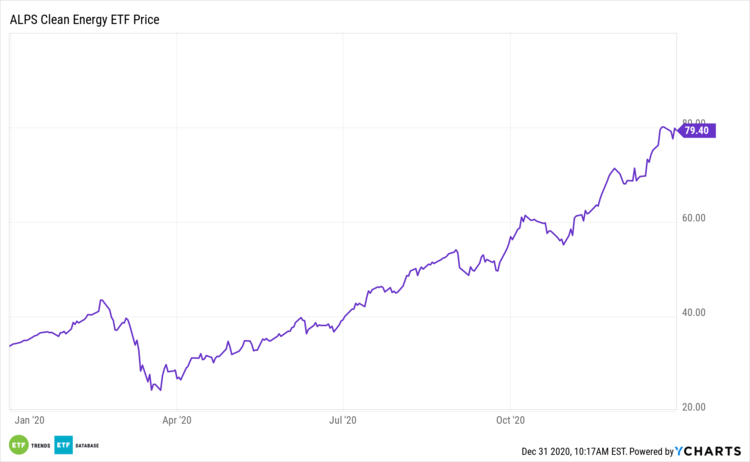
ACES YTD Performance

ACES, Clean Energy Stocks Are Just Getting Started

Even with its stellar 2020 showing, ACES enters 2021 with ample tailwinds. Traditional sources of energy like oil are constantly being challenged by alternative sources as more green initiatives become mainstream, which makes alternative energy ETFs an option when investors want exposure to the energy sector.

“The wind and solar industries — and, increasingly, companies involved in energy storage — are also investible, Raymond James said. Public firms in the battery supply chain have historically only included lithium suppliers, the firm said, but now batterymakers like QuantumScape are going public via blank check companies,” adds Business Insider.

Currently, coal and renewables account for roughly the same percentage of power consumption in the U.S., but the latter is poised to overtake the former, particularly as renewable costs decline. In fact, it’s likely that by 2030, new solar and wind farms will cost less than coal-fired plants. Photovoltaic costs plunged 82% over the previous decade, indicating it’s reasonable to expect solar will eventually be more cost-efficient than coal.

Another important factor in the ACES equation is that its components having international exposure, which is meaningful at a time when so many market observers are discussing sliding energy investment. That may be the case when it comes to fossil fuels, but plenty of ex-US markets are bolstering renewable allocations.

Other alternative energy ETFs include the First Trust Global Wind Energy ETF (FAN A-) and the SPDR Kensho Clean Power ETF (CNRG B).

For more on cornerstone strategies, visit our ETF Building Blocks Channel.


Content continues below advertisement

Loading Articles...

Advertisement

Is Your Portfolio Positioned With Enough Global Exposure?

ETF Education Channel

How to Allocate Commodities in Portfolios

Tom LydonApr 26, 2022
2022-04-26

A long-running debate in asset allocation circles is how much of a portfolio an investor should...

Core Strategies Channel

Why ETFs Experience Limit Up/Down Protections

Karrie GordonMay 13, 2022
2022-05-13

In a digital age where information moves in milliseconds and millions of participants can transact...

}
X
